Unlock safety with our 4 Stage forklift operator training checklist! Essential tips for new employees to master the skills!
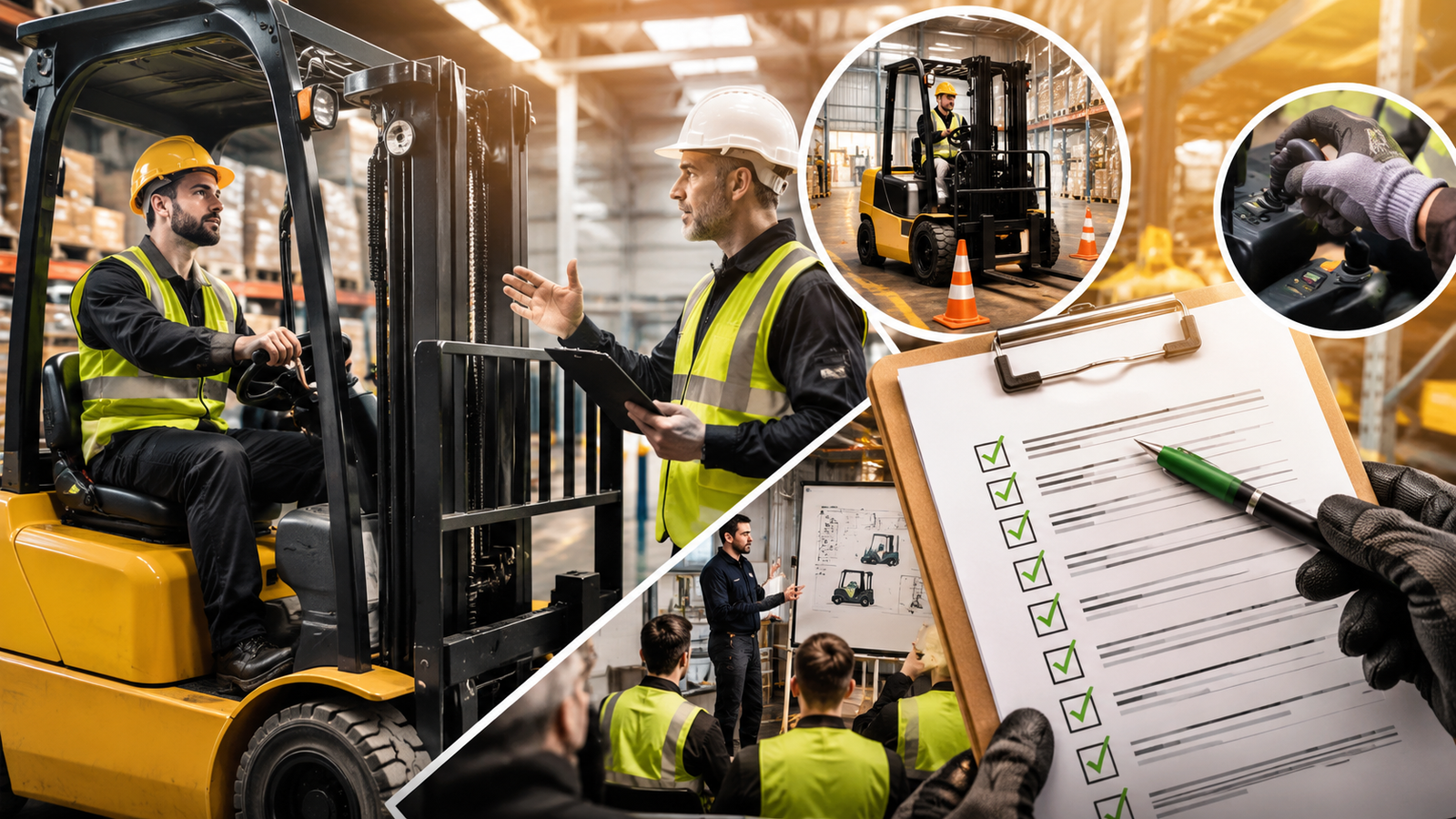
Forklift operator training checklist: Equip new employees with vital skills. Discover our ultimate guide
Welcome to American Forklifts, the greatest source for the best forklifts for sale in the USA and your most trusted resource for material handling information. Onboarding new operators to your team is a process that involves a keen attention to detail, whether you’re operating a busy warehouse, a fast-paced distribution center or a challenging construction site. Heavy equipment is risky by nature and the margin for mistake is razor thin. An ultimate forklift operator training checklist is an absolute non-negotiable requirement for new workers.
Industry safety standards estimate that up to 70% of heavy equipment incidents in the workplace might be avoided with strict, current teaching. With an organized forklift operator training checklist in place, warehouse managers can methodically ensure that each new employee learns the operating mechanics, safety guidelines, and emergency procedures needed to successfully operate these powerful multi-tool workhorses.
At American Forklifts, we aim to provide you with the knowledge and tools to maximize the capabilities of your fleet. In this thorough guide, we’ll break down the critical components that must be included in your facility’s training routine to ensure you maintain the greatest level of efficiency, compliance, and workplace security.
Why a Complete Forklift Operator Training Checklist is Important?
Integrating a standardized forklift operator training checklist into your onboarding process is so much more than a bureaucratic compliance box to tick; it’s the very foundation of a safe and highly productive workplace. New recruits will have different levels of expertise and experienced professionals may fall into the hazardous trap of complacency if not constantly re-evaluated.
The checklist is standardized, so no important safety routine is omitted during orientation. This also guarantees a uniform level of knowledge throughout your team. An effective forklift operator training checklist is one way to actively safeguard your organization against crippling legal obligations, regulatory penalties, and catastrophic damage to equipment.
Moreover, thorough records of your training methods will provide you with an ironclad argument in the case of regular inspections or an inquiry after an event, showing that your establishment puts the safety of its staff members above all else. At American Forklifts, we urge all warehouse owners to regard this checklist as a financial investment for the life of their equipment and safety of their personnel and not as an administrative hassle.
- minimizes workplace accidents: An adequately developed checklist greatly minimizes the probability of collisions, fallen loads and tip-overs by training all operators on awareness of space and capacity constraints.
- Ensures regulatory compliance: A comprehensive forklift operator training checklist helps you ensure your onboarding program meets or surpasses rigorous government and OSHA safety rules.
- Increases the life of your equipment: Training your staff on normal maintenance and operation helps avoid excessive wear and tear on your expensive forklift fleet, saving your company money on expensive repairs.
Top 4 Stages for Forklift operator training checklist
Stage 1 – Classroom Training and Theoretical Knowledge
Before anybody else is permitted to physically enter the cabin or to touch the controls of a machine, however, they must first be instructed in the basics by intensive classroom work. A full checklist for training forklift operators must put a lot of emphasis on theoretical understanding, from fundamental physics to identifying particular risks in the workplace. At this stage, trainees must be taught about the stability triangle, the center of gravity and how placing the load impacts the lateral and longitudinal balance of the forklift.
In addition to classroom instruction, classroom instruction should include detailed technical information on the exact kind of forklift students will be operating; for example, heavy-duty counterbalance forklifts, specialist reach trucks, or the silent electric versions that are shown in our American Forklifts catalog.
By including theoretical education on your forklift operator training checklist you are making sure your operators are not simply pressing levers mindlessly but are truly understanding the science that underlies their technology. This is the kind of insight that differentiates a poor driver from a professional who’s safety-minded and can foresee and diffuse dangers before they arise.
- Understanding the stability triangle: Trainees need to know how the center of gravity moves while moving, lifting and tilting to avoid deadly rollover accidents in the warehouse.
- Identify workplace risks: The curriculum should include site-specific hazards such as blind spots, pedestrian pathways, tight aisles, and uneven floor conditions.
- Equipment mechanics: New employees must be trained on the special capabilities and limits of different types of forklifts such as electric motor rider trucks and internal combustion units.
Phase 2- Pre-Shift and Maintenance Inspection Procedure
One of the most important, yet often forgotten, components of any good forklift operator training checklist is the necessary pre-shift inspection. Regular maintenance is the lifeblood of efficiency and safety for any warehouse fleet, and we talk about it a lot at American Forklifts. Operators must methodically check the mechanical condition of their equipment before turning the ignition in an effort to discover any possible defect which might endanger safety throughout their shift.
In this part of the forklift operator training checklist, new recruits should learn how to inspect for leaks in hydraulic hoses, check the quality and pressure of the tires, check the charge levels of the batteries and test all visual and aural warning signs. If operators notice any anomalies, they should be educated to shut down the unit immediately and report the problem to a skilled forklift technician rather than trying to utilize damaged equipment.
A demanding pre-shift inspection procedure on your forklift operator training checklist can help you avoid mechanical failures of doom and doom, and it will also help you develop a deep feeling of personal responsibility and accountability within your operational team.
- Fluid and hydraulic checks: Operators need to be vigilant in checking engine oil, hydraulic fluid, and coolant levels to avoid engine seizures and hydraulic failures while lifting high weights.
- Tire and structural inspections: Trainees need to check cushion or pneumatic tires for dangerous wear, gouges or deflation that might seriously upset the balance of the apparatus while it is running.
- Safety mechanism checks: The checklist should demand daily checks on the brakes, steering columns, horn operation and overhead guard integrity to guarantee the highest level of protection for the operator.
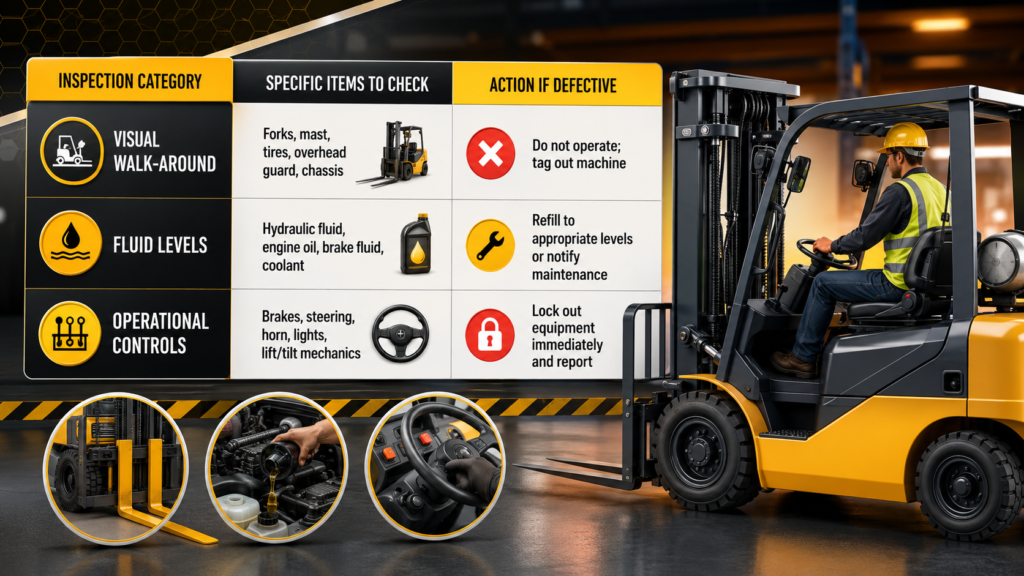
Table: Forklift Operator Training Checklist
| Inspection Category | Specific Items to Check | Action if Defective |
| Visual Walk-Around | Forks, mast, tires, overhead guard, chassis | Do not operate; tag out machine |
| Fluid Levels | Hydraulic fluid, engine oil, brake fluid, coolant | Refill to appropriate levels or notify maintenance |
| Operational Controls | Brakes, steering, horn, lights, lift/tilt mechanics | Lock out equipment immediately and report |
Phase 3: Practical Operation and Load Handling
After the theoretical base has been set and the pre-shift inspection procedures have been perfected, the forklift operator training checklist must advance to the important stage of actual operation. This is where theory becomes practice and the new employees must prove with their bodies that they can operate the forklift with precise accuracy while a competent examiner watches them.
The forklift operator training checklist’s practical phase puts students through their paces with obstacle courses, blind junction approaches, safe maneuvering around simulated pedestrians and the delicate art of load handling. Instructors should monitor the operator’s approach to the load, ensuring the forks are fully beneath the pallet, raise the materials smoothly, and travel with the load at a safe, low height.
In addition, practical training should include tasks that are based on a situation such as loading and unloading of trailers, climbing steep inclines and using specialist forklift boom attachments or laser-guided systems for accurate picking.
A detailed hands-on phase inside your forklift operator training checklist is the ultimate proving ground to make sure that a new recruit is actually equipped to face the great stresses of a fast-paced warehouse environment.
- Precision load maneuvering: Trainees have to make excellent approaches to ensure the load is properly balanced and carried at the lowest feasible height for best stability.
- Spatial awareness and pedestrian safety: Operators must show that they can yield to foot traffic, blow their horns at blind junctions, and have a clear line of sight at all times.
- Environmental obstacles: The practical examination should include operators driving the equipment effectively up ramps, navigating tight, narrow hallways and parking the equipment with the forks all the way down.
4. Final Competency Evaluation and Documentation
The last checklist on forklift operator training is the official competence assessment and the detailed record keeping procedure that follows. It is not sufficient to provide training; companies must also independently check and formally record that the new worker has assimilated the material and can perform the tasks perfectly.
The final assessment portion of the forklift operator training checklist requires the instructor to evaluate the learner on a tight list of performance indicators to ensure that no risky practices go undetected.
The operator should pass the written examination and the practical driving test before the certification is properly documented. At American Forklifts we often tell our customers that your training records are your best defense against compliance fines when you are hit with an unexpected audit.
Your paperwork must clearly identify the operator’s identity, date of training and assessment, kind of forklift for which the operator has been certified, and the credentials of the competent trainer. Incorporating a strict level of assessment and documentation into your forklift operator training checklist means your organization is fully compliant and operationally secure.
- Overall Skills Assessment: The final exam will be a zero tolerance test where the operator will show complete compliance with all safety procedures and operating methods.
- Comprehensive compliance documentation: Employers must keep accurate records showing precisely who was taught, on what particular equipment, by whom, and the exact date the certification was issued.
- Trigger-based retraining protocols: The checklist must set out clear instructions for necessary refresher training that is automatically triggered by any accidents, near-misses or the introduction of new equipment.
Table: Forklift Operator Training Checklist
| Documentation Element | Importance for Compliance | Retention Requirement |
| Operator Name & Date | Proves the specific individual completed training on a set timeline | Keep on file for duration of employment |
| Equipment Classification | Ensures the operator is only driving the specific machines they tested on | Update whenever new equipment is introduced |
| Evaluator Credentials | Validates that the training was conducted by a qualified professional | Keep alongside operator records for audits |
FAQs: Forklift Operator Training Checklist
Do I need a regular driver’s license to become certified as a forklift operator?
No. You are not needed to have a valid normal state driver’s license to operate a motorized industrial vehicle under federal OSHA requirements. Forklift certification is a specialized certificate, related to the mechanics and safety procedures of material handling equipment. However, individual companies may still need you to have a valid driver’s license as part of their own corporate internal recruiting procedures.
How frequently does forklift training need to be renewed to be compliant?
Industry norms and OSHA rules require that forklift operators be formally evaluated on their performance at least once every three years. But this three-year point is only the maximum time permitted. If an operator has been involved in an accident, is witnessed driving recklessly or is assigned to drive a totally new type of forklift, then immediate refresher training is needed by law.
Is it possible to finish all of the forklift operator training online?
No, you cannot obtain full forklift certification using online classes. The theoretical, classroom-based part of your forklift operator training checklist may undoubtedly be done via online e-learning platforms, but the law requires a real, hands-on practical examination. The learner must be physically working the apparatus in a real-world context, with a certified teacher present before any certification may be awarded.
Who may be deemed competent to provide forklift training and assessments?
Qualified trainer means a person who by recognized degree, certificate, professional standing or expertise and considerable experience has effectively proved the capacity to educate and assess powered industrial o. This might be an experienced internal employee recruited by the firm or a professional engaged from a respected external forklift training provider.
What are the risks of not providing adequate forklift training?
The use of uncertified drivers, without sufficient forklift operator training checklists, may have devastating effects for a corporation. During audits, companies are subject to stiff financial penalties and huge fines by regulatory authorities such as OSHA. Furthermore, the organization might be faced with severe legal obligations and a terrible loss of operating reputation if an unskilled operator causes an accident that results in harm or damage to equipment.