Forklift Service: What is Checked in Battery, Tires and Hydraulics?
Routine forklift service is the lifeblood of efficiency and safety for a warehouse fleet. Material handling equipment, pushed to the limit during seasonal peaks and daily multi-shift operations, will suffer wear and tear inevitably.
If you don’t take a proactive strategy for maintenance, small problems can turn into catastrophic mechanical failures that can halt your entire supply chain and pose serious safety hazards. A trusted partner like American Forklifts can help you keep your fleet running smoothly with cutting-edge technologies including on-board telematics, helping you shift from reactive repairs to a proactive fleet management approach.
When machines are providing the right data, warehouse managers can know precisely when to check a piece of equipment before it fails.
- Use of telematics systems to accurately predict service intervals and collect operational data.
- Moving your warehouse from reactive repairs to proactive maintenance.
- Prevent unexpected equipment failures during high usage, thereby improving overall warehouse safety.
The Heart of the Machine: Inspection of Battery and Power Systems
The battery is the literal power behind your electric material handling equipment and its health is a primary focus of any comprehensive forklift service. Battery maintenance for electric forklifts is far more than plugging the unit into a charger at the end of a shift. The technicians inspect the battery case for physical damage or acid leakage that could endanger the machine and the work place.
They check the battery’s charge cycles to make sure operators aren’t running the units below the recommended 20% capacity, which can cause excess heat and permanently damage internal components. Proper electric forklift maintenance includes checking the electrical harnesses, drive motors and contactors to ensure that power is being transmitted efficiently with no excessive resistance.
- Monitoring the electrolyte and refilling lead-acid batteries with distilled water to maintain chemical balance.
- Checking the battery terminals, along with the cables and connectors for corrosion and safe power delivery.
- Professional load testing to ensure the battery can continue to handle the demands of your daily shifts.
Rolling Safely: Examining Tire Condition and Wear
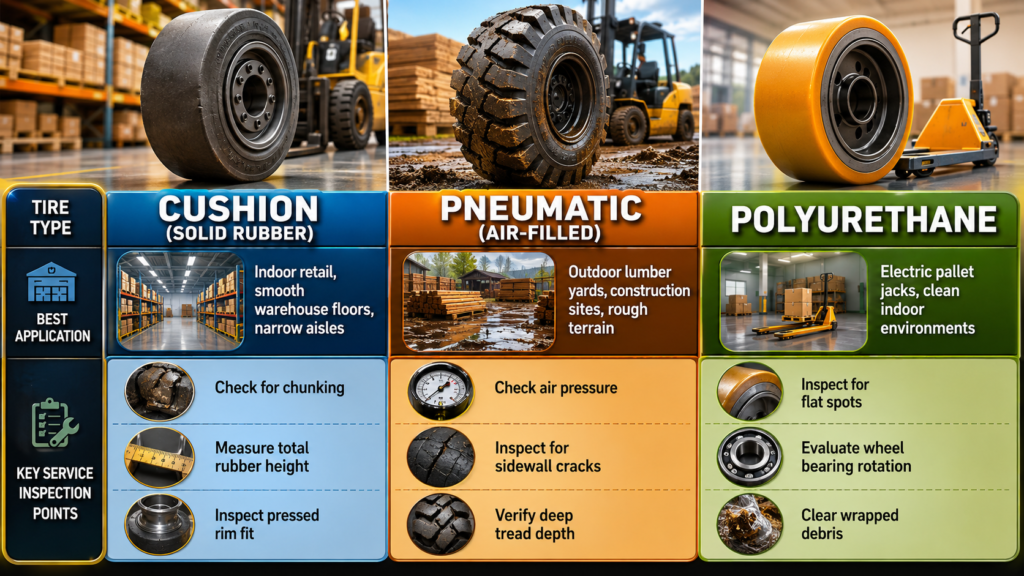
The condition of your tires can impact your vehicle’s stability and safety to carry loads whether the equipment is operating on smooth indoor concrete or rough outdoor terrain. During forklift servicing, it is important to carry out tire replacement assessments, especially for cushion tire forklifts with solid rubber construction that is vulcanized directly onto steel bands.
These solid units are immune to punctures from floor debris but experience gradual wear which reduces the machine under-clearance and lifting equilibrium. Technicians measure the rubber remaining to industry safety standards, and check for uneven wear patterns that might indicate misalignment or aggressive behavior by the operator.
Proper tire health ensures excellent traction and prevents the chassis from absorbing excessive vibration, which can accelerate wear and tear on other mechanical components and cause operator fatigue.
- Measure overall tread depth and tire height to ensure they are above the manufacturer’s safe wear line
- Check solid and pneumatic tires for chunking, deep tearing or warehouse debris embedded in them.
- Evaluate wheel bearings, rim alignment and lug hardware for smoothest maneuverability.
| Tire Type | Best Application | Key Service Inspection Points |
| Cushion (Solid Rubber) | Indoor retail, smooth warehouse floors, narrow aisles | Check for chunking, measure total rubber height, inspect pressed rim fit. |
| Pneumatic (Air-Filled) | Outdoor lumber yards, construction sites, rough terrain | Check air pressure, inspect for sidewall cracks, verify deep tread depth. |
| Polyurethane | Electric pallet jacks, clean indoor environments | Inspect for flat spots, evaluate wheel bearing rotation, clear wrapped debris. |
Hydraulic System Inspection and Fluid Care Lifting Power
The hydraulic system is the muscle structure of your forklift, lifting thousands of pounds of inventory up into the racking smoothly and safely. A full hydraulic system check should be part of any forklift service, as even a small leak of fluid can result in a complete loss of lift pressure.
Service technicians spend a lot of time under the carriage and around the mast looking at the complex network of hoses, lift cylinders and tilt cylinders for any weeping seals or structural abrasions. Hydraulic oil also needs to be analysed and replaced at appropriate intervals; degraded fluid increases internal friction, making the electric motor work harder, which ultimately drains the battery faster and reduces overall fleet efficiency.
- Checking levels of hydraulic fluids and changing old oil to reduce internal pump friction.
- Inspect all high-pressure hoses, O-rings and cylinder seals for active leaks or premature cracking.
- Testing the mast assembly, carriage rollers and lift chains under simulated load to ensure smooth operation.
Telematics-based Forklift Service Optimization
Data plays a huge role in modern warehouse management and American Forklifts emphasizes the tremendous benefits of forklift telematics to help optimize your maintenance schedules.
The telemetry gateways plug into the vehicle’s internal computer and transmit real-time data via the warehouse Wi-Fi directly to cloud fleet dashboards. Rather than a static calendar for your next forklift service, you get usage-based dashboard alerts that tell your maintenance crew the exact moment an electric forklift requires a hydraulic fluid change.
Supervisors can identify harsh operator behaviors using long-term travel logs and impact monitoring, and uncover latent structural damages that should be resolved before they cause severe safety issues.
- Utilizing dashboard alerts for maintenance based on actual running hours not calendar days.
- Monitor multi-axis accelerometer data to record vehicle impacts and trigger immediate structural safety assessments
- Reviewing operator usage logs for training opportunities that will reduce long-term wear and tear on the machinery.
Closing the Gap: Temporary Housing during Big Maintenance
If your machine requires a major system overhaul or complete forklift service, you cannot afford to allow seasonal demands to overcome your depleted fleet. That’s where short-term forklift rentals come in to save your operational productivity.
American Forklifts will get you fully inspected, OSHA-compliant rental units quick, right to your facility. Your supply chain won’t miss a beat when your main equipment is in the shop. Forklift Rental agreements include full maintenance coverage so that you are protected from any unexpected repair costs while using the temporary equipment.
With this approach, warehouse managers can keep their project cost-tracking on point without suffering the financial consequences of unanticipated downtime.
- Short term rentals so you are always at full capacity when your fleet is in for longer term maintenance.
- Gains the advantage of all-inclusive maintenance coverage which eliminates the surprise cost of repairs on rental units.
- Multi-point mechanical inspections confirm full OSHA compliance prior to rental delivery.
Frequently Asked Questions: Forklift Service & Maintenance
How often do I need to schedule a professional forklift service?
The length of maintenance intervals is highly dependent on type of equipment and environment of operation. Using a calendar to service can be deceiving which is why hours are the industry standard to avoid unnecessary breakdowns.
- A full service is usually required every 500 hours of operation for electric models.
- Complex engine fluids require internal combustion (IC) models to be serviced every 250 to 300 hours.
- Even if you use your equipment very little, it still needs a full inspection by a professional at least once a year.
What are some signs that my forklift needs to be fixed immediately?
Ignoring early signs of equipment distress will undoubtedly lead to more expensive repair bills and dangerous working conditions. Operators are to be trained to report such mechanical anomalies immediately to their shift supervisors.
- Puddles of oil, coolant, or hydraulic fluid that collect under the parked machinery.
- Soft or unresponsive brakes, or loud squealing sounds when stopping suddenly or making a turn.
- Jerky, stuttering motions in the mast assembly or extremely slow lifting speeds.
What is the difference between a daily pre-shift inspection and a scheduled maintenance?
Both layers of equipment care are legally required by organizations like OSHA and are critical to forklift warehouse safety, but they serve completely different functional purposes in your overarching fleet management strategy.
- Pre-Start Checks are visual and functional checks performed by the operator before the start of their shift.
- Planned maintenance includes comprehensive mechanical diagnostics by certified technicians.
- Regular servicing avoids long-term component degradation, while daily checks pick up immediate safety hazards.
How long do electric forklift batteries typically last before they need to be replaced?
Battery replacement is a significant capital expense for any warehouse, and proper daily care and regular forklift maintenance checks are absolutely essential to maximizing your long-term return on investment.
- Generally, a properly cared for industrial lead-acid battery will last for 5-7 years.
- Consistent watering and not allowing the regular discharges to fall below 20% will greatly increase the life of the battery.
- Shortened run times and very hot charging cables are signs of a dying battery.
Does regular maintenance of forklifts reduce noise in the warehouse?
Yes, a well-maintained machine runs much more quietly, leading to a vastly improved work environment. That’s particularly true when operating quiet electric forklifts in busy indoor retail or storage settings.
- Harsh metallic screeching on heavy lifts will be eliminated by well lubricated mast chains and rollers.
- Clean, well-working hydraulic pumps make a low, controlled hum, not a high-pitched whine.
- Smooth warehouse concrete floor surfaces with perfectly rounded cushion tires are free from loud, rhythmic clunking sounds.
What is proactive forklift maintenance?
Proactive maintenance is a massive evolution in fleet care, moving beyond simply fixing what is broken, to understanding exactly why the mechanical failure happened in the first place, so that it can be completely avoided.
- It aims to find and remove the root causes of mechanical failures.
- It’s all about open and honest communication between the warehouse operators and the service technicians.
- It actively corrects unsuitable driving habits or environmental mismatches, to avoid repeating the same expensive damage.
What does a major annual overhaul of a forklift involve?
The annual service overhaul is the most comprehensive inspection your material handling equipment will ever undergo, engineered to strictly certify the machine’s complete safety for another full year of tough industrial work.
- Full removal, inspection and replacement of badly worn brake system components.
- Certified load testing to legally certify the machine is still safe to lift its maximum rated weight capacity.
- Thorough structural inspections of the chassis, mast and overhead guard to find and fix hidden stress fractures.
Summary: Professional Assistance for Maximum Uptime
The best way to protect your operators and your bottom line is to stay on top of your forklift service schedule. Every single step, whether it’s a routine battery inspection, a crucial tire replacement, or a complex hydraulic system check, plays a massive role in maintaining OSHA compliance and overall warehouse efficiency. American Forklifts has the deep expertise and technology integrations to help your facility reduce unexpected downtime and keep products moving smoothly.
- Regular service intervals make sense if you want higher fleet availability and safer warehouse floors.
- Employing professional expertise to keep complex hydraulic and electrical systems correctly maintained.
- Smarter, highly predictable and cost-effective maintenance planning by integrating telematics data.