Revolution in Drum Handling: Advanced Rotator Attachments for Smooth Industrial Operations
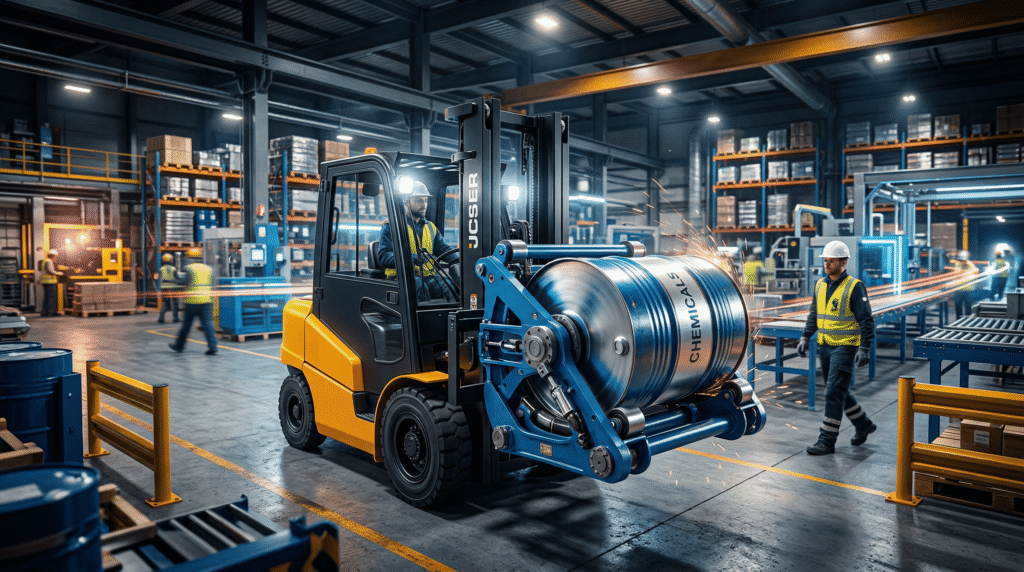
In 2026, when things are changing quickly, being efficient in business is no longer just a goal; it’s a need for survival. The “Drum Handling Revolution” is happening right now in warehouses and factories, thanks to the use of advanced forklift rotator attachments.
In the past, moving heavy drums was a difficult, time-consuming job that required a lot of people and was dangerous and could lead to product loss. But modern, high-precision rotators have made these barrels, which used to be hard to move, into useful, easy-to-handle units.
Drum Handling by Forklifts in Business:
If your business deals with liquids, powders, or granular materials, the best way to make sure that everything runs smoothly is to upgrade to these specialized attachments.
As global supply chains get more complicated, the need for speed and accuracy has never been greater. Standard forks are made for pallets, not for the round, often unstable shape of a 55-gallon drum.
Trying to move these without the right tools can cause “drum-slippage,” which is a common cause of accidents at work and in the environment. Businesses can now flip, pour, and move materials with 360-degree control by using a dedicated drum handling solution. This makes a standard forklift into a powerful tool that can do many things.
- No More Manual Labor: With advanced rotators, one person can do tasks that used to take three people.
- 360-Degree Maneuverability: Operators can turn loads to the exact angle needed for mixing or pouring in a controlled way.
- Works with Everything: New attachments are built to work with steel, plastic, and fiber drums just as safely.
Getting the most out of your operations with hydraulic accuracy
When we say “Advanced Rotator Attachments,” we mean the change from mechanical “pull-chain” types to hydraulic systems that function with the complete machine.
The third-function lever on the forklift connects directly to these systems. This lets the operator easily manage them from the safety of the cabin. Hydraulic rotators assist prevent spills from happening when “precision pouring” is crucial to a recipe or formula, such in food processing or chemical manufacture.
This improvement in technology is very important for keeping things running smoothly in factories. Facilities are getting 30% to 50% more work done per day by reducing down on the “cycle time” each drum, which is the time it takes to select, transfer, rotate, and replace.
The attachments will be considerably stronger in 2026. Many of them will have strengthened steel frames and weather-resistant coatings that keep them functional even in tough outdoor or high-moisture conditions.
- Real-Time Control: You may modify the speed and angle of rotation right immediately using the forklift’s internal hydraulic controls.
- Less Waste of Materials: Knowing exactly where to put each drop or grain saves money.
- Less wear and tear on equipment: Smooth hydraulic motions put less stress on the forklift mast than jerky, manual tilting.
Safety First: Easily Meeting OSHA Standards by 2026
The most essential thing for any company to operate effectively is to keep people safe. The “Drum Handling Revolution” is about more than simply moving items; it’s also about making sure people are safe. Since 2026, OSHA has made it harder to handle harmful items by hand.
Drum handling attachments operate as a mechanical barrier to keep the worker away from the probable risk. These attachments keep the operator at a safe distance, which considerably minimizes the danger of musculoskeletal injuries, crushed fingers, or exposure to harmful splashes, whether they are dealing with caustic chemicals or large bulk powders.
Advanced rotators also come with complicated locking mechanisms. The “Chain Belly Strap” and “Eccentric Locks” keep the drum stationary no matter how you tilt it when you hold it. When hauling drums across rough warehouse floors or up steep ramps, this level of safety is highly crucial.
When you acquire these products, you’re not only receiving equipment; you’re also helping to create a “Safety-First” culture that cuts insurance costs and makes employees happier.
- Hands-Free Operation: The operator doesn’t have to get up from their seat to do anything, from clamping to turning the machine upside down.
- Automatic Locking Jaws: New “Eagle Beak” and rim-clamp designs lock on their own when they touch the drum.
- Hazardous Zone Compliance: Many rotators now have ATEX certification, which means they can be used in places where there is a risk of explosions or other dangerous events.
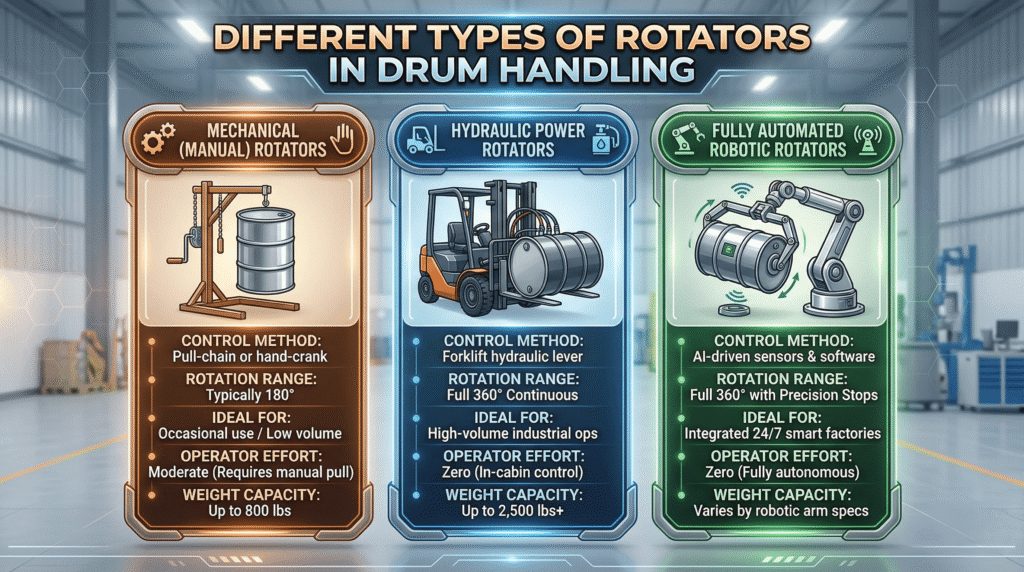
Different Types of Rotators in Drum Handling:
| Feature | Mechanical (Manual) Rotators | Hydraulic Power Rotators | Fully Automated Robotic Rotators |
| Control Method | Pull-chain or hand-crank | Forklift hydraulic lever | AI-driven sensors & software |
| Rotation Range | Typically 180° | Full 360° Continuous | Full 360° with Precision Stops |
| Ideal For | Occasional use / Low volume | High-volume industrial ops | Integrated 24/7 smart factories |
| Operator Effort | Moderate (Requires manual pull) | Zero (In-cabin control) | Zero (Fully autonomous) |
| Weight Capacity | Up to 800 lbs | Up to 2,500 lbs+ | Varies by robotic arm specs |
The Cost of Upgrading: Return on Investment and Long-Term Value
For people who make decisions at americanforklifts.org, the bottom line is often the most important thing. Is it worth it to buy a specialized attachment for a forklift that rotates? The information from 2026 points to a strong “Yes.”
The initial cost of a high-end hydraulic rotator is higher than that of a standard set of forks, but the return on investment (ROI) is usually seen within the first 6 to 12 months. This is possible because of lower labor costs, savings on materials that don’t spill, and a huge drop in workplace injury claims.
Also, you don’t need a special “Drum Truck” taking up space in your fleet because these attachments can be used in many different ways. One forklift with a quick-connect rotator can unload pallets in the morning and then dispense chemicals in the afternoon.
This “multi-tool” way of managing a fleet is a key part of smooth industrial operations. It lets the business run more efficiently and be more flexible, so it can quickly respond to changes in market demand.
- Flexible Fleet Management: Use one forklift for many different jobs with attachments that can be changed quickly.
- Longer Equipment Life: High-quality rotators are made to last 15 to 20 years, so they are a long-term investment.
- Low Maintenance Requirements: Modern sealed hydraulic systems don’t need much service, which lowers the cost of “down time.”
Drum Rotator Attachments: Frequently Asked Questions in 2026
Is it possible for one drum rotator to work with both plastic and steel drums?
Yes, modern drum handling rotators come with universal clamping systems. They can securely grip the rigid ribs of a steel drum or the smoother, more flexible surface of a poly (plastic) drum without causing deformation or slippage. This is possible because they have features like rubber-lined jaws or adjustable “belly straps.”
How much weight can a forklift rotator attachment hold at most?
Standard industrial rotators can usually handle between 1,500 and 2,500 lbs. in 2026. But there are heavy-duty models that can hold up to 4,000 pounds, which makes them good for very heavy materials like metal shavings or thick resins.
Do I need to learn anything special to use a hydraulic drum rotator?
Yes. Even though the controls are easy to understand, OSHA says that operators must get special training on any new attachment. This makes sure they know how the extra weight changes the forklift’s center of gravity and how to safely do a 360-degree turn while carrying a load.
What happens to my forklift’s lift capacity when I add a rotator?
Every attachment adds “dead weight” and moves the “load center” forward. Checking the data plate on your forklift is very important. In general, an attachment can lower the net lifting capacity by 10% to 15%, so make sure your forklift can handle the weight of both the rotator and a full drum.
Are there rotators that don’t spark in places where dangerous chemicals are present?
Of course. There are “EE” or “EX” rated (ATEX-certified) rotators for places that work with flammable liquids. These are made of brass or stainless steel, which don’t spark, to keep people safe in places where things can get dangerous.
How quickly can I go from using standard forks to a drum rotator?
Modern “slip-on” designs and quick-disconnect hydraulic couplings make it easy for a trained operator to switch from standard forks to a drum rotator in less than five minutes. This keeps industrial operations running smoothly without long delays.
Is it better to rotate 360 degrees than 180 degrees?
A 360-degree rotator is more flexible than a 180-degree rotator, but 180 degrees is enough for simple emptying. It lets the operator “shake” the drum to get rid of stuck things and lets pouring from either side of the forklift, which is a big plus in narrow aisles in warehouses.
Be the leader of the revolution: Drum Handling Revolution
The Drum Handling Revolution is more than just a trend; it’s the new norm for the modern industrial age. You are choosing to put safety first, get the most work done, and stay ahead of the competition by adding advanced forklift rotator attachments to your workflow.
As we get closer to 2026, the difference between traditional operations and those that use “seamless” technology will grow even bigger. Go to americanforklifts.org to learn about the newest drum handling technology and turn your fleet of forklifts into a high-performance material handling system right now.