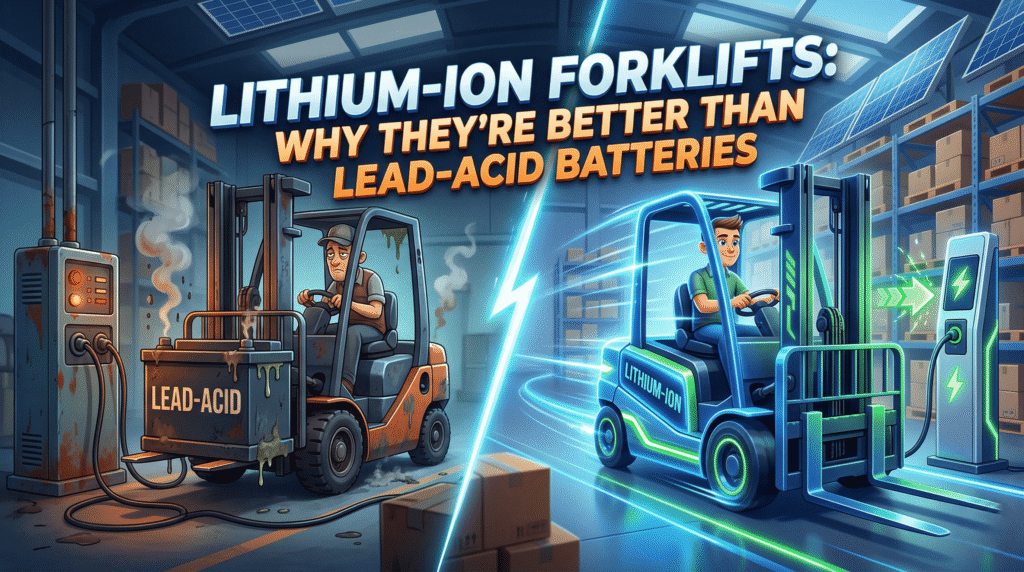
Lithium-Ion Forklifts: Why They’re Better Than Lead-Acid Battery
There is a huge change in the way that equipment is powered in the material handling business. For many years, the flooded lead-acid batteries was the best battery for electric lift trucks in warehouses. It was dependable, but it needed a lot of care. But things have changed. As we get closer to 2026, Lithium-Ion Forklifts are quickly becoming the best choice for enterprises that need to be very efficient.
This change isn’t simply a fad; it’s a smart move by warehouse managers to save expenses, make workers safer, and do rid of the downtime that comes with using old battery technology. Companies are moving away from the “8-8-8 rule” (8 hours of usage, 8 hours of charging, and 8 hours of cooling) and toward a more flexible, continuous workflow by choosing lithium-ion solutions.
We at American Forklifts have seen this change happen in real life. The need for lithium-ion technology comes from the fact that it can offer steady power throughout the whole discharge cycle. Lead-acid battery lose charge and “voltage drop,” which makes the forklift seem slow.
Lithium-ion batteries, on the other hand, maintain a consistent voltage until they are almost empty. This makes sure that your forklift works just as well at the conclusion of a shift as it did at the beginning. As companies want to be 100% efficient, switching to lithium-ion is no longer a luxury; it’s a strategic must if they want to remain competitive in a fast-paced global market.
The Efficiency Revolution: Charging and Getting Things Done
The fact that Lithium-Ion Forklifts charge so quickly is one of the main reasons they are replacing lead-acid versions. Lead-acid batteries are known for needing a lengthy time to charge and “cool down.”
In a multi-shift setting, this generally means that each vehicle has to have two or three batteries to keep the fleet going. “Opportunity charging” is a mechanism that lithium-ion technology uses to do rid of this problem totally. This lets workers plug in their equipment for brief breaks, meals, or shift changes without hurting the battery’s life.
- Quick charging: Lithium batteries may be fully charged in about 1 to 2 hours, whereas lead-acid batteries take more than 8 hours.
- Opportunity Charging: You may “top off” the battery during a 15-minute coffee break, which gives you enough power to complete the shift without having to fully recharge it.
- No Battery Swapping: You don’t have to move heavy equipment or set up special facilities to change batteries since one battery may remain in the truck for many shifts.
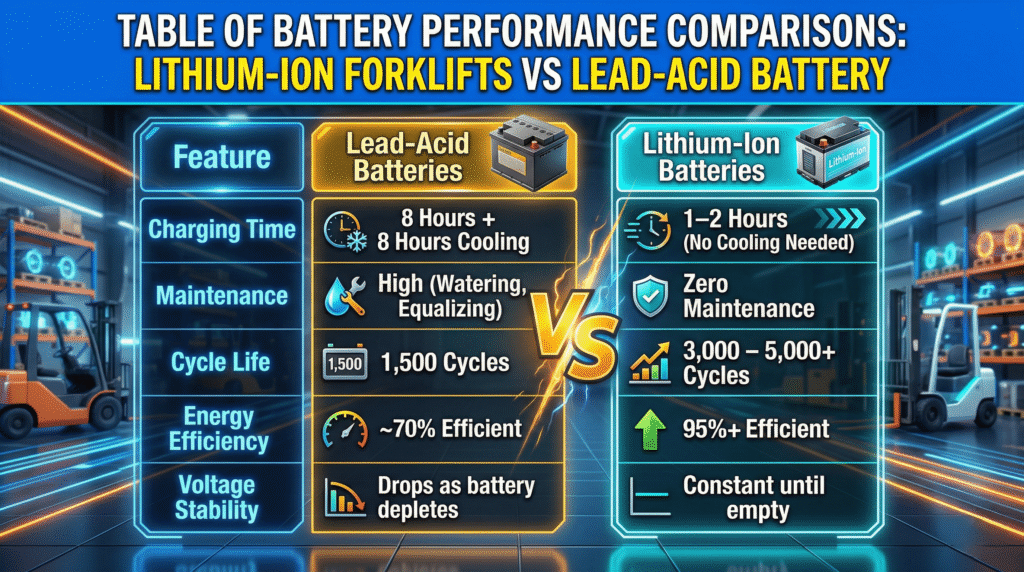
Table of Battery Performance Comparisons – Lithium-Ion Forklifts Vs Lead-Acid Battery
| Feature | Lead-Acid Batteries | Lithium-Ion Batteries |
| Charging Time | 8 Hours + 8 Hours Cooling | 1–2 Hours (No Cooling Needed) |
| Maintenance | High (Watering, Equalizing) | Zero Maintenance |
| Cycle Life | 1,500 Cycles | 3,000 – 5,000+ Cycles |
| Energy Efficiency | ~70% Efficient | 95%+ Efficient |
| Voltage Stability | Drops as battery depletes | Constant until empty |
Getting Rid Of Maintenance And Labor Costs
The “hidden costs” of lead-acid batteries are frequently the time and effort they take to keep up. To maintain a lead-acid battery working, teams need to routinely fill the cells with distilled water, clean up any acid spills to stop the terminals from corroding, and do equalization charges to balance the cells. A battery’s interior plates may be irreversibly damaged if a team forgets to water it even once, which means it will need to be replaced sooner and at a higher cost. Lithium-ion forklifts are easy to use and don’t need any special tools, so your maintenance personnel may focus on more important jobs.
- No Watering: Lithium-ion batteries are sealed systems that never need water.
- No Acid Handling: There is no liquid acid, therefore there is no chance of spillage that might damage things or the requirement for costly neutralizing solutions.
- Longer Lifespan: A single lithium battery may last the whole life of a forklift truck, with up to 5,000 charge cycles. Lead-acid batteries, on the other hand, need to be replaced every 3 to 5 years.
Better Safety And Following The Rules For The Environment
Lithium-Ion Forklifts make handling batteries more safer, which is a major requirement for any contemporary warehouse. When lead-acid batteries are charging, they “gas off,” which means they release hydrogen and sulfuric acid mist into the air. To avoid explosions or breathing problems, this needs specific, powerful ventilation systems and separate charging rooms. Also, switching out 2,000-pound lead-acid batteries is a dangerous thing to do since it might cause crush injuries. Lithium-ion technology gets rid of all of these risks.
- No Toxic Fumes: Lithium-ion batteries don’t give out toxic fumes while they’re charging, so chargers may be put wherever in the warehouse.
- Stable Chemistry: Lithium Iron Phosphate (LFP) is used in most current industrial lithium batteries. It is chemically stable and greatly lowers the chance of thermal runaway.
- Effect on the Environment: Lithium batteries use less electricity from the grid, which helps firms reach their carbon-neutral and sustainability objectives.
Total Cost of Ownership (TCO): The Long-Term Win
A lithium-ion battery may cost two to three times as much as a lead-acid battery up front, but the Total Cost of Ownership (TCO) tells a different picture. When you add up the cost of additional batteries, charging rooms, wasted power, and hundreds of hours of maintenance work, the return on investment (ROI) for lithium-ion battery usually happens within 18 to 24 months.
The savings are considerably bigger for enterprises that are high-intensity and run many shifts. You’re not just purchasing a battery; you’re also getting more uptime and less overhead.
- Lower Utility Bills: Lithium-ion batteries use around 30% less energy, so more of the electricity you pay for really goes to the forklift’s motors.
- Getting Back Floor Space: You may install additional pallet racking and enhance your storage space without creating a bigger facility by getting rid of battery rooms.
- Less wear and tear on equipment: When the voltage is stable, the forklift’s electrical parts aren’t strained by running at low voltage, which might make the whole vehicle last longer.
FAQs: Lithium-Ion Forklifts Vs Lead-Acid Battery
Is it worth the extra money to buy lithium-ion forklifts?
Yes, particularly for organizations that run more than one shift. The initial cost is greater, but the savings on maintenance, energy, and not having to buy extra batteries generally mean that the investment pays for itself in two years.
Is it possible to change my lead-acid forklift to utilize lithium-ion?
Yes, most of the time. Many companies provide “drop-in” lithium-ion replacements that come with the right counterweights to make sure the forklift stays stable and safe to use according to its original specs.
Do lithium-ion batteries need specific chargers?
Yes. You need to use a charger that is made for lithium-ion batteries. Using a lead-acid charger might damage the Battery Management System (BMS) and create a big fire risk.
How long does a lithium-ion forklift battery really last?
A good lithium-ion battery usually lasts between 3,000 and 5,000 charge cycles. In a normal warehouse, this usually means 8 to 10 years of usage, which is about the same amount of time as the forklift’s full operating life.
Is charging the battery while it’s in use bad?
Not at all. Opportunity charging is good for lithium-ion batteries. It helps keep the charge level stable all day long and doesn’t have the “memory effect” that may happen with other types of batteries.
Is it safe to store lithium-ion batteries in the cold?
Yes, lithium-ion batteries work quite well in cold or freezing places. Many of them include built-in heaters that let them charge and work well at temperatures where lead-acid batteries would lose a lot of their power.
What kind of care do I need to provide a lithium forklift battery?
Almost none. You don’t have to do anything to lithium batteries. You don’t have to water them, equalize them, or wipe the acid off the terminals. Just maintain the connections clean and charge the device according to the instructions from the manufacturer.
Final Words for Warehouse Managers – Lithium-Ion Forklifts Vs Lead-Acid Battery
The switch to lithium-ion forklifts is a clear evidence that the industry is moving toward technology that is smarter, cleaner, and works better. Businesses may now be more productive than ever by getting rid of the logistical problems that come with the standard lead-acid charging cycle.
Switching to lithium-ion batteries is a proven approach to make sure your fleet will be ready for the future, whether you have a tiny warehouse or a huge distribution center.
American Forklifts is committed to helping you locate the best power solution for your requirements. It’s not simply a change in battery chemistry; it’s an improvement to the way you run your business.