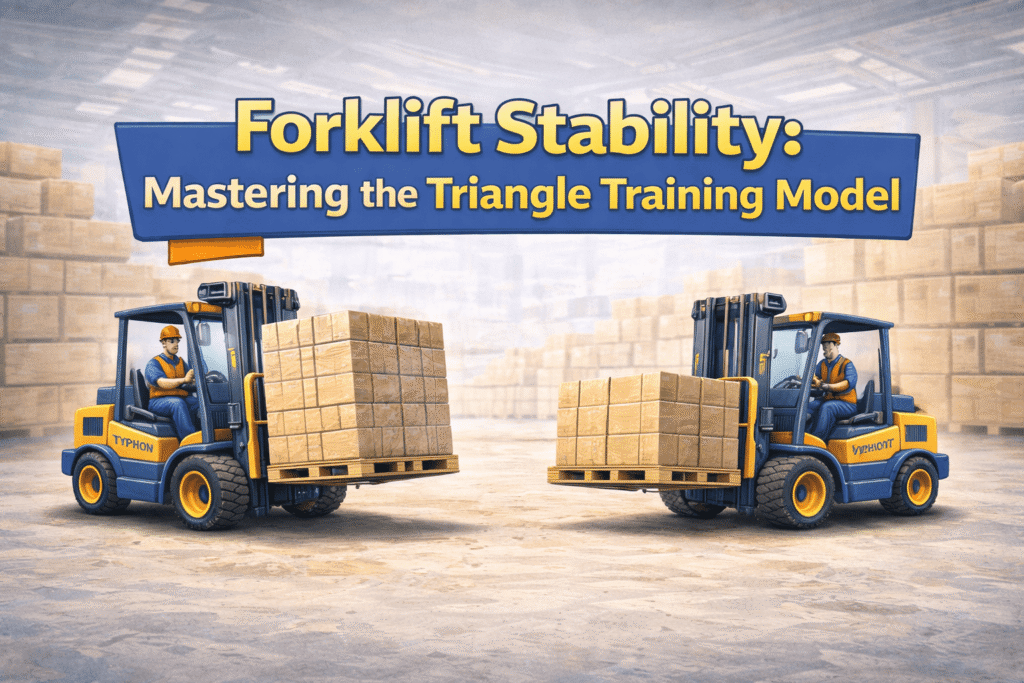
The Ultimate Guide to Forklift Stability: Mastering the Triangle Training Model
Walk into any busy warehouse, distribution center, or manufacturing plant, and the soundtrack is always the same: the hum of engines, the beep of reversing alarms, and the clatter of pallets. At the center of this organized chaos is the forklift. To the untrained observer, a forklift looks like a miniature, indestructible truck. However, beneath heavy steel counterweights and hydraulic masts lies a delicate balancing act governed by strict laws of physics.
Every year, thousands of workplace accidents and injuries occur because operators and managers fundamentally misunderstand how these machines balance their loads. Failure to maintain forklift stability is the primary cause of the vast majority of tip-overs.
Whether you are a seasoned fleet manager writing a safety protocol or a new operator getting behind the wheel for the first time, mastering the concept of the “Stability Triangle” is non-negotiable. It is the literal difference between a productive shift and a fatal disaster.
In this comprehensive guide, we are going to break down the science, the operational mechanics, and the real-world scenarios that define forklift stability.
1. The Core Illusion: Why a Forklift is Not a Car
The biggest mental hurdle most new operators face is their own driving experience. When you get into your personal car, you are sitting in a vehicle with a four-point suspension system. If you take a corner too quickly in a sedan, the weight shifts, the suspension absorbs the shock, and the four wheels keep you grounded.
A forklift does not work this way.
Most industrial counterbalanced forklifts, even those with four wheels, operate on a three-point suspension system. The front axle is fixed, but the rear axle (the steering axle) is attached to the frame by a single pivot pin in the exact center. This design is necessary; it allows the forklift to drive over uneven warehouse floors and dock plates while keeping all tires in contact with the ground.
However, because of this single rear pivot point, the machine does not have a rectangular base of support. Instead, it relies on a geometric triangle. Understanding this is the foundational step in mastering forklift stability.
2. Decoding the Stability Triangle
The stability triangle is an invisible boundary that dictates whether your machine stays upright or ends up on its side.
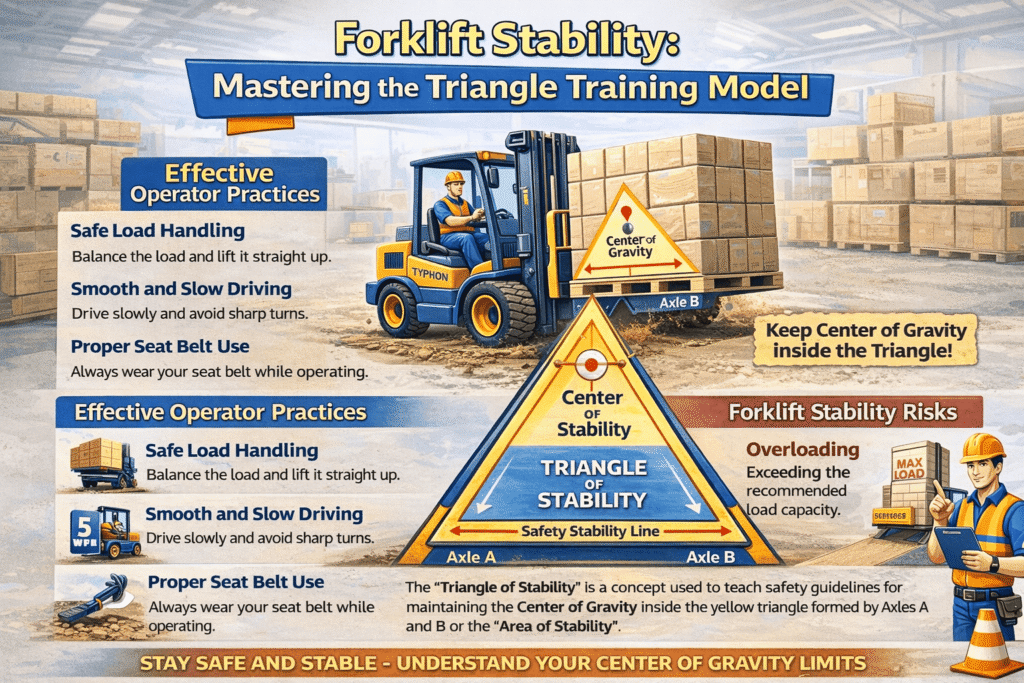
To visualize this, imagine drawing straight lines between three specific points on the machine:
- Point A: The center of the left front drive wheel.
- Point B: The center of the right front drive wheel.
- Point C: The center pivot point of the rear steering axle.
Connect Point A to Point B, Point B to Point C, and Point C back to Point A. You have just drawn the Stability Triangle.
The golden rule of forklift stability is absolute and unforgiving: As long as the machine’s center of gravity remains inside this triangle, the forklift will not tip over. The moment the center of gravity crosses over any of those three invisible lines, gravity takes over, and the machine goes down.
3. The Invisible Pendulum: Understanding the Center of Gravity (CG)
To keep the forklift inside the triangle, we have to talk about the Center of Gravity (CG). The CG is the exact mathematical point where an object’s weight is perfectly balanced in all directions.
When dealing with forklift stability, you aren’t just managing one center of gravity; you are actually managing three:
The Vehicle Center of Gravity
When a forklift is completely empty, it is incredibly heavy in the back. The massive cast-iron counterweight is designed to offset the weight of the steel mast and forks up front. Because of this, an unloaded forklift’s CG is typically located just under the operator’s seat, slightly toward the rear.
The Load Center of Gravity
Every item you pick up has its balance point. If you are picking up a perfectly uniform, 48-inch-long pallet of paper, the load center is exactly in the middle—24 inches from the face of the forks. If you pick up an asymmetrical load, like a heavy machine engine mounted on a skid, the load CG might be heavily skewed to the left, right, or front.
The Combined Center of Gravity
This is where the magic (or the danger) happens. When a forklift picks up a load, the Vehicle CG and the Load CG merge to create a new, shifting point called the combined center of gravity.
Think of the front axle (the line between the two front wheels) as the fulcrum of a seesaw.
- The counterweight is the kid sitting on one end.
- The pallet of goods is the kid sitting on the other end.
- As you pick up a heavier load, the combined CG slides forward toward the front axle. If the load is too heavy, the combined CG crosses the front axle line, the counterweight lifts off the ground, and the forklift tips forward. This is known as a longitudinal tip-over.
4. The 3D Reality: Elevating into the Stability Pyramid
The triangle model is great for understanding a forklift driving across a flat floor. But forklifts are designed to lift. Once that mast goes up, we have to stop thinking in 2D triangles and start thinking in 3D pyramids.
Imagine the stability triangle on the floor, and draw lines from each of the three points up to a single point high in the air above the driver’s head. You’ve just created the Stability Pyramid.
As you lift a load into the air, the combined center of gravity moves straight up.
Look at the shape of a pyramid: it is wide at the base and incredibly narrow at the top. This means that when your load is 4 inches off the ground, you have a massive margin of error. Your CG can shift left, right, forward, or backward by several inches, and you will stay safely inside the base of the pyramid.
But when you lift that same load 15 feet into the air to place it on a top-tier rack, the Combined CG is pushed into the narrowest part of the pyramid. Up there, you have virtually zero margin for error. A slight slope in the floor, a gentle tap on the brakes, or turning the steering wheel even a fraction can cause the CG to break the boundary, resulting in a catastrophic lateral (sideways) tip-over.
5. Dynamic Forces Threatening Forklift Stability
If forklifts only operated in a vacuum at zero miles per hour, maintaining forklift stability would be easy. But warehouses are dynamic environments. When a forklift is in motion, physics introduces dynamic forces that actively try to pull your Combined CG out of the safe zone.
Centrifugal Force
When you turn the steering wheel of a moving vehicle, centrifugal force pushes the vehicle’s weight toward the outside of the turn. Because the rear of the Stability Triangle narrows down to a single point, forklifts are highly susceptible to lateral tip-overs during turns. Never turn with an elevated load, and always reduce speed to a crawl before initiating a turn, even when empty.
Momentum and Inertia
An object in motion wants to stay in motion. If you are driving forward at full speed with a heavy load and suddenly slam on the brakes, the forklift stops, but the momentum of the heavy mast and the load continues moving forward. This violent shift pushes the Combined CG sharply toward the front axle, risking a forward tip-over or causing the load to slide right off the forks.
Mast Tilt Dynamics
The tilt cylinders on a forklift are incredibly powerful tools for securing a load, but misusing them ruins forklift stability.
- Tilting Back: When carrying a load, tilting the mast back brings the Load CG closer to the Vehicle CG. This is the safest, most stable driving posture.
- Tilting Forward: Tilting a load forward pushes the Combined CG dangerously close to the front axle line. You should only ever tilt forward when the forklift is completely stopped, and the load is positioned directly over the rack or stack where it is being deposited.
6. The Environment’s Role: Grades, Ramps, and Docks
Even if you are driving perfectly, the environment can compromise your stability.
Navigating Inclines
When you drive a forklift onto a ramp, the horizontal line of gravity changes. If you drive a loaded forklift nose-first down a ramp, gravity pulls the Combined CG forward, easily crossing the front axle line.
To maintain forklift stability on slopes, follow the “Load Upgrade” rule:
- If carrying a load: Always keep the forks pointed UP the ramp. Drive forward up the ramp, and reverse down the ramp.
- If driving empty: Always keep the forks pointed DOWN the ramp. The counterweight is now the heaviest part of the machine, so it needs to remain pointing uphill.
Floor Conditions
A small piece of wood, a deep pothole, or an uneven dock plate might seem insignificant, but when carrying a heavy load, one wheel dipping into a hole causes the entire mast to tilt sharply. This sudden jolt is often all it takes to throw the Combined CG outside the triangle.
7. Reading the Data Plate for Safe Operations
You cannot maintain forklift stability if you don’t know the physical limits of your machine. Every industrial truck is equipped with a Data Plate (or Capacity Plate). This isn’t just a manufacturer’s suggestion; it is a strict mathematical boundary.
| Data Plate Metric | What it Means for Stability |
| Max Capacity | The absolute maximum weight the machine can lift safely. |
| Load Center | The distance from the fork face where the max capacity is calculated (usually 24 inches). If your load is unusually long (e.g., a 60-inch load center), your actual lifting capacity drops dramatically. |
| Maximum Lift Height | The highest the mast can safely extend with the rated load. |
| Attachments | If your forklift has a side-shifter, carton clamp, or carpet pole, the data plate must reflect this. Attachments add weight to the front end and push the load center further out, significantly reducing your safe lifting capacity. |
If an operator tries to lift 5,000 lbs on a machine rated for 4,000 lbs, no amount of careful driving will save them. The math will fail, the Combined CG will push past the front tires, and the forklift will tip.
8. The “Mouse Trap” Effect: Surviving a Tip-Over
Despite all training, tip-overs still happen. When a forklift begins to tip over laterally (sideways), human instinct screams at the operator to jump out of the falling machine. This instinct is deadly.
Because of the massive weight of the overhead guard and the counterweight, a tipping forklift falls incredibly fast. If an operator tries to jump clear, the machine will almost always fall faster than they can jump, pinning and crushing them underneath the overhead guard in what safety experts call the “mouse trap” effect.
If you lose forklift stability and the machine begins to tip:
- Do not jump.
- Stay in the seat.
- Grip the steering wheel tightly and brace your feet against the floorboard.
- Lean away from the direction of the fall to protect your head from striking the ground or rack.
9. Top 5 Operational Habits to Maintain Forklift Stability
Safety is not just a theory; it is a series of habits practiced every single shift. To ensure the Triangle Training Model translates to the warehouse floor, operators must internalize these rules:
- The 4-Inch Rule: When traveling, keep the forks lowered to approximately 4 to 6 inches off the ground. This keeps the combined CG firmly nested in the widest, safest part of the stability pyramid.
- No High-Speed Cornering: Slow down to a walking pace before entering an intersection or making a 90-degree turn.
- Center Your Loads: Never pick up a load off-center. If a pallet is heavy on one side, ensure the heavier side is positioned as close to the backrest of the forks as possible.
- Inspect Your Tires: Forklift tires don’t have air to cushion impacts (most are solid pneumatic or cushion tires). If a tire is chunked, missing pieces of rubber, or worn unevenly, the machine is naturally leaning, which pre-shifts your combined CG dangerously close to the edge of the triangle before you even pick up a load.
- Look Up and Look Out: Situational awareness prevents sudden swerving. If you see an obstacle early, you can brake smoothly, preserving the balance of your combined CG.
10. Conclusion: Building a Culture of Balance
Mastering forklift stability is an ongoing process that requires constant vigilance, proper training, and a deep respect for the physical forces at play. The Triangle Training Model is more than just an OSHA compliance diagram drawn on a whiteboard; it is the invisible lifeline that keeps your operators safe, your inventory intact, and your business moving forward.
When operators truly understand that they are managing a shifting center of gravity—not just driving a car with forks—they transition from being mere steering-wheel holders to professional material handling experts. Educate your team, respect the data plate, keep the loads low, and let physics work for you, not against you.