How long does a lithium battery last? The Ultimate Guide to Forklift Power
In the material handling industry, the move toward energy that is both sustainable and efficient is no longer a trend; it is now the norm. We see businesses all over the US switching to lithium-ion technology at American Forklifts in order to stay competitive. Fleet managers ask a lot of important questions before making the switch, but one of the most important is, “How long does a lithium battery last?”
To figure out your Total Cost of Ownership (TCO) and keep your warehouse running smoothly, you need to know how long these power cells will last.
Importance of Lithium Battery
Traditional lead-acid batteries have been used in the industry for decades, but they often fail early because of bad maintenance and “memory effect” problems. But lithium-ion batteries last much longer and are much more reliable. A good lithium-ion forklift battery can last anywhere from 7 to 10 years, or even longer, depending on how it is used and cared for.
- Long life: Lithium batteries can usually be charged 3,000 to 5,000 times.
- Predictability: Their performance doesn’t drop off a lot when the charge drops, unlike lead-acid batteries.
- Warranty: Most makers offer long warranties that cover the battery for most of its expected life.
How Long Do Lithium-ion forklift battery Last?
When we talk about how old a battery is, we need to make a difference between “cycle life” and “chronological years.” In the industrial sector, cycle life is the best way to measure how long something will last. A cycle is when you use up the battery and then charge it back up to full. Lithium-ion batteries are made to work in places where there is a lot of activity and people work in shifts.
The way we count years is better because lithium-ion batteries support “opportunity charging,” which means you can plug them in for short breaks without hurting the cells. You don’t have to charge it for a full 8 hours every time you plug it in. This flexibility keeps the battery in a healthy state of charge, which means it can last for more calendar years.
- Cycle Capacity: You can expect 3 to 5 times more cycles than with regular lead-acid batteries.
- Efficiency: Higher energy density means longer run times each day.
- Little Degradation: Many lithium batteries still have 80% of their original capacity after 2,000 cycles.
Important Things That Affect the Life of Lithium Batteries
The average lifespan is great, but there are a few things that can either lengthen or shorten the time you can use your investment. “Environment is everything” is something we at American Forklifts stress.
For example, a battery used in a pharmaceutical warehouse with temperature control will probably last longer than one used in a cold storage facility or a foundry with high heat.
The Integrated Battery Management System (BMS) is what makes the lithium battery work. It keeps the cells from getting too much charge, too little charge, or too hot. A good BMS keeps the battery in its “sweet spot,” which stops chemical degradation that shortens its life.
This is why it’s important to buy from well-known brands through American Forklifts if you want to get a good return on your investment over time.
- Temperature Control: Chemicals can become unstable when they are exposed to very hot or very cold weather.
- BMS Quality: A strong Battery Management System keeps cells from getting out of balance.
- Charging habits: It’s better to charge the battery regularly than to let it run down to 0%.
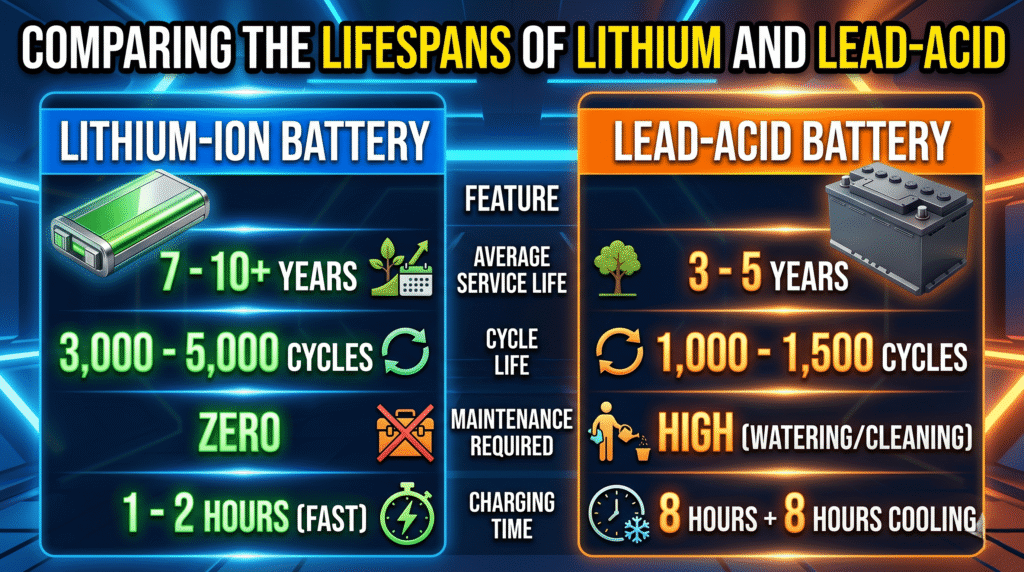
Comparing the Lifespans of Lithium and Lead-Acid
| Feature | Lithium-Ion Battery | Lead-Acid Battery |
| Average Service Life | 7 – 10+ Years | 3 – 5 Years |
| Cycle Life | 3,000 – 5,000 Cycles | 1,000 – 1,500 Cycles |
| Maintenance Required | Zero (Maintenance Free) | High (Watering/Cleaning) |
| Charging Time | 1 – 2 Hours (Fast) | 8 Hours + 8 Hours Cooling |
How Opportunity Charging Adds Years of Service
One of the best things about lithium-ion technology at American Forklifts is that you can charge the forklift whenever it’s not in use. This “opportunity charging” gets rid of the need for battery rooms and costly equipment to change batteries.
But more importantly, it keeps the battery at the right charge level, which is good for the lithium-iron-phosphate (LFP) chemistry that is often used in forklifts.
Keeping the battery charged between 20% and 80% all day long will help the internal parts last longer. Lithium batteries stay cool, unlike lead-acid batteries, which need a “rest period” to cool down after charging. This lack of heat buildup is one of the main reasons they last so much longer when used in a high-intensity 24/7 operation.
- No Cooling Time: This stops the damage that happens to other batteries when they get too hot.
- Simple to use: Operators just plug in during lunch or a 15-minute break.
- Steady Power: The voltage stays the same even when the battery is only 20% charged.
The Cost-Benefit Analysis of Living Longer
The “cost per year” of a lithium-ion battery is much lower than that of a lead-acid battery, even though the initial purchase price is higher. When you think about how long a lithium battery lasts (twice as long or more) and how little maintenance it needs, the investment pays for itself in the first 18 to 24 months.
In a typical American warehouse, you might have to replace a lead-acid battery every four years. You would buy almost three lead-acid batteries for every lithium battery you bought in ten years. When you factor in the costs of distilled water, acid cleaning, and the time spent on maintenance, the lithium battery is the best financial choice for modern fleets.
- Lower TCO: The Total Cost of Ownership can go down by as much as 40% over the course of five years.
- Savings on labor: no more watering or equalizing charges.
- Space Savings: Get back the square footage that battery charging rooms use.
Impact on the environment and at the end of life
It’s not just about money; it’s also about being able to last. A battery that lasts 10 years makes less waste than one that has to be thrown away after 3 years. Also, lithium-ion batteries are much easier to use. They don’t “gas” (give off fumes) when they charge, so they are safer for indoor spaces and places that handle food.
When a lithium battery in a forklift reaches the end of its useful life (usually when it has 70–80% of its original capacity left), it often gets a “second life” in stationary energy storage. This means that the battery cells can last much longer than ten years, which helps the environment and lowers the carbon footprint of your business.
- Good for the environment: no lead, no acid, and no bad emissions.
- Energy Efficient: Uses 30% less energy than lead-acid batteries when charging.
- Ready for a Second Life: Can be recycled and used again to store solar power.
FAQs – Forklift Lithium Battery
How long does a lithium battery last in a forklift?
A lithium-ion forklift battery usually lasts between 7 and 10 years. This means that it can be charged and discharged about 3,000 to 5,000 times, which is a lot more than the 1,500 times that lead-acid batteries can be charged and discharged.
Is it okay to leave a lithium battery charging all night?
Yes, modern lithium batteries sold by American Forklifts have advanced Battery Management Systems (BMS) that stop the flow of electricity when the battery is full. This keeps the battery from getting too hot and overcharging.
Does charging a lithium battery often shorten its life?
Lithium-ion, on the other hand, is the opposite. “Opportunity charging,” which is short bursts of charging, is recommended and doesn’t have the “memory effect.” It helps keep the battery in a good voltage range, which can often add years to its life.
What happens to a lithium battery when it dies?
The battery doesn’t just stop working. Instead, its “capacity” gets smaller. If it can only hold 70% to 80% of its original charge, it may not be able to handle a high-intensity shift anymore and should be replaced or repurposed.
Do small fleets really need to pay more for lithium batteries?
Yes, because they don’t need any maintenance or special charging areas. Lithium batteries are great for small businesses because they save time and make sure that equipment is always ready to use.
Do cold temperatures change how long a lithium battery lasts?
Extreme cold can slow down chemical reactions, but a lot of industrial lithium batteries have built-in heaters. The battery will last a long time as long as it is charged and used within the temperature range set by the manufacturer.
How can I tell if my lithium battery for my forklift is going bad?
Some signs are that the battery runs out of power faster, takes longer to charge, or the BMS often sends out “error codes” or shuts down for safety reasons. Regular checks can help find these problems before they get worse.