How to Pick the Right Forklift Capacity for Heavy Industrial Loads
Choosing the right forklift capacity for your company or facility is one of the most important things a manager or owner can do. It’s not only about getting a pallet from point A to point B; it’s also about safety, accuracy, and the long-term health of the business.
When working with huge industrial loads, the risks are much greater. Choosing a machine that doesn’t have enough capacity might cause the equipment to break down, topple over, or even kill someone.
On the other hand, giving your fleet too many details might cost you more money and make it harder to move about in small locations. We at American Forklifts think that learning about the mechanics of load capacity is the first step in making the workplace safer and more efficient. Hence, our inventory includes various forklift capacity machines to match your industrial load requirements.
Understanding the Basics of Forklift Rated Capacity
You need to know what “rated capacity” implies before you can choose the proper equipment. Every forklift has a data plate, often called a capacity plate, that shows the maximum weight the vehicle can safely lift at a certain load center.
This is usually figured out at a load center of 24 inches for most conventional industrial forklifts. This implies that if your load is longer or the weight isn’t centered, you won’t be able to lift as much as you thought you could. Knowing this difference may be the difference between a productive shift and a terrible equipment breakdown.
- Rated Capacity vs. Net Capacity: Rated capacity is the most amount that can be stored under perfect circumstances. Net capacity takes into consideration attachments and high-lift reductions.
- The Importance of the Data Plate: Always check the data plate that the manufacturer gives you, which is usually near the operator’s seat, for exact restrictions.
- Standard Load Centers: Most capacities are based on a 24-inch (600mm) load center. If you change this, you need to do a derating calculation to make sure it’s safe.
How Load Center Affects Industrial Stability
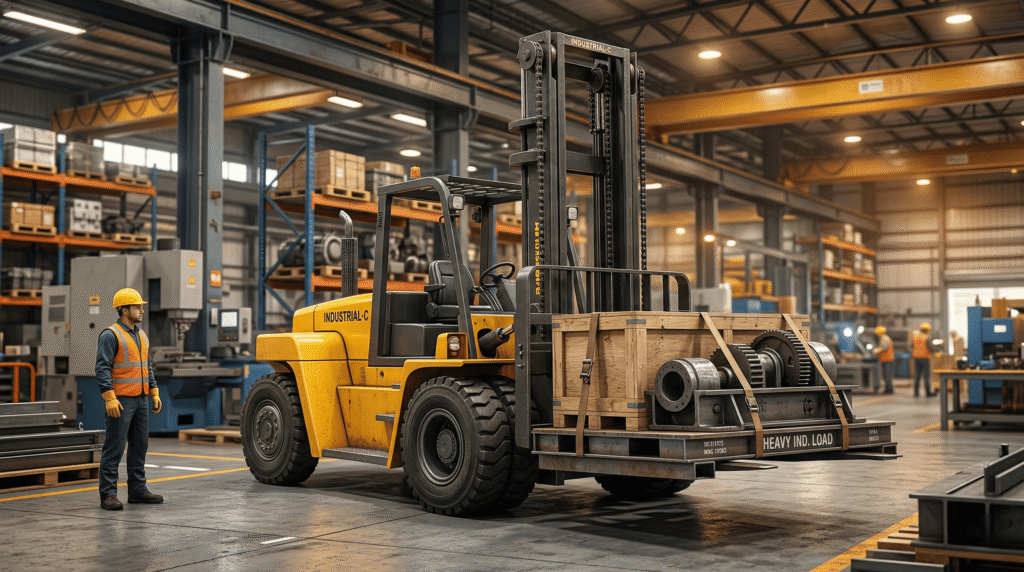
The load center is the distance between the front of the forks to the center of gravity of the load. In factories with a lot of heavy machinery, loads are not often perfect cubes. The front axle of a forklift is the fulcrum, and large machines, long steel beams, or enormous packages move the center of gravity away from it.
The forklift behaves like a huge see-saw as the load center goes up. If the “load moment” (the weight times the distance) is too much for the counterbalance to hold the machine in place, the back wheels will rise, which will cause the machine to tip over.
- The Seesaw Principle: The front axle is the fulcrum, and putting the load farther front makes it easier to lift against the forklift’s counterweight.
- Irregular Load Shapes: Long or broad loads need extra care since their center of gravity is typically significantly more than the usual 24 inches.
- Stability Triangle: The operator must maintain the truck’s and load’s center of gravity inside the “stability triangle” created by the front wheels and the rear axle pivot.
1. How the height of the lift and the choice of mast affect the forklift capacity
A lot of companies make the mistake of picking a forklift based just on how heavy the loads are, not how high they need to go. Physics says that the forklift becomes less stable as the load gets higher. Manufacturers “derate” the machine to make up for this.
For example, a forklift that can carry 10,000 pounds at ground level could only be safe to move 6,000 pounds when the mast is completely extended to 20 feet. When selecting a forklift for high-bay storage or outdoor construction stacking, this “residual capacity” is an important number to look at.
- Limits on Residual Capacity: The actual lifting capacity goes down in a straight line or in an exponential way when the mast achieves its highest point of extension.
- Types of Masts: The kind of mast you choose, whether it’s a two-stage, three-stage (triplex), or four-stage (quad), will affect both your maximum reach and your height when it’s folded.
- Safety while using a high-lift: For big industrial loads at height, it’s usually best to choose a forklift with a base capacity that is 20% higher than your heaviest load.
2. Taking into account attachments and special tools
When doing heavy industrial work, such employing paper roll clamps, side shifters, or fork extenders, attachments are quite important. But every attachment that goes on a forklift accomplishes two things: it adds “dead weight” to the front of the carriage and shifts the load center forward.
Both of these things lower the machine’s overall capacity. You might lose 5% to 10% of your lifting ability if you utilize a side shifter. That drop may be as high as 40% for more complicated attachments like heavy-duty clamps.
- Adding Weight: The weight of the attachment itself must be taken away from the forklift’s total rated capacity.
- Horizontal Displacement: Attachments typically force the load forward by several inches, which makes the load moment much bigger and makes it less stable.
- Required Paperwork: OSHA says that each forklift that uses an attachment must have a new data plate that shows the new lower capacity.
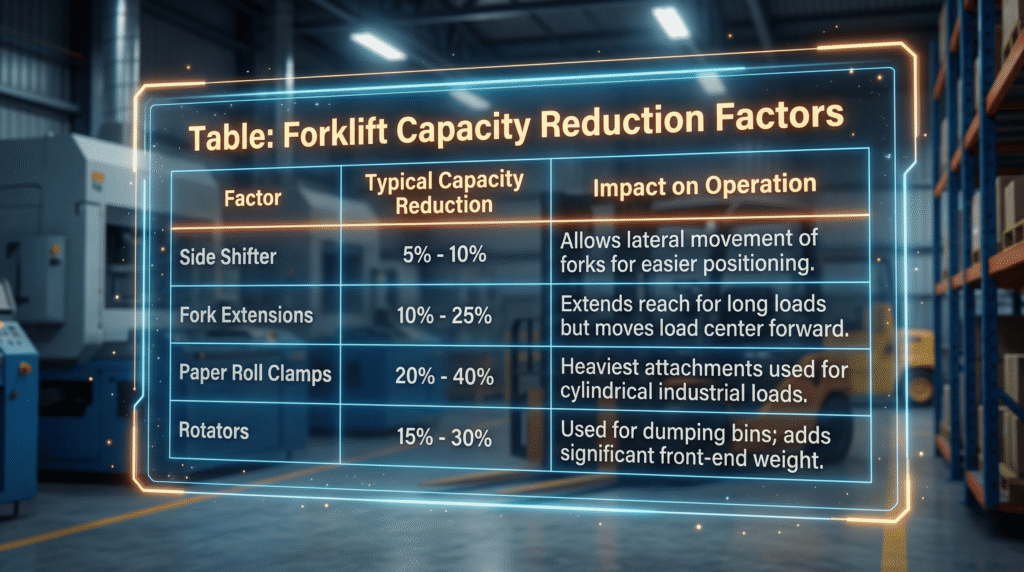
3. Table: Forklift Capacity Reduction Factors
| Factor | Typical Capacity Reduction | Impact on Operation |
| Side Shifter | 5% – 10% | Allows lateral movement of forks for easier positioning. |
| Fork Extensions | 10% – 25% | Extends reach for long loads but moves load center forward. |
| Paper Roll Clamps | 20% – 40% | Heaviest attachments used for cylindrical industrial loads. |
| Rotators | 15% – 30% | Used for dumping bins; adds significant front-end weight. |
4. Taking a Look at Your Operating Environment and Terrain
The ground or floor you drive on is just as crucial as the load itself. Forklifts typically go from smooth warehouse floors to broken asphalt or gravel yards in large industrial situations.
Forklift Capacity is also greatly affected by slopes and ramps. The center of gravity moves toward the back of the forklift as it goes up a gradient and toward the forks when it goes down. Any surface that isn’t precisely flat makes the machine less stable and less able to hold huge industrial loads.
- Indoor vs. Outdoor Surfaces: Cushion tires work well on smooth concrete, while pneumatic tires are needed for the rough ground of industrial yards.
- Managing Slopes: Capacity ratings are usually calculated on flat terrain, but steep slopes need the load to be tilted back and carried low.
- Ground Loading Capacity: Make sure the floor of your building can really hold the weight of the forklift and its heaviest load without breaking.
5. Cost-effectiveness over time and fleet growth
It may be tempting to acquire the smallest forklift that “technically” fulfills your requirements right now, but this generally means greater maintenance expenditures. Using a forklift at 95% of its capability all day, every day wears down the hydraulic system, gearbox, and tires quickly.
If you choose a machine with a little more capacity than you need, the engine and hydraulics will be able to work in a “comfort zone,” which will make the vehicle last longer and cut down on downtime.
- Longer Maintenance: Over-capacity machines put less stress on the hydraulic pumps and lift chains over time.
- Future-Proofing: As companies develop, their industrial load tends to become larger. Choosing a machine with a bigger capacity today means you won’t have to trade it in in two years.
- Resale worth: Forklifts with a higher capacity (like 15,000 lbs and above) frequently keep their worth better on the secondary market since they are built to last in heavy industries.
Frequently Asked Questions About Industrial Load Forklift Capacity
How can I figure out how much weight my forklift can lift with an attachment?
To get the net capacity, you need to take the weight of the attachment away from the rated capacity and add the horizontal loss (how much further the attachment pushes the load). For 100% accuracy and OSHA compliance, it is recommended to get in touch with the manufacturer for a new data plate.
Is it possible for a forklift with a 5,000 lb capacity to lift a 5,000 lb load?
Only if the load is exactly centered at the load center (which is normally 24 inches) and you are raising it to a low height. You are likely to go above the machine’s safe working limitations if the weight is too big or has to be hoisted high.
What’s the difference between Rated Capacity and Residual Capacity?
Rated capacity is the most weight that the vehicle can lift at a standard height and load center. When the mast is completely extended or when attachments are being used, the residual capacity is the actual quantity the truck can lift.
Does the kind of fuel (electric or IC) change how much weight it can lift?
Not usually. Heavy-duty electric and internal combustion (IC) forklifts are also available. But for really heavy loads outside (30,000 pounds or more), IC forklifts are frequently better since they can keep going without needing to cool down the battery.
How frequently should you change the capacity plates on your forklift?
You should change the plate every time you change the forklift in any way, such adding a new attachment, replacing the mast, or if the previous plate gets hard to see. It is a serious safety infraction to use the wrong plate.
Why does my forklift seem “light” in the rear when I raise anything that it can handle?
This is a symptom that your load center is too far forward or the ground isn’t level. The “moment of force” is still stronger than the counterbalance, even if the weight is right. You need to stop right away and move the load closer to the mast.
Is it okay to put more weight on the rear of a forklift to make it carry more?
Not at all. OSHA rules say that adding “home-made” counterweights is against the law and very hazardous. It exerts stress on the steering axle and tires that can’t be measured, which might cause mechanical failure or loss of steering control.