Fix Common Forklift Brake Issues Fast: Pro Guide
One of the major systems that stand between the operator and a disaster is the brake system of the forklift. In the warehousing and logistics sector, a fraction of a second is enough for a human to be seriously injured, so it is crucial to react and brake in time with no delays. Obtaining the knowledge on how to Fix Common Forklift Brake Issues Fast is more than just a skill for maintenance technicians.
It is equally important for the managers and operators as the core of safety requirements in any work facility.
This expert information-kit delves extensively into good-practices, step-by-step repairs, and preventive maintenance techniques that ensure maximum braking effectiveness of your machinery.
Top Fix Common Forklift Brake Issues Fast: Pro Guide
Knowing the Red Flags:
A decent diagnosis of the symptoms should be done first before applying a fix. The majority of the communication concerning the state of the brakes is given gradually rather than abruptly so that you would not be able to spot the changes if you are too busy.
If you are able to recognize those signs, you can save yourself from a complete brake wrecking.
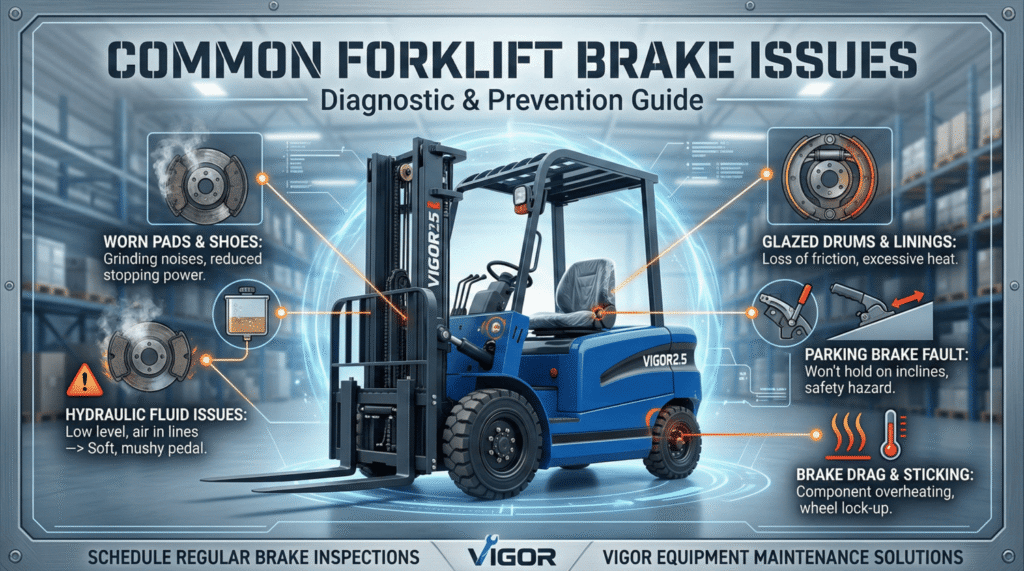
- Soft or Spongy Pedal: If the brake pedal is soft and spongy, or it even needs to be pressed to the floorboard before the brakes come on, the hydraulic system of the forklift has air in it, or there is leakage of the master cylinder.
- Unusual Noises: Squealing, grinding, and clicking are typical brake sounds that indicate that the friction linings have worn thin and metal scraping is ensuing.
- Pulling to One Side: A forklift that drifts to one side during braking is an indication of uneven brake adjustment or a sticking wheel cylinder (the pistons in the brake cylinder are stuck.
2. Troubleshooting Master Cylinder and Fluid Leaks
The master cylinder is one of the main components in the hydraulic braking system of your forklift. This part is responsible for changing the force exerted by the driver’s foot on the brake pedal into the equivalent force of the hydraulic fluid. The failure of this component means the breakdown of the entire brake system.
- Check Fluid Levels: Before anything else, you should check and make sure that there is enough fluid in the brake fluid reservoir. Very often, low levels are a sign of a leaking brake line or a leaking wheel cylinder.
- Seal Inspection: Look around the seals of the master cylinder and check for any signs of dampness or fluid “leaking” that is sometimes called “weeping”. A compromised seal allows the fluid to slip past the piston, which leads to a drop in pressure.
- Bleeding the System: If you have a spongy pedal and yet the fluid level in the reservoir is correct, it means that you will have to “bleed” the brakes to get rid of the air that is “trapped” inside the system and thus, making the liquid incompressible.
Common Hydraulic Fluid Issues & Solutions
| Symptom | Probable Cause | Fast Fix |
| Pedal sinks slowly | Internal master cylinder leak | Rebuild or replace master cylinder |
| Rapid fluid loss | Ruptured brake line | Replace damaged line and bleed system |
| Discolored fluid | Contamination/Moisture | Flush the system with fresh fluid |
3. Mastering Forklift Brake Shoe and Drum Repairs
Drum brakes are usually standard on both IC and electric forklifts. As the friction material on the brake shoes gets thinner with use, it eventually disappears leading to metal-on-metal contact, which not only damages the drums but also lowers the braking efficiency of the vehicle.
- Dust removal from brakes: It is a good idea to clear out brake dust every 250 machine hours by means of compressed air or a special detergent to remove the accumulated layers. Helpful both in preventing “glazing” and friction at the required high level.
- Changing the lining of shoes: When the thickness of the brake lining is less than 1/4 inch, it needs to be changed. It is more economical to replace the drum, if the shoes are still being used after that, than having to repair it after gouging its surface which is a much more expensive affair.
- Spring and hardware check: In addition to the drum, the return springs and hold-down pins should be checked during the above-mentioned replacement. Mistakenly assuming that the brakes are “dragging” because of weak springs, and henceforth causing overheating of the brake drum is a common occurrence
4. Forklift Parking Brake Troubleshooting
The parking brake is the part of the forklift that is most often overlooked; however, it is crucial for ensuring the safety of operators on a loading dock. One of the main causes of fatalities in warehouses is when workers are hit by a “runaway” forklift which could have been prevented by a properly functioning parking brake.
- Adjusting cable tension: Most of the problems related to the parking brake can be traced back to the cables that have been stretched over time. An adjustment of the tension nuts can go a long way toward making sure that the lever “clicks” firmly and that it can easily hold the forklift on a 15% grade.
- Lubrication of lever mechanism: Should the lever be difficult to pull or stubbornly hanging after release, thorough cleaning of the ratchet mechanism should be done coupled with a delicate lubrication so that the handle easily and smoothly goes up.
- Interlock testing: Make sure the seat switch or electronic parking brake interlock properly stops the forklift from moving if it is not going to be used while the brake is still engaged.
5. Professional Brake Maintenance Tips in High-Speed Mode
In order to Fix Common Forklift Brake Issues Fast, you should have a process that is well planned and efficient. Working efficiently in a workshop means that the operators on the floor will have their machines back sooner than later.
To bring back your utility vehicles to their working condition without being forced to compromise on the quality, adhere to these professional hacks.
Keep spare kits close at hand: You should always have a stock of “brake kits” that include all the necessary parts such as shoes, springs, and wheel cylinders for your specific forklift makes and models (Typhon, Toyota, Hyster, Yale, semai).
- Use the hole for manual adjustment: You do not have to pull the wheels every time. By simply using a flat screwdriver through the adjustment slot in the backing plate, you can easily turn the star wheel to the point where the pedal “play” disappears.
- Standardized cleaning: Never, under any circumstances, use a brake cleaner that contains chlorine. This type of cleaner will quickly evaporate, leaving no residue that might interfere with the new friction surfaces.
6. 2,000-Hours Professional Inspection Checklist
It goes without saying that daily inspection is a must. However, a thorough in-depth inspection every two thousand hours of working time is industry-standard for.
- Resurfacing of drums: look for “heat spots” or “out-of-round” conditions on drums surface. The ones that are within the tolerance can be turned to get a smooth surface for new shoes.
- Overhauling of the wheel cylinders: If they are not leaking currently, wheel cylinder cups can still dry out over the time and hence cause leaks in near future. Getting certain that the rubber parts that are replaced at a major service are not wasted to only cost of servicing but in the long term to future leaks efficiency as well.
- Checking axle seals: Brake shoes soaked in oil are beyond saving. After a thorough cleaning attempt, you must replace the shoes because they cannot be cleaned anymore. Do not use oil in the brake area such as from an axle leak.
7. Safety and Testing After the Repairs
Make sure that you always test the forklift thoroughly before returning it to work. It might be tempting to try and get the job done fast, so you do not lose the machine from the floors for too long; however, your actions should allow the operator to be sure that the truck is really safe.
- 7-MPH test: Choose an open space and try driving the forklift for about 7 mph. Step hard on the brakes and see if the stopping power corresponds to manufacturer’s specifications. The stop should be without any abrupt steering and the deceleration have to be smooth.
- Reverse braking: To go along with forward testing, test braking when driving backward. This ensures two things: the first one is that the self-adjusters in the system are working; the second one is the shoes are properly seating.
- Lock-out/Tag-out: working on the braking system following lock-out tag-out procedures allows first the safety of the technician and secondly that no one else can move the vehicle or start the engine while the wheels are disassembled.
FAQs – Fix Common Forklift Brake Issues Fast
Why does my forklift brake pedal go straight to the floor?
In general, the lack of hydraulic pressure is the main culprit in your braking system. Examples of the most frequent reasons are low brake fluid, clogged lines with air, and deteriorated master cylinder.
To start with the investigation of course, you have to check up the fluid level. If you happened to discover that the fluid is already at the maximum, then bleeding the hydraulic system or replacing the master cylinder seals has to be the next thing on your list.
When should I replace forklift brakes?
It is generally recommended to change forklift brake shoes approximately every 5,000-7,000 working hours. The determining factors of the timing are mainly the surrounding conditions and the operating style.
It is a good practice that during an inspection every 2,000 hours you are able to measure and decide whether a change is needed or not based on the degree of brake wear.
What causes a forklift to pull to one side when braking?
Failure of one issue or a combination of issues on either side can lead to pulling a forklift to one side when operating the brake. One side’s wheel cylinder might be frozen or the brake shoes could be contaminated with oil or grease, making the brake friction less on one side than the other.
Can automotive brake fluid be used in forklifts?
This is where the manufacturer’s instructions play an important role. While the majority of forklifts use general DOT 3 or DOT 4 grade brake fluid, those specialized models, especially with “wet” disc brakes, require a particular type of hydraulic oil.
You should always consult your operator’s manual before deciding to use one type of fluid over another to make sure that you do not damage your seals when switching brake fluids.
Why are my brakes squealing on the forklift?
Brake pads that have become thin or even gone completely can result in the brakes making a screaming noise. A metal wear indicator and/or metal backing can react by making a loud noise as a result of friction between the rotor or drum when the friction material is not there to soften the contact.
Or you might just have too much brake dust that has accumulated and has not been cleaned regularly. This is something that should be done immediately to prevent the issue from recurring.
What is the correct way to adjust the parking brake of a forklift?
In most cases, the parking brake is a manual one, and an adjustment is made by tightening up the cable using a nut underneath the floorboard or at the base of the lever.
You should make the adjustment until the parking brake can safely hold the fork truck on a 15% gradient while fully loaded.
Is it dangerous to drive with “grinding” brakes?
If the brakes are making a grinding noise, then it should be a huge red flag for you. By grinding, we mean that the brake lining is completely gone. Apart from considerably increasing the stopping distance which in itself is very dangerous there is also another problem.
Grinding the drums is one of the most serious types of damage for brakes. From your point of view, the most expensive result is that a simple and affordable replacement of shoes turns into a costly one because the drums have to be replaced as well.