Need Power? 2-Ton vs 3-Ton Electric Forklifts: The Best Capacity for Your Business!
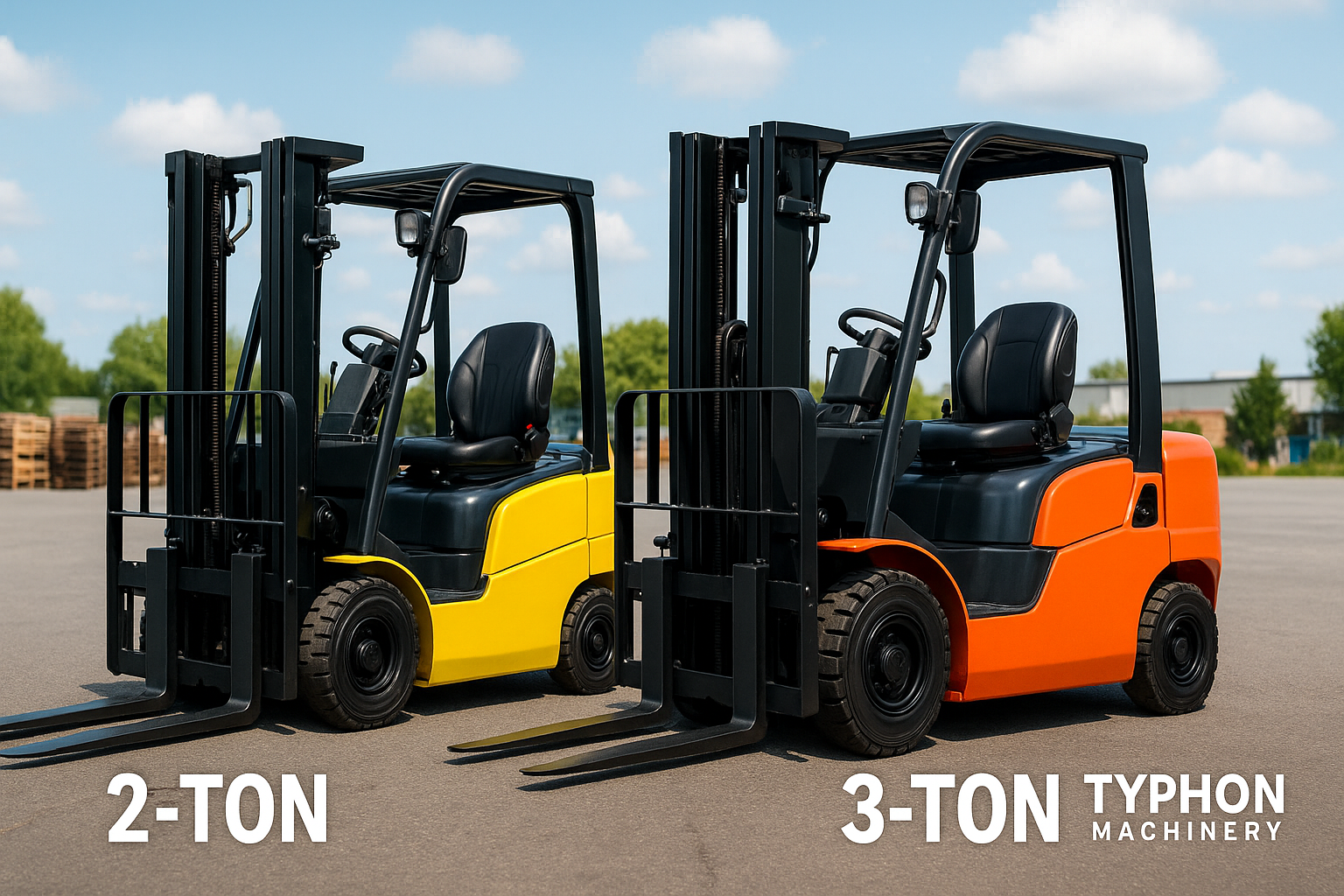
2-Ton vs 3-Ton Electric Forklifts: Which Capacity Do You Really Need?
Both 2-ton and 3-ton electric forklifts are perfect in the context of a contemporary warehouse; however, they function a bit differently: 2-ton machines emphasize features such as maneuverability and lower total cost of ownership, whereas 3-ton ones highlight a higher load capacity, safety margin, and future growth headroom.
The question of which capacity would be most appropriate to your work can be answered with your heaviest loads, typical pallet weights, aisle layout, and the extent of the safety margin you would like to incorporate into your material handling strategy.
Understanding 2-Ton vs 3-Ton Electric Forklifts
Electric forklifts weighing between 2 and 3 tons represent the “core” segment of indoor warehousing, manufacturing, and logistics, where they provide eco-friendly and quiet operations combined with good lifting power and accurate control.
- Usually, a 2-ton electric forklift is created to handle around 2,000 kg of the load in a specified load center safely, whereas a 3-ton electric forklift is made for up to 3,000 kg under the same conditions, provided the load is positioned correctly and within the rated lift height.
- 2-Ton vs 3-Ton electric forklift models are the most efficient and thus widely popular choices in logistics and warehouse scenarios for the handling of pallets, racking, and loading/unloading processes in distribution centers, production plants, and warehouses.
- Within this tonnage range, electric counterbalance forklifts are offered with different options (3‑wheel for tighter turning, 4‑wheel for more stability and higher capacities), and the final decision can be therefore influenced by the specification considerably rather that by the tonnage alone.
For a brand like American Forklifts that stands for objective, transparent guidance, the main point of the comparison is to match the machine with real loads rather than just picking the “larger is better” option.
When to Choose 2-Ton Electric Forklift?
- Typically, a 2-ton electric forklift is the most energy efficient and cost-effective solution for lighter and standardized palletized loads of consumer goods, cartons, and packaged materials that do not exceed 1.5 tons in most cases.
- Industry experts often advise that the capacity of the selected forklift should be approximately 20–30% higher than the maximum load that is usually present, thus, a 2-ton truck is considered ideal when the daily handling is seldom above 1.5–1.6 tons.
- Typical applications are e‑commerce fulfillment, retail distribution, light manufacturing, food and beverage warehouses, and indoor logistics where compact size and maneuverability are essential.
- Compared to 3-ton models, many 2-ton electric forklifts are lighter and more compact, which results in less floor loading, easier turning in narrow aisles, and can lower energy consumption per shift.
- If cost control is the main focus of your operation, then a 2-ton truck may stand for a lower purchase price, smaller batteries, less charging infrastructure requirements, and, usually, less wear on floors and racking.
When to Choose a 3-Ton Electric Forklift?
The moment when an electric forklift with a capacity of 3 tons is required is a situation where the materials handled by your company are not only heavy but also dense. For example, steel, timber, building materials, machinery components, or bulk pallets that weigh more than 2 tons.
- Moreover, this higher-capacity class can give you more safety margin for scenarios such as high stacking, long or awkward loads, or cases where the load center is shifted outward on the forks or attachments.
- Use cases that are most likely to require such equipment include industrial manufacturing plants, construction material yards, heavy logistics hubs, and high-bay warehouses where pallets are stored at significant heights
- 3-ton electric forklifts usually come with longer and stronger chassis structures, reinforced masts, and more robust drive components to be able to maintain stability and performance even during heavy continuous use.
- In case a company decides to scale up or diversify into heavier product lines, it would be wise to start with a 3-ton class thus the necessity of purchasing a new forklift will be minimal in the near future.
Key Specification Comparison: 2-Ton vs 3-Ton Electric Forklifts
Most of the time, the decisions on buying 2-ton and 3-ton electric forklifts are made after comparing the capacities, dimensions, power, and operating environment of the respective models. The comparison between two capacities that is shown in the table below is merely a rough one to help thinking and your American Forklifts partner can assist you in mapping these benchmarks to the real product data and fleet needs.
Table: Comparison – 2-Ton vs 3-Ton Electric Forklifts
| Aspect | Typical 2-Ton Electric Forklift | Typical 3-Ton Electric Forklift |
| Rated capacity (load center) | Around 2,000 kg at standard load center (e.g., 500 mm) | Around 3,000 kg at standard load center (e.g., 500 mm) |
| Best for | Light–medium pallets, boxes, cartons, FMCG loads | Dense, heavy pallets, building materials, machinery |
| Typical applications | Retail, e‑commerce, small warehouses, light industry | Manufacturing, logistics hubs, construction supply |
| Maneuverability | Higher agility, better in tight aisles and small docks | Slightly larger turning radius and footprint |
| Energy use & running costs | Often lower energy consumption and reduced floor wear | Higher energy demand but better suited to heavy-duty cycles |
| Safety margin for heavy loads | Adequate if your max loads stay well below 2 tons | Superior margin for frequent 2–2.5 ton real-world loads |

Load center is the most important factor: effective capacity drops in case that loads are extended further out on the forks than the rated load center, which is the reason why 3-ton models are preferred in heavier operations.
At the same lift heights comparison, a 3-ton machine generally will have higher residual capacity as height gets higher than a 2-ton one.
In both categories, the most up-to-date electric forklifts can be fitted either with lithium-ion or lead-acid batteries, thus affecting the runtime, charging strategy, and total cost of ownership.
Operational Factors That Decide Capacity
The decision of choosing between 2-ton and 3-ton electric forklifts cannot be solely based on the maximum label on the nameplate; it is more about the behavior of the truck in your actual facility and duty cycle. The process of capacity selection, which is structured, takes your load profile, operating environment, and safety policies into account collectively instead of separately.
- The heaviest pallets from the last couple of months should be thoroughly analyzed by you, exception loads should be considered as well, and a realistic maximum weight together with at least a 20–30% safety margin for the forklift’s rated capacity should be calculated.
- Think about lift height: the stronger mast and residual capacity of a 3-ton truck may be necessary for you if you are stacking to high racking or mezzanines even when the average loads are moderate.
- Include attachment usage (clamps, rotators, extended forks) in your calculations because every attachment has a weight and moves the load center forward, thus, effectively, the usable capacity is reduced.
Space, Maneuverability, and Aisle Layout
Indoor warehouses and distribution centers tend to underestimate the impact of factors such as aisle width and turning radius on the choice of the most appropriate forklift capacity. Although both 2-ton and 3-ton forklifts can be designed for working in narrow aisles, smaller capacity units usually allow you to have a real advantage in tight layouts and areas with a lot of traffic.
2-ton electric forklifts in particular 3-wheel configurations can be utilized in narrower aisles and more confined loading bays, thus, by the help of these tasks, pick rates are improved, and congestion caused by docks and racking is reduced.ep-equipment+1
Generally, the chassis of a 3-ton electric forklift is larger and, as a result, turning circle, which may require slightly wider aisles or more careful traffic management to avoid bottlenecks.
Capacity decision goes hand in hand with warehouse redesign or new-build work. Apart from that, there is racking layout and aisle width to be considered along with battery charging or swap zones thus returning the invested capital in the most efficient way.
Cost, Energy, and Total Ownership Value
Typically, 3-ton electric forklifts are the ones that raise the cost of the initial investment by a few thousand dollars, and per hour, they may consume more energy; however, they are more versatile for future heavier loads.
- At the same time, 2-ton models are mainly concentrated on having less acquisition costs, being of lighter weight, and consuming energy in a more efficient way – which is perfect for businesses that seldom operate at the upper limits of their capacity.
- In case your business is very cost-sensitive and works with standard, lighter pallets, a 2-ton electric forklift will be capable of keeping purchase and operating costs at a reasonable level.
- In a situation where labor, downtime, and safety are among the biggest issues, the presence of a 3-ton forklift with a higher capacity can be used for alleviating the equipment, reduction of the overload risk possibilities, and increasing the throughput per shift.
American Forklifts is making the point of presenting transparently and without bias the pros and cons of the different options so that the buyer can consider the lifetime costs—energy, maintenance, battery strategy, and future expansion—instead of making the decision solely on the basis of the price.
Safety, Compliance, and Future-Proofing
Choosing the right capacity is closely related to safety at the workplace and compliance with rules and regulations, because an under-rated forklift used for heavy loads may result in tip-overs, damage to products, and, eventually, accidents of a serious nature. One of the most effective ways of ensuring the safety of operators, stock, and the facility while maintaining productivity is that of building in sufficient headroom by selecting the right tonnage.
- When the operators are almost at the limit of loads, a 3-ton electric forklift usually can offer a more forgiving safety margin since it is the case that they are at the limit loads or the load weights might not be known exactly at the time of handling.
- In case of strict safety policies, frequent capacity and stability verifications, as well as documented pre-operation inspections, the combination of the appropriate tonnage and training significantly lowers the risk level.
- By providing educational, safety-related content, and operator training resources, American Forklifts assists the buyers in taking capacity decisions compatible with their broader safety culture and compliance obligations.
Which Capacity Should Your Business Choose?
If you intended to select between a 2-ton and 3-ton electric forklift for your business, then the very first step would be applying a rudimentary rule: your heaviest load that you handle on a regular basis and not the lightest should be the basis of your decision. Afterward, include the lift height, aisle constraints, future growth, and the cost of possible under-specification in your decision – this structured approach is reflective of the knowledge-driven decision-making philosophy at American Forklifts.
If your loads are hardly ever over 1.5–1.6 tons, you mainly operate in an indoor environment that is characterized by tight spaces, and you are willing to cut down on equipment and energy costs without compromising performance, then the appropriate option for you would be a 2-ton electric forklift.
In case you are handling 2–2.5 ton pallets on a regular basis, running multi-shift heavy operations, or looking forward to extending your product line with heavy categories in the near future, you should opt for a 3-ton electric forklift.
Not sure what to do? Then cooperate with an expert to perform a thorough assessment of your current fleet, kinds of loads, and layout so that you can determine the capacity which will facilitate the safe, efficient, and scalable material handling practices that will be sustainable in future.
FAQs: 2-Ton vs 3-Ton Electric Forklifts
Is a 2-ton electric forklift enough for standard pallet loads?
A 2-ton electric forklift with an appropriate safety margin is sufficient and in many cases more economical in a warehouse and retail operations handling typical palletized goods under approx. 1.5 tons.
When should I upgrade to a 3-ton electric forklift?
You should try a 3-ton model if your maximum loads regularly come close to or are over 2 tons; dense material handling like steel or timber is your business and if you require higher stacking with heavy pallets. samcovina+1
Does a 3-ton forklift always mean better safety?
Basically, a 3-ton forklift possesses more capacity headroom, which, in heavy-duty scenarios, can make safety better. However, overall safety still depends on proper training, correct load handling, and adherence to rated load charts and inspections.
How does aisle width influence my capacity choice?
The narrow aisles are more suitable for the most compact forklifts, and the majority of 2-ton class machines—particularly 3‑wheel types—are designed to be able to make very tight turns, while some 3-ton units need slightly wider aisles for smooth, safe maneuvering.
Do attachments change whether for 2-ton vs 3-ton electric forklift?
Indeed, attachments add weight and lengthen the load center, thus, the usable capacity is reduced, so in case operations involve clamps, rotators, or long forks you would maintain a working safe margin if you move to a 3-ton electric forklift.
Are energy costs much higher with a 3-ton electric forklift?
Under heavy loading, a 3-ton unit is typically more power-hungry and, as a result, may need bigger batteries, but the situation is offset by the fact that heavy-duty operations can be carried out faster and overloading smaller equipment can be avoided.
How can American Forklifts help me choose the right capacity?
Through providing unbiased information, expert guidance, and practical insights into forklift types, capacities, and applications, American Forklifts brings you the confidence to match a 2-ton vs 3-ton electric forklift with your real operating requirements.