Forklift Safety Tips to Avoid OSHA Violations: Discover 7 proven strategies to enhance safety
Welcome to the exciting and fast-moving world of material handling and logistics in 2026. As supply chain demands continue to rise, warehouses and distribution centers are working at such a fast pace that they are struggling to meet consumers’ expectations. However, with this high-speed operation, there is an unfortunate tendency for safety protocols to be taken less seriously.
At americanforklifts.org, we have seen how small mistakes can cause major accidents, serious injuries, and heavy financial penalties from the Occupational Safety and Health Administration (OSHA). Facility managers and forklift operators should aim to keep production at top levels while ensuring that the health and safety of their employees are never compromised.
Following established safety measures is not only a matter of compliance with regulations but also a way of creating a working environment where everyone is committed to safety and goes home safely every day.
Knowing the most efficient Forklift Safety Tips to Avoid OSHA Violations deeply is a must-making point for the survival of your business when you want to maneuver through the highly regulated modern workplace.
The OSHA inspectors have turned into highly stringent in their scrutiny, employing sophisticated data analytics and conducting surprise visits to the sites for discovery of the areas of non-compliance.
The amounts of fines for the serious or repeated violations are on a sharp rise which means that negligence of safety check by one-person or an unskilled operator can cause a company the loss of hundreds of thousands of dollars.
Hence, the only sustainable strategy is to stay ahead of risks. We will take you through this ultimate guide to find out the ways that will not only secure your workers but will also save your business from various losses and keep your workplace as a model in industry safety.
Top 7 Proven Forklift Safety Tips to Avoid OSHA Violations
1. Comprehensive Operator Certification and Training Should Be Your First Priority
Driving a powered industrial truck places a great deal of responsibility on an individual and they must possess specialized knowledge, excellent ability to locate the situation and outstanding motor skills.
There are numerous cases whereby forklift certification is treated as nothing more than a formal paperwork by the companies and not a critical life-saving educational process. In 2026, OSHA requires that all forklift operators should have a formal training program, a practical training and evaluations for competency shall be held periodically.
What this means is that a watching an online video or doing a quick multiple-choice test is not sufficient in meeting the rigorous safety standards when operating these heavy machines. Through comprehensive training, your employees will learn how to handle emergencies, avoid accidents and even prevent costly facility damages which make this tip one of the crucial ones among Forklift Safety Tips to Avoid OSHA Violations.
- Make it a requisite that before an operator is allowed into the warehouse to practice his/her skills, he/she must undergo both an OSHA-compliant classroom theory and a hands-on driving evaluation.
- Keep thorough and readily available training files that include dates when employees were trained, certifications and performance evaluations to provide during OSHA audits which may be unannounced.
- Organize mandatory refresher trainings not only every three years but also after an incident or a near-miss and after changing material handling equipment.
2. Do Daily Pre-Operational Inspections Carefully
The failure to check a forklift prior to putting it to work during the day or a shift happens to be one of the most frequent OSHA violations. A forklift is a piece of heavy equipment that is exposed to very heavy mechanical stresses day in and day out, so it is expected that parts are subject to wear and tear.
An operator might save a few minutes by skipping the daily pre-operation checklist but what he/she is doing is drastically increasing the chances of a major mechanical malfunction while hauling a heavy load which might result in a tragedy.
Also, a detailed inspection covers, among other things, checking fluid levels, hydraulic line status, brake testing, and ensuring that the horn and lights, the safety devices, are fully functional.
When operators habitually hunt and notify about little mechanical problems which will otherwise develop into major issues, the company can save itself from the shutdown of production, high costs for emergency repairs, and accidents of a serious nature.
- Inspect fluid cylinders for any signs of leakage, scoring, or pressure losses that could lead to dropped loads.
- Check that the forklift load backrest is securely mounted and not bent or structurally damaged to prevent materials from falling backward onto the operator.
- Operate all primary controls, including steering, braking, and lift levers, to confirm that they work smoothly and responsively before moving any inventory.
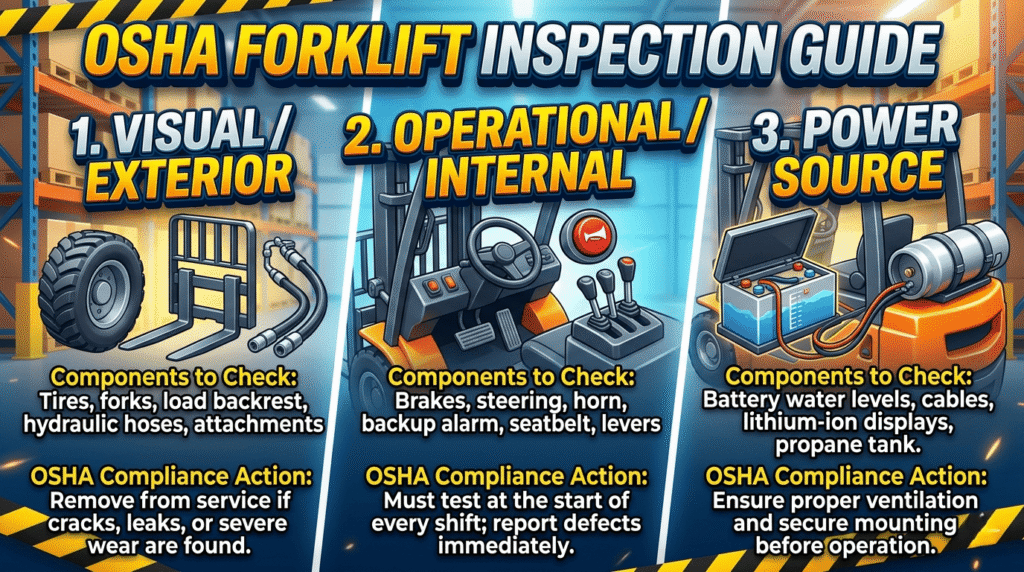
Table: OSHA Compliance Checklist
| Inspection Category | Components to Check | OSHA Compliance Action |
| Visual / Exterior | Tires, forks, load backrest, hydraulic hoses, attachments | Remove from service if cracks, leaks, or severe wear are found |
| Operational / Internal | Brakes, steering, horn, backup alarm, seatbelt, levers | Must test at the start of every shift; report defects immediately |
| Power Source | Battery water levels, cables, lithium-ion displays, propane tank | Ensure proper ventilation and secure mounting before operation |
3. Know the Load Limits and Use the Right Attachments
Having a deep understanding of the physics involved in determining the load capacity is without doubt a must for anyone who is operating a forklift because to exceed a machine beyond its limits as determined by the manufacturer is physically the sure way of causing the forklift to topple over.
Each forklift comes with a data plate that specifies the maximum lifting capacity with a particular load center and to disregard these numbers would constitute a very serious violation of OSHA regulations.
Besides, the warehouses undergoing modernization are heavily reliant on those attachments hydraulic variations – like the Clamp Masters for the unpalletized handling of fragile electronic items or heavy paper rolls – which completely change the lifting power of the base model.
The forklift operators need to be very careful in their understanding of not only how such equipment affect the total net capacity of the forklift but also how it moves the center of gravity of the forklift. Properly following these Forklift Safety Tips to Avoid OSHA Violations will help you steer clear of great losses physically and financially.
- Never go over the amount of load which the manufacturer has rated the forklift for. Also don’t forget to figure out the new capacity when using specific hydraulic attachments.
- Make sure that new hydraulic clamps are fitted with valves for pressure adjustment so that, on the one hand, they do not destroy fragile loads and, on the other hand, they maintain a secure grip.
- Before starting work, daily checking of the forks and attachments for any cracks, bends or damages is a must.
4. Enact and Maintain Safe Flooring Conditions and Keep Up Pedestrian Separation
The average manufacturing facility or a distribution center is abuzz with moving heavy equipment and different individuals on foot all the time, making it a very dangerous place to be. In line with safety statistics, a large number of forklift injuries are as a result of pedestrians being hit or crushed by moving vehicles mainly due to poor visibility or lack of separate pathways.
To this end, it is up to the facilities to design and enforce a physical and visual environment that isolates foot traffic away from the zones where forklifts are operating. Besides the use of brightly colored floor tape, installing durable guardrails and using curved mirrors in the blind corners can greatly enhance visibility.
Having a culture whereby pedestrians and operators are able to communicate clearly and in standardized way such as making eye contact and signaling using hand before crossing is an absolutely necessary part of our list of Forklift Safety Tips to Avoid OSHA Violations.
- Set up highly conspicuous floor markings and physical barriers to produce dedicated, restricted areas solely for forklift traffic.
- Put blue safety spotlights and loud, automated backup alarms on all forklifts to give pedestrians advance warning of an approaching vehicle.
- Put a rule of “no unauthorized personnel” in place and insist that all workers wear high-visibility reflective clothing.
5. Follow Battery & Refueling Safety Protocols at All Times
Regardless of whether a forklift is powered by state-of-the-art lithium ion batteries, conventional lead acid batteries or internal combustion engines which run on propane or diesel, the power source comes hand in hand with a unique set of very dangerous workplace hazards.
Working with industrial batteries means handling really high electrical currents, heavy weight lifting and exposure to very corrosive sulfuric acid or one that is highly explosive hydrogen gas.
OSHA laid down extraordinarily detailed rules concerning the design, ventilation and safety equipment for the only spots that are permitted for battery charging and refueling. No provision of eye wash, proper exhaustion ventilation and correct personal protective equipment (PPE) are obvious results of OSHA imposing fines in what may be dangerous working conditions.
Close compliance with the charging and refueling guidelines is one of the key aspects of Forklift Safety Tips to Avoid OSHA Violations facility managers and supervisors must ensure.
- Use proper and approved Personal Protective Equipment (PPE), like acid resistant gloves and face shield, when checking or watering lead acid batteries.
- Allow some time to pass before working near a newly charged battery because it still emits hazardous gases such as hydrogen.
- The batteries ought to be inspected for loose connection of terminals, corrosion, and damage of cables and insulation.
6. Stability for the Safe Operation: Understanding of the Center of Gravity
Forklifts are quite unique in their design as they have a narrow wheelbase and a heavy counterweight at the rear which together form a triangle of stability that operators need to sustain perfectly to make sure that their machine does not tip over.
Most forklift tip over accidents result in fatalities, however, operators cannot blame such incidents on factors beyond their control most of the time because the overturns have been caused by letting the center of gravity escape the stability triangle through the wrong use of speed, load adjustment and grade negotiation.
Turning the forklift very quickly, driving with an elevated load or going down a ramp in the wrong manner can all cause the center of gravity to shift outside the stability triangle within a fraction of a second. Forklift drivers need to be convinced that they are able to constantly readjust their habits in the face of a wet floor, an uneven surface or a floor type transition.
- Keep the load the lowest possible to the ground without compromising safety so that you can maintain a low, secure center of gravity at all times.
- Do not turn the forklift sideways on a ramp, incline, or sloped surface since this will immediately endanger the stability triangle and make the vehicle unsafe.
- Place the bulk of the load close to the forklift load backrest in order to prevent the forklift from tipping forward.
7. Employ The Use Of Modern Technology and Ergonomics Improvement
With the countdown to 2026, smart technology and ergonomic design are being used in material handling equipment and safety management is being changed at the warehouse level. It is the fate of the modern forklifts to be fitted with telematics systems that are capable of monitoring driver behavior, registering impact events and automatically limiting the speed of the vehicle in the areas where risk is high.
Besides, operator fatigue cannot be downplayed as one of the causes of accidents at work. So, acquiring forklifts that have features of ergonomic seating, vibration control and joystick controls that are very easy to use will contribute greatly to the operators staying awake and focused throughout the shift.
By getting on board these technological developments, businesses can eliminate the traditional safety measures which are generally reactive and turn their safety culture into the highly proactive one. To use data to spot the risky behaviors that can lead to an accident is the highest step in our evolution of Forklift Safety Tips to Avoid OSHA Violations.
- Make use of the built-in telematics systems to monitor the operating speed, record unexpected impacts and enforce driver accountability.
- Make sure that the cabins of the operators have the option of adjustable, ergonomic seating so as to reduce physical fatigue and prevent chronic back injuries.
- Fit automatic proximity sensors that are capable of detecting nearby pedestrians or objects and will slow down the forklifts safely to avoid collisions.
Conclusion: Top 7 Forklift Safety Tips to Avoid OSHA Violations
Wrapping it all up, achieving and maintaining a spotless safety record in the material handling industry necessitates persistent commitment, absolute vigilance and an action-oriented hazard mitigation methodology.
The world of 2026 is tech-savvy but at the same time, the underlying safety measures are mainly dependent on correct training, regular repairs and maintenance as well as having an awareness of one’s surroundings and the conditions around the work site.
When your company consistently practices these comprehensive Forklift Safety Tips to Avoid OSHA Violations, not only will they safeguard its most valuable asset – its workers – but they will also make a sizeable increase in their operational efficiency and improvement of morale. americanforklifts.org is firmly dedicated to providing the tools, expert opinions and thorough equipment reviews that help businesses to prosper in a safe manner.
Whether investing in a fleet of Bobcat machines, making use of innovative Clamp Masters attachments or simply updating daily inspection checklists, always keep in mind that safety is an ongoing journey and not a one-time destination. Give your employees power with the appropriate knowledge, provide them with the best tools and watch as their workplace outshines industrial excellence standards.
FAQs – Forklift Safety Tips to Avoid OSHA Violations
What are the most common OSHA forklift violations in 2026?
Among the most common violations cited by OSHA are usage of operators lacking proper certification, not conducting daily pre-operation inspections, forklift load capacity data plates that are missing or illegible, and unsecured or elevated loads while driving forklifts.
How often does OSHA require forklift operators to be certified?
OSHA requires that powered industrial truck operateurs be formally evaluated and successfully recertifield at least once every three years. However, if the operateur is seen operating unsafely, accident involuent, or operateur is given a different type of forklift, then retraining is done immediately.
Are daily forklift inspections mandatory by OSHA?
They most certainly are and OSHA requires that no forklift be used without going through at least a daily inspection that is scheduled before putting the vehicle into service. For operations on a 24-hour basis, shifts would necessitate safety inspections.
Can you drive a forklift without formal certification if you have previous experience?
NO! Even if an operator has thousands of hours of experience under his belt, OSHA requires that the operator be presently evaluated and certified by his employer for the specific forklift and environment.
What is the financial penalty for an OSHA forklift violation?
On the doorstep of 2026, the penalty for an OSHA violation is a heavy one. Serious violations may lead to fines in excess of $15,000, whereas willful or repeated violations may attract fines well above $150,000 together with legal cases and shutdowns.
How do hydraulic attachments affect a forklift’s lifting capacity?
Clamp Masters and such additions as described increase the weight of the forklift at the front end and the load center is also pushed further away from the forklift’s fulcrum. This means the overall safe lifting capacity of the vehicle is reduced and the capacity must be recalculated and displayed on a new data plate.
Do you need a regular driver’s license to operate a forklift under OSHA rules?
Not at all. OSHA does not require a regular state-issued driver’s license to operate a forklift, but it does demand that operators are equipped with the specific forklift certification and that they exhibit the physical and mental qualities to operate the machinery safely within the workplace.