Which is better propane or electric forklift?
Choosing the right material handling equipment is undoubtedly one of the most important decisions a warehouse manager or business owner has to make. The industry has been debating for years, and the question “which is better propane or electric forklift?” keeps on coming up.
Both sources of power offer distinct advantages and disadvantages. The final decision will depend heavily on your specific operational requirements, availability of funds, and work environment. Besides, as industries strive toward greener initiatives, knowledge of the significant differences between internal combustion engines and battery-powered machines is a must.
At American Forklifts, we are committed to sharing detailed information so that you not only get the best ROI but also ensure maximum safety and productivity. Within this guide, we will explain operational efficiency, environmental impacts, maintenance costs, and safety protocols in detail to assist you with your decision on which is better propane or electric forklift for your business.
We will also provide:
- Detailed Cost Comparison: Weľl look at initial costs versus long-term running and maintenance cost savings.
- Performance Factors: You will understand how each type of forklift deals with maneuverability, lifting capabilities, and different terrains.
- Safety and Environment Issues: Besides OSHA regulations and emission reductions, we will also talk about safety protocols at work.
Which is better propane or electric forklift? Top Specifications
Operational Efficiency and Performance Dynamics
When it comes to the question which is better propane or electric forklift, operational efficiency and performance are generally the most important factors considered by warehouse managers.
Electric forklifts are known for their simplicity, flexibility, and technology enhancements. Thanks to the latest electronic control technology; electric forklifts have a great accuracy in steering, accelerating, and working with hydraulics, to the point where operators reduce their physical strain and improve their handling accuracy.
Although, propane forklifts have a strong reputation for their durable build and uninterrupted power. Batteries powering electric vehicles tend to decline in performance. However, propane forklifts are capable of delivering 100% power until the fuel tank is completely empty.
- Accuracy and maneuverability: Electric forklifts provide precision in control as well as tighter turning radius, thereby making them more suitable for narrow aisle navigation.
- Stable power delivery: Propane forklifts give steady, unwavering torque and lifting power essential for heavy outdoor transport.
- Operator fatigue: Electric models emit significantly less vibration and noise, thus greatly reducing operator fatigue during a long shift.
Environmental Impact and Workplace Emissions
The answer to the question of which is better propane or electric forklift is largely determined by ecological impact and air quality issues. Indoor air quality and zero emissions at tailpipe definitely make electric forklifts the winner of the debate especially if you consider warehousing, food processing, pharmaceutical, and other such places without sufficient ventilation.
With the help of these emission free vehicles companies can easily meet their environmental targets and goals without having any problems with regulations. Propane forklifts which use combusting the fossil fuel, although cleaner than diesel alternatives, still emit carbon monoxide and other gases that produce greenhouse effect.
So, these facilities have to spend a lot on ventilation and air monitoring systems to protect employees’ health. Additionally, electric forklifts generate much quieter hums than the loud, mechanical roar of an internal combustion engine which is an added benefit in terms of contributing to a safer, comfortable, and more communicative work atmosphere.
- Zero Tailpipe Emissions: Electric forklifts produce no exhaust fumes, completely preserving indoor air quality and protecting worker health.
- Noise Pollution Reduction: The quiet operation of battery-powered lifts minimizes workplace noise pollution and improves situational awareness.
- Ventilation Requirements: Propane forklifts necessitate expensive and complex warehouse ventilation systems to mitigate the buildup of carbon monoxide.
Maintenance Requirements and Long-Term Costs
Maintenance wise, which is better propane or electric forklift? The answer to this question is a simple numerical one: electric forklifts, over their lifetime, are much more cost effective in terms of running and maintenance.
Industry statistics say that electric forklifts are maintained at the average cost of $1.25 per hour whereas propane models are maintained for about $2.00 per hour. This large difference is due to the fact that electric forklifts have only a very small number of moving parts compared to an engine of an internal combustion vehicle.
For an electric model, you are completely solving the problem of engine oil changes, spark plugs replacements, transmission fluid flushes, and complex fuel system tune-ups. It is only battery and electrical wiring maintenance that need your attention.
Meanwhile, propane forklifts need an extensive and very frequent engine servicing so as to be able to perform for their owners. While the initial purchase cost of an electric forklift along with the industrial battery and charging station may be high, the operational cost can be up to 75% lesser over time, thereby greatly compensating for the initial shock of the sticker price.
- Hourly Maintenance Savings: Electric forklifts save businesses roughly $0.75 per operating hour in routine maintenance costs compared to propane.
- Fewer Moving Components: The lack of a traditional combustion engine in electric lifts means there are significantly fewer mechanical parts that can wear out or break.
- Elimination of Consumable Fluids: Electric machinery negates the ongoing costs and environmental disposal hazards of engine oil, coolant, and transmission fluids.
Depreciation Rates and Asset Resale Value
What asset will depreciate faster, propane or electric? This is an important consideration when owners want to calculate the overall cost of ownership, besides which it also makes the ongoing discussion on which is better propane or electric forklift more interesting.
Due to the fact of lower operational wear, lesser mechanical vibrations, and increasing running demand for eco-friendly machines worldwide, electric forklifts tend to depreciate at a slower rate than those with internal combustion.
A typical depreciation curve shows that a carefully maintained 2-ton electric forklift retains 75% to 80% of its original value even after the first year, and 50% after five years. Sellers have to take care that they keep logs of all scheduled maintenance and charging optimum habits for the battery as it is the battery condition that majorly contributes to the secondary market price of the machine.
Propane forklifts on the other hand due to the vibrations, wear and tear of the inside-explosion of the engine would depreciate at a faster rate. However, because of their toughness they still find good secondary market.
- Slower Value Loss: Electric forklifts retain a higher percentage of their initial purchase price over a five-year lifespan due to minimal mechanical degradation.
- Battery Health is Key: The residual value of an electric forklift is heavily tied to the health and maintenance records of its primary battery system.
- Detailed Record Keeping: Documenting a tracked history of maintenance can artificially boost the resale value of either forklift type by 20% to 30%.
Safety Protocols and Fire Prevention Standards
In terms of workplace safety, there is no compromise and hazards would differ according to which is better propane or electric forklift. Propane forklifts come with highly pressurized, volatile fuel tanks.
A leak can cause flammable vapors to accumulate at the ground surface, creating extremely hazardous situations of fire and explosion apart from operators being at risk of cold burns (frostbite) when they manually change the liquid propane tanks.
In comparison, electric forklifts remove fuel leak dangers completely but add lead-acid or lithium-ion battery packs at a risk of short circuits or “thermal runaway.” The place that electric forklifts are most vulnerable to fire risk is at the charging station because of heat building and the possibility of hydrogen gas accumulation.
According to OSHA 1910.178 and NFPA regulations, special electric forklift fire extinguishers should be either mounted or be kept near the charging bays so as to control any battery fires spreading to the surrounding warehouse materials like wooden pallets and shrink wraps.
- Volatile Fuel Handling: Propane forklifts require strict safety protocols for handling pressurized tanks to avoid explosive leaks and skin frostbite.
- Thermal Runaway Risks: Electric forklift batteries must be monitored during the charging phase to prevent overheating and hazardous hydrogen gas buildup.
- Fire Extinguisher Compliance: Adhering to OSHA and NFPA standards by installing proper fire extinguishers near charging zones is essential for electric lift safety.
Power Consumption and Fuel Pricing Volatility
Taking into consideration the power consumption will provide an insight into the economic stability of operating the machines. Electric forklift battery in the average case has a capacity of around 40kWh and requires about 10kW for a standard shift to work.
Electricity charges are usually stable and maintain a relatively flat course which therefore make accountants working in warehouse comfortable to forecast tenant costs with high accuracy for years to come.
That is not the case with propane as it is a fossil fuel that is directly linked with unpredictable world oil and gas markets. There is a risk of price variations that can have very substantial impacts on one’s monthly operating budget without any prior notice.
- Predictable Energy Costs: Industrial electricity rates remain relatively flat, offering budget stability compared to the highly erratic pricing of liquid propane.
- Strict Charging Habits: Interrupting charge cycles or overcharging traditional electric batteries can prematurely destroy the battery, causing massive replacement costs.
- Average Consumption Rates: Understanding that a standard electric forklift consumes about 10kW per shift helps facilities optimize their off-peak electrical charging strategies.
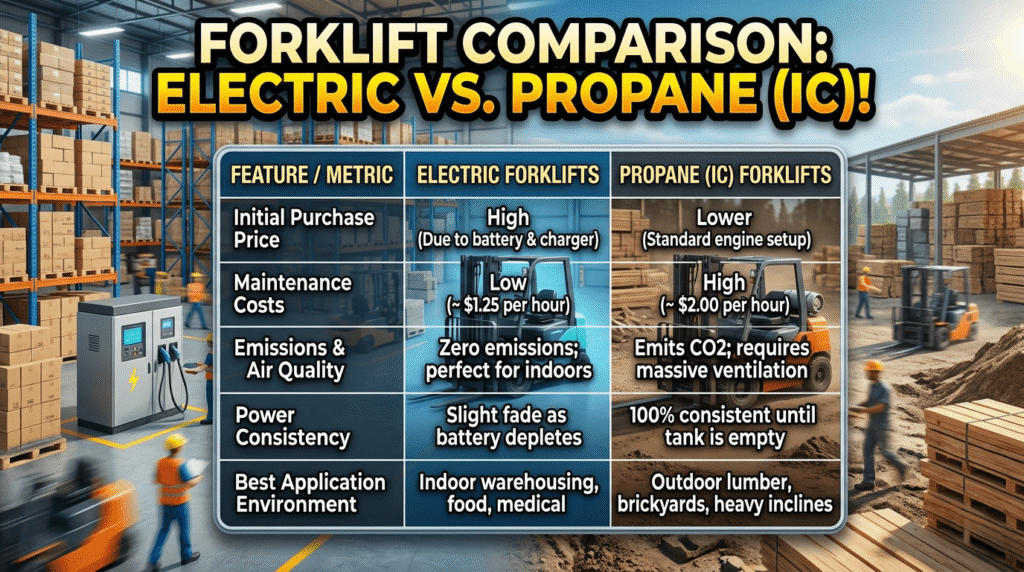
Comparative Overview: Electric vs. Propane Forklifts
In case you want to have a very quick overview of the differences between the two and want to be able to decide which one to buy very easily, then we have given below, a very simple, side-by-side comparison table for your ready reference.
| Feature / Metric | Electric Forklifts | Propane (IC) Forklifts |
| Initial Purchase Price | High (Due to battery & charger) | Lower (Standard engine setup) |
| Maintenance Costs | Low (~$1.25 per hour) | High (~$2.00 per hour) |
| Emissions & Air Quality | Zero emissions; perfect for indoors | Emits CO2; requires massive ventilation |
| Power Consistency | Slight fade as battery depletes | 100% consistent until tank is empty |
| Best Application Environment | Indoor warehousing, food, medical | Outdoor lumber, brickyards, heavy inclines |
FAQs on Propane or Electric Forklift
To help you decide which is better propane or electric forklift, we have gone through the top trending questions.
Which is better conveyor or electric forklift for the indoor application?
For indoor use, electric forklift is unanimously considered as the best option. They generate no tailpipe emissions so there are absolutely no concerns about carbon monoxide poisoning in the enclosed areas.
- As they work quietly, there will be no echoing in the warehouses which will allow the workers to be able to hear safety warnings and also communicate effectively.
- They do not leak engine oil, or exhaust soot, thus the floors and the inventory are kept absolutely clean.
What are the maintenance costs for propane or electric forklifts?
Electric forklifts, without a doubt, dominate the maintenance cost comparison over the span of their operation.
- Per Hour Rates: Running maintenance of electric units is about $1.25 an hour as opposed to $2.00 per hour for the propane ones.
- No Engine Fluids Required: You will never be replenishing the usage of the engine oils, radiators coolants or transmission fluids.
- More Availability: Due to the very few moving parts, the electric lifts spend very little time in the shop and most of the time working on the warehouse floor.
How long do electric forklift batteries last compared to propane tanks?
When it comes to runtime and lifespan, the power sources are pretty different in application.
- Shift Runtime: A full charge electric battery will last a normal 8 hour shift whereas a single propane tank will go for about 4 to 6 hours depending on how hard the work is.
- Refuel Speed: Propane tank replacement is quickest unchanged for less than 5 minutes whereas conventional lead-acid batteries require 8 hours to charge and 8 hours to cool down.
- Lifespan: Electric batteries, if properly maintained, may last about five years (roughly 1,500 charge cycles) whereas propane tanks can be used indefinitely as long as they are certified safe after inspection.
Do electric forklifts need a fire extinguisher like propane ones?
Although rules are a bit more complicated, not having a fire extinguisher is a safety oversight highly discouraged.
- Associates and NFPA Compliance: Extinguishers at charging stations are absolutely mandatory according to OSHA 1910.178 even if the installation on the vehicle is not explicitly required in all situations.
- Thermal Runaway Risk: High capacity batteries are prone to fires in case of short circuits and if charging is done incorrectly.
- Asset Protection: For just a few hundred dollars, investing in an extinguisher is an excellent way to protect not only the operator but also your valuable equipment.
Which forklift depreciates faster: electric or propane?
In general, propane forklifts depreciate faster than electric ones.
- Mechanical Wear: Propane lifts develop structural and mechanical degradation faster due to the continual vibration and internal combustion explosions.
- Market Demand: The secondary market for eco-friendly machineries is growing rapidly which helps in keeping electric resale values high.
- Value Retention: Provided that the battery is very well maintained and documented, electric forklifts can still retain after the first year, up to 80% of their value.
Can electric forklifts be used outdoors?
In the past, electric were only capable to be used indoors, however, today electric forklifts are being converted most of the time to be outdoor capable.
- Weather Proofing: The latest models of electric forklifts are equipped with protective measures against weather and have a sealed chassis to keep the electronics safe from dust and light rain.
- Terrain Restrictions: They are usually still using cushion tires made for concrete while propane forklifts use pneumatic tires that can go through gravel and dirt.
- Power Level: For very rugged outdoor terrains with heavy inclines, propane remains a dominant and a safer choice.
What is the initial cost difference between electric and propane forklifts?
When it comes to the upfront financial investment, it is the biggest hurdle in the case of electric fleets.
- Price to Buy: Electric forklifts are much more costly in the beginning and can even be from 20% to 40% higher in price than a comparable propane model.
- Hidden Startup Costs: Buyers also need to think about the heavy battery cost, need for special charging stations, and installation of proper electrical infrastructure.
- Return on Investment: The huge saving fuel and maintenance wise generally compensate for the initial difference in price over a period of 18 to 24 months of full operation.