2-Ton vs 3-Ton Electric Forklifts Which Capacity Do You Really Need
Choosing the right equipment for your warehouse depends not only on power but also on precision, efficiency, and long-term cost-effectiveness. When looking around material handling equipment, people usually argue 2- ton vs 3-ton electric forklifts.
But one thousand kg difference on paper is just a surface – the change is so fundamental that it affects the operations of your facility, the width of your aisles, and even the battery lifespan. We, at American Forklifts, understand that sometimes the logic of “bigger is better” fails to work in the world of modern logistics.
Choosing an undersized unit, on the one hand, increases the risk of accidents and fastens wear and tear on the parts; while, on the other hand, it will cause you to waste energy unnecessarily and limit your movements if you do pick up a heavy 3-ton model when a 2-ton one would do just fine.
This detailed article will reveal the main performance parameters, operational pros and cons, and environmental aspects of these two sizes. Whether you work with a high-density distribution center or a small retail warehouse, knowing these small details will help you purchase the right equipment that boosts production and not hampers it.
Top Specifications among 2-ton vs 3-ton electric forklifts
1. What separates 2-ton vs 3-ton electric forklifts
The most noticeable contrast of a 2-ton electric forklift to a 3-ton electric forklift is their rated lifting ability. The 2-ton type, such as Typhon VIGOR 2, for instance, can lift loads up to 4,400 lbs (roughly 2,000 kg). Meanwhile, a 3-ton one is built for bigger and heavier goods in industry and can carry up to 6,600 lbs (3,000 kg).
Always keep in mind that “capacity” means not only the greatest weight but also safety. For that, manufacturers constantly consider the load center – the distance from the fork tips to the load’s center of mass.
- Safety Thresholds: Using up 2-ton vs 3-ton electric forklifts at their maximum load significantly lowering their stability; it is always advisable to select a capacity that could be 15-20% heavier than your heaviest load.
- Structural Integrity: Masts and counterweights on 3-ton models usually are more robustly designed so that they can keep their balance even when the load is lifted high.
- Load Center Sensitivity: Taking into consideration that a 2-ton forklift might be able only to lift 1,500 kg if the load is too big or unevenly balanced, therefore, in this case, the 3-ton option would be the safer choice for pallets.
2. Maneuverability and Aisle Width Requirements
Sometimes, a 2-ton vs 3-ton electric forklift comparison isn’t about power but space planning because warehouses always have limited space, and one way to gain storage is by making aisles narrower. A 2-ton electric forklift is most likely the kind of equipment that carries a shorter wheelbase and a smaller turning radius and, therefore, is a “maneuverable marvel” in narrow aisles.
However, a 3-ton machine is mighty but usually requires more room to move around without bumping into the racks.
- Turning Radius: Typical 2-ton electric forklifts have the turning radius in the range of 2,200mm to 2,300mm, which allows the operator to work in aisles as narrow as 3.2 meters.
- Chassis Dimensions: The width of the 2-ton chassis, in most cases, is more compact (around 1,100mm to 1,230mm) and thus perfect for tight spaces where the inventory can be seen on the floor
- Operator Visibility: Little chassis turnover of a smaller unit often provides better visibility for the operator and hence is safer in a crowded warehouse.
3. Battery performance and energy efficiency
If you look at 2-ton vs 3-ton electric forklifts comparison, some people may get surprised by how much the difference in their motor power and, therefore, in the battery volume of a 3-ton forklift impacts the source of energy consumption as one of the major operation costs of the production line.
Remember that moving deadweight and heavier loads is the main concern here and that, therefore, you need a more powerful motor and battery of higher capacity when it comes to 3-ton forklifts. These days, a lot of businesses at American Forklifts (including those in the forklift battery category, that you can see at https://americanforklifts.org/category/forklift-battery/) are switching to Lithium-Ion units, which 2-ton vs 3-ton electric forklifts owners agree are the most suitable to combine the two diametrically opposite requirements: power and efficiency.
- Battery Capacity: 2-ton forklifts are likely to be compatible with a 60V/250Ah battery, whereas for the 3-ton model, you might need a battery with a higher voltage or amperage to keep the same lifting speed performance over the whole shift.
- Operational Hours: As the 2-ton is the lighter machine, it is capable of producing longer operating time (up to 8-10 hours) on a single charge than 3-ton ones which work on the same level of production.
- Charging Requirements: Most likely, heavy machines will need more frequent “opportunity charging” during breaks in order to not run out of hydraulic power in the last few hours of the shift.
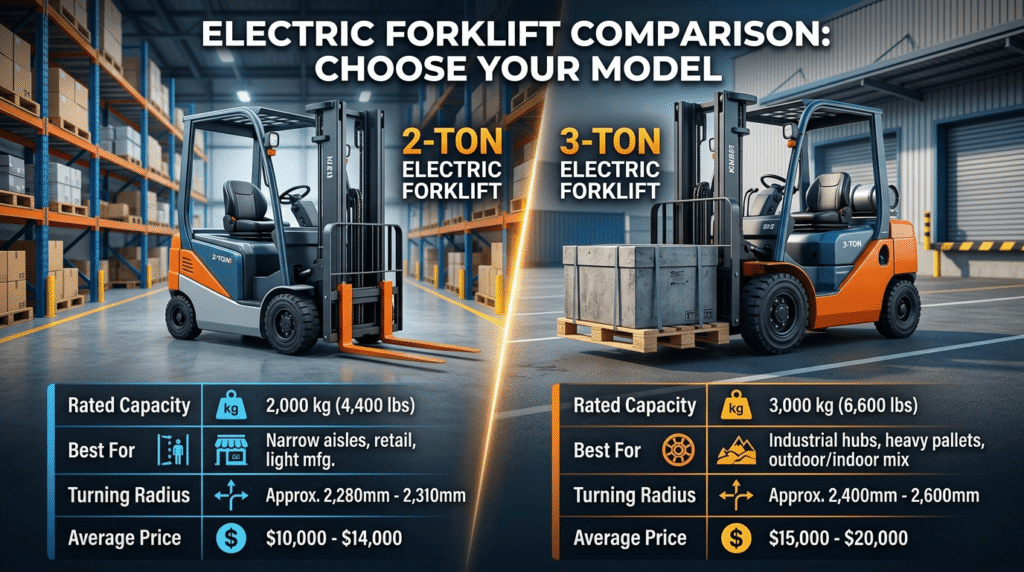
Table: 2-Ton vs 3-Ton Electric Forklift Features
| Feature | 2-Ton Electric Forklift | 3-Ton Electric Forklift |
| Rated Capacity | 2,000 kg (4,400 lbs) | 3,000 kg (6,600 lbs) |
| Best For | Narrow aisles, retail, light mfg. | Industrial hubs, heavy pallets, outdoor/indoor mix |
| Turning Radius | Approx. 2,280mm – 2,310mm | Approx. 2,400mm – 2,600mm |
| Average Price | $10,000 – $14,000 | $15,000 – $20,000+ |
4. Total Cost of Ownership (TCO) Comparison
Initial purchase price is just the beginning. When thinking about 2-ton vs 3-ton electric forklifts, you should also understand the implication of long-term maintenance and infrastructure costs.
A 3-ton forklift is our larger investment upfront; however, if your company grows, it will negate the need for buying another machine.
On the other hand, a 2-ton model set offers a faster ROI for the standard 1,000kg pallets.
Maintenance Costs: 2-ton variants usually include smaller tires and simpler hydraulic components that have lower long-term wear-and-tear costs.
Floor Wear: Weight increase due to a 3-ton machine (and possibly a 3-ton load) can do more damage to the floors, eventually leading to cracks.
Depreciation: Used 2-ton electric forklifts are quite popular among SMEs, therefore, they tend to have a better resale and a stronger value retention.
5. When/where 2-Ton Models make sense
2-ton electric forklifts are the backbone of the e-commerce and retail sectors. This size class is the best balance between speed and utility for typical movements of pallets stored consumer goods, electronic goods, or light machinery.
Several times, Typhon Hi-Lo 20 is the model that we at americanforklifts.org help our clients to purchase due to its compact size that easily fits trailers and containers.
- Container Loading: Their lower profile and lighter weight make 2-ton models ideal for driving onto loading docks and into shipping containers without exceeding floor weight limits.
- High-Shelf Stacking: Many 2-ton models are optimized for vertical reach (up to 4.5m), making them perfect for warehouses that utilize high-density racking systems.
- Indoor Cleanrooms: Due to zero emissions and quiet operation, these smaller units are the gold standard for food distribution and pharmaceutical storage.
6. 3-Ton – When to Upgrade
Sometimes 2-ton vs 3-ton electric forklifts debate comes to one point very clearly: if your materials are construction supplies, big paper rolls or heavy metal pieces, you just cannot do without a 3-ton one.
Furthermore, using forklift which is underpowered for lifting heavy loads is, actually, the #1 reason why fork breakdowns and tipovers happen.
- Mixed Load Handling: A 3-ton capacity gives the required safety margin when handling the “mystery pallets” that have varying weights and are quite common at times.
- Attachment Usage: Different attachments such as paper roll clamps or side-shifters reduce the net capacity of a forklift; typically, a 3-ton base is required in order to maintain a functioning 2-ton lift after attachments are added.
- Outdoor Transitions: Many 3-ton electric models come with larger tires and stronger chassis, which is why they are better suited to the combination of smooth indoor floors and slightly uneven outdoor loading areas that they often have to deal with.
FAQ’s – 2-ton vs 3-ton electric forklifts
What is the difference between a 2-ton and 3-ton forklift?
The main difference lies in the maximum weight that they can safely lift. A 2-ton forklift lifts up to 4,400 lbs, whereas a 3-ton one lifts up to 6,600 lbs. Besides, 3-ton models are bigger, less maneuverable, and batteries are going to be used more.
Can a 2-ton forklift lift 3 tons in an emergency?
Impossible. Lifting more than the rated capacity of a forklift can make the machine tip forward, can damage the hydraulic system, or cause the structural parts to fail catastrophically. Always stick to load plate specifications.
How wide do aisles need to be for a 3-ton electric forklift?
Usually, a 3-ton counterbalance forklift requires a minimum aisle width of 3.5 to 4 meters (11-13 feet) for safe turning and stacking, while a 2-ton model is often capable of functioning in 3.2-meter aisles.
Is a 3-ton forklift more expensive to maintain than a 2-ton?
Yes, usually the case is so. Tires, batteries and hydraulic parts are bigger and their replacement is more expensive. On top of that, increased weight leads to faster wear of floors and tires.
Which battery is better for these forklifts: Lead-Acid or Lithium-Ion?
Lithium-Ion is considered the #1 runner-up among 2-ton vs 3-ton electric forklifts according to the latest trend since it gives fast charging capability, requires no maintenance, and has a long life, though the initial price is quite high.
Do I need a different license for a 3-ton forklift compared to a 2-ton?
Basically, certification according to a particular forklift class (e.g. Class 1 Electric Counterbalance) carries a weight range that does not mention a particular weight; though operators should get “familiarization training” on the heavier unit.
How long does a 2-ton electric forklift battery last on one charge?
Typically, a 2-ton electric forklift battery lasts 6-10 hours of “active” use depending on the battery type (Lead-Acid vs. Li-Ion) and the intensity of usage.
Final Verdict: Which Capacity Do You Really Need?
It comes down to your heaviest pallet and your narrowest aisle when deciding on between 2-ton vs 3-ton electric forklift. In case if 95% of your loads are below 1,800kg and your warehouse is cramped, then the 2-ton model will be your most productive asset. Moreover, it is faster, runs cheaper, and is easier to steer.
Nevertheless, if your intention is to futureproof your business even heavy inventory comes to you or you need heavy attachments, the 3-ton model will have both the stability and power to perform industrial-grade tasks.
We at American Forklifts offer both capacity ranges in order to have your fleet well matched to the reality of your operations. Don’t allow yourself to be slowed down due to logistics that were designed with “one size fits all” in mind.