The Future of Material Handling: AI & Autonomous Forklift Technology 2026
As the industry is shifting dramatically from the purely manual mode of operation, the pace of this change is getting noticeably more rapid. Autonomous forklift technology is commonly referred to as a subclass of Autonomous Mobile Robot (AMR) which, are no longer a remote option but a real, scalable solution that has been implemented successfully to respond to the most urgent challenges of logistics sector.
The devices employ an elaborate-package-of-sensors scheme, computer vision, and AI software to find their way and perform operations without receiving instructions from a human, thus ensuring constant efficiency throughout the day.
The industry is gradually moving from trial stage of single-asset to multi-site program with standard Key Performance Indicators (KPIs) that reflect the trust in the forklift technology measurable Return on Investment (ROI) changes.
The Rise of Autonomous Forklifts: An Industry Pivot
Solving the Labor Crisis: Autonomous forklifts are essentially a technology that solves the problem of labor shortage in logistics, which is the root cause of the crisis in the industry and hence, they are instrumental in solving the labor crisis problem, by simply taking over the monotonous tasks of fast-changing/trailer loading/unloading, and inbound-to-put away-flow of works, thereby releasing human workers for more complex and valuable tasks.
Driving Unprecedented Consistency: Automated forklifts, unlike human drivers, whose efficiency can go down as a result of fatigue or changing shifts, are capable of keeping a programmed, great-precision work rate and accuracy at all times, thus providing stability of processes and predictable throughput 24 hours a day, seven days a week.
Scalability and Flexibility: The new generation of autonomous systems features modularity as one of its inherent characteristics. The additional vehicles in the facilities can be easily deployed and the robotic control systems can be adjusted without the facilities being substantially re-engineered, thus allowing the operations to be quickly scaled up or down depending on the current demand, which is a real-time one.
The AI and Machine – Autonomous Forklifts Technology
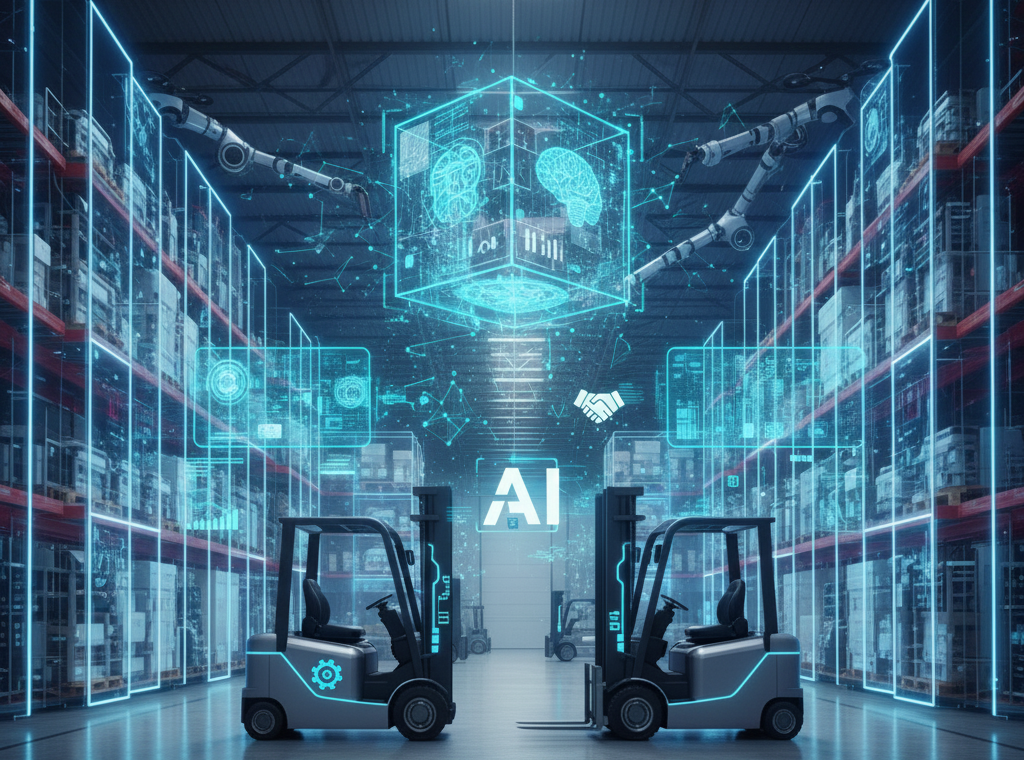
While automation is responsible for the actual movement, Artificial Intelligence and Machine Learning (ML) are the elements that provide intelligence to a mere Automated Guided Vehicle (AGV) thus making it a truly dynamic, decision-making system. AI represents the “Control Tower” of the whole fleet which is constantly optimizing operation, avoiding failures, and ensuring there is a smooth coordination between the warehouse workers, automated forklifts, and other warehouse systems like conveyors and Automated Mobile Robots (AMRs).
- Intelligent Fleet Orchestration: AI algorithms keep on analyzing the data from the real-time situations to optimize the task assignments, manage the traffic priority from the mixed human/machine aisles and coordinate movements with Warehouse Management Systems (WMS) thus eliminating bottlenecks and ensuring constraint-aware, end-to-end flow.
- Predictive Maintenance (PdM): IoT sensors that are implanted in the forklifts are constantly monitoring hundreds of parameters—from motor vibration and hydraulic pressure to battery health. ML models take this data to forecast the time before the equipment failure weeks ahead, thus issuing a maintenance alert well before the breakdown, which drastically minimizes the unexpected downtime and maintenance expenses.
- Smarter Navigation and Perception: The forklift’s perception stack is powered by advanced AI that makes use of sensor fusion (safety LiDAR, 3D cameras, and wheel odometry). This setup allows the machine to perform robust re-localization, semantic mapping, accurate fork tip guidance, and rack slot verification thus enhancing the first-pass yield for put away and retrieval operations.
Safety Beyond Compliance: The Zero-Error Mandate
Safety has always been the one factor that weighed the most in forklift operations. In 2026, the technology which is the main enabler in the shift of paradigm from mere compliance to an aggressive and almost extraordinarily successful pursuit of a zero-accident environment is making it possible. It is safer by nature, therefore, the removal of the human component from the most dull and high-risk driving tasks, whilst operator-assist features are making manual operation more forgiving than ever before.
Collision Avoidance Systems:
Automated forklifts come with a package of safety features which include stereoscopic 360° safety radar, laser scanners, and pre-programmed no-go zones. The vehicle will be stopping or re-routing in a safe way if it detects a pallet, rack, or human, thus, it is also programmed to eliminate the safety accidents that are caused by human errors or fatigue when the vehicle is stopped or re-routed instantly.
Advanced Operator Assist Tech:
Operator assist forklift technology is an indispensable feature for manually-driven forklifts. Systems like Lift Stability Monitoring and Load Stability Monitoring are at work here and they use sensors that are positioned in a vehicle to recognize the motion that is unsafe and automatically intervene by slowing down the vehicle or adjusting the lift height thus at the same time tipping and load spilling are prevented in a proactive way.
ISO and Cyber-Security Standards:
The functional safety standards such as ISO 3691-4 are becoming the minimum that needs to be met. Besides this, as forklifts are turning into connected devices, cybersecurity and IT/OT convergence become the issues that are most vital and that need to be tackled through the implementation of requirements like secure boot, encrypted communications, and patch management policies that are aimed at ensuring security for the fleet against digital threats.
The Power Strategy:
Electrification and energy density represent the two major factors that are strongly influenced by the trend of environment consciousness, which, in turn, is the main reason for the global urge to go for electricity and is directly affecting the forklift technology. The question of whether the Internal Combustion (IC) forklifts will prevail over their fork-lifted competitors or the electric models will become more popular in the market of freight trucks is definitely answered by the rise of the latter.
There is a continual loss of market share for forklifts equipped with Internal Combustion (IC) engines in favor of electric models, which is a turn that is being encouraged and supported by major technological breakthroughs in the field of batteries. The move is a must for the American facilities that are driven to lower their carbon footprint and reduce their operating costs.
| Power Source | Primary Advantage in 2026 | Application Sweet Spot |
| Lithium-Ion (Li-ion) | Fast and Opportunity Charging, High Energy Density | Two-to-three-shift operations, standard warehouse and distribution |
| Hydrogen Fuel Cell | Consistent High Power, Zero Emissions, Quick Refueling | Multi-shift, heavy-duty applications, cold storage environments |
| Electric (Lead-Acid) | Lower Initial Cost, Simple Technology | Single-shift operations, lighter duty cycles |
- The Lithium-Ion Dominance: Li-ion batteries are the main reason for the two- to three-shift operations as they are capable of supporting opportunity charging (short charging periods during natural breaks), thus, vehicle dwell time is greatly reduced and battery change-outs are completely eliminated.
- Hydrogen as a Specialty Solution: The cases of continuous load-demand of facilities that require heavy usage, or those that operate in extremely cold temperatures are the only reasons why the hydrogen fuel cell-based solutions are being chosen. They provide the stable power needed along with the fast refueling that is usually associated with IC engines thus, are zero-emission ones.
- Regenerative Braking and Efficiency: Optimizing routes is not the only thing AI-driven technology does; it also takes care of energy consumption. Contemporary electric forklifts are equipped with the feature of regenerative braking and intelligent motor control capabilities through which the battery life between the periods of the charge is extended thus, the overall energy efficiency of the fleet is maximized.
Business Models and The Human Element in 2026
The arrival of sophisticated forklift technology is changing not only the financial and human resource models that support material handling but also the equipment themselves. The high initial capital expenditure (CapEx) of the autonomous systems is being balanced by the flexible financing and the shift of labor focus, that is, the return on investment (ROI) for the operators is kept at a comfortable level.
- Robotics as a Service (RaaS): In a bid to get over the obstacle of the upfront costs, several enterprises are embracing RaaS, which is a model that changes the expenditure from capitals to operations (OpEx). This facilitates the equipment, software, maintenance, and support being merged into one monthly charge, thus, the business is aligned with the performance metrics like throughput and uptime on which the incentives are based.
- The Upskilling Mandate: The role of the human operator will not vanish; instead, it will transform. With automation taking over the repetitive driving, the manual staff members will be assigned more purposeful and skilled tasks such as goods-in control, exception handling for the automated fleet (teleoperation), and precision assembly.
- Training with VR/AR: Forward operator education will be on the agenda of continuous safety and improvement, core issues, which will get a lot of attention and the investment will be more visible. The use of Virtual Reality (VR) and Augmented Reality (AR) is a tool to re-create the most complex warehouse scenarios that are aimed to train the operators and the maintenance technicians in a secure and controlled environment before they are introduced to the live, mixed-fleet floor.

Tabular Overview – Autonomous Forklift Technology:
| Metric Category | Manual Forklift Operation | Autonomous Forklift Fleet (2026) | ROI Impact |
| Safety Incidents | High (Human Error, Fatigue) | Near Zero (Sensor Fusion, AI-Driven Avoidance) | Drastically reduced insurance/liability costs |
| Throughput Consistency | Variable (Breaks, Shifts, Driver Speed) | 24/7 Highly Consistent (Programmed Efficiency) | Increased fulfillment rate, reliable planning |
| Fleet Efficiency | Based on Manual Route Selection | AI-Optimized Routing (Real-time Dynamic Pathing) | 15-25% improvement in travel time |
| Maintenance | Reactive/Scheduled | Predictive Maintenance (PdM) (AI sensor data analysis) | Minimal unscheduled downtime, lower repair costs |
| Labor Utilization | Low Value (Driving, Moving) | High Value (Oversight, Exception Handling, Skilled Tasks) | Improved employee retention and productivity |
FAQs on Autonomous Forklift Technology
What is the main difference between an AGV and an AMR forklift?
Automated Guided Vehicles (AGVs) are limited to fixed, pre-defined routes and are usually guided by wires, magnets, or tape while. Autonomous Mobile Robots (AMRs) which also include the latest generation of AGVs use smart navigation (e.g. LiDAR and SLAM – Simultaneous Localization and MAPPING) to obtain information on the environment, dynamically calculate the best routes and safely avoid any that are unanticipated obstacle in real-time. AMRs are quite flexible and are more capable of adapting to changes in layouts.
Will Autonomous Forklift Technology replace all human drivers by 2026?
No, not by 2026. Autonomous forklifts are mainly used for the automation of the repetitive and monotonous tasks that have a low level of variance (e.g. straight-line transfers, simple put away).
Human drivers will become higher-skilled as their roles will focus be on complex exceptions, odd-shaped loads, non-standard loading/unloading operations, and fleet supervision/maintenance. A mixed fleet environment is the coming stage.
How do autonomous forklifts operate safely in aisles with human workers?
They are safe due to using a technology profile called sensor fusion. This entails safety-certified LiDAR, 3D cameras, and ultrasonic sensors, that help the machine to establish an around-the-clock 360-degree safety zone. If a person or a vehicle comes within a certain distance, AGF will properly react to safety by, e.g., slow down or stop completely, and also comply with strict international safety standards like ISO 3691-4.
Are the initial investment costs of autonomous forklifts worth the ROI?
Absolutely, the high initial cost comes with a long-term plan of savings. The ROI is highly driven by the round-the-clock productivity, labor cost savings, near elimination of product damage (due to precision), and significantly lower operational costs from predictive maintenance and energy consumption optimization. RaaS models further help in making the investment financially feasible.
What navigation technology is most common for AGFs?
The most common and robust forklift technology for autonomous forklifts is SLAM (Simultaneous Localization and Mapping together with LiDAR (Light Detection and Ranging) and camera-based vision systems. This set of tools enables the AGF to create a map of the environment and find its place on that map at the same time, thus, it ensures the exact and reliable movement in a dynamic warehouse setting.
How does AI help with battery life and sustainability?
Artificial intelligence implements intelligent charge scheduling and route optimization. It works out the most energy-saving and battery-friendly route for a given task and it also lets the forklift perform opportunity charging (predetermined inactivity periods).
In case of electric fleets, AI keeps track of battery health and strives to maintain the charge and discharge cycle at the optimum level in order to maximize the battery overall lifespan and performance.
What is the biggest challenge to mass adoption of autonomous forklifts in American warehouses?
The biggest barrier to integration is the problem of integration complexity and change management. Great effort will be needed to integrate the autonomous fleets with legacy Warehouse Management Systems (WMS) and existing infrastructure in a way that is seamless and without any dangerous disruptions.
Moreover, as the success is heavily dependent on the implementation of changes in process redesign and the training of existing workforce that will be in charge of supervising, maintaining and managing the automated systems.