Safety First: Next-Gen Sensor-Equipped Forklifts Attachments to Prevent Accidents
Welcome to AmericanForklifts.org, where we prioritize the seamless integration of industrial power and unwavering safety standards. Industrial settings like warehouses, distribution centers, and construction sites are high-stakes environments where the line between efficiency and hazard is incredibly thin. Over the decades, we have seen material handling equipment evolve from manual hoists to highly sophisticated machines.
However, with heavy loads, restrictive blind spots, and fast-paced operational demands, the risk of accidents remains a constant challenge for facility managers. Today, the most significant leap in workplace protection comes in the form of sensor-equipped forklift attachments. These technological marvels are rapidly transforming how businesses protect their most valuable assets: their workforce. By actively monitoring surroundings, correcting operator errors in real-time, and communicating with pedestrians, next-gen sensor-equipped forklift attachments are no longer just optional upgrades; they are an absolute necessity for modern, safe, and compliant operations.
The Evolution of Forklift Safety and Design
To truly appreciate the monumental leap provided by sensor-equipped forklift attachments, we must first look back at the history and fundamental design of these essential industrial vehicles. As discussed on AmericanForklifts.org, the modern forklift traces its roots back to the early 20th century, notably with the Pennsylvania Railroad’s battery-powered luggage trucks in 1906 and Clark’s revolutionary “Tructractor” in 1917.
From the beginning, these machines were designed purely for utility, capable of lifting immense weights in compact spaces. However, unlike standard automobiles, forklifts rely on rear-wheel steering for tight turning radiuses and operate with a high, variable center of gravity. When loaded, the mast, forks, and cargo create massive blind spots for the operator. Because they lack the low, balanced center of gravity found in passenger cars, they are notoriously susceptible to tip-overs if not operated with extreme precision.
Traditional safety relied entirely on the driver’s training, situational awareness, and rudimentary tools like rearview mirrors. Fortunately, the introduction of modern sensor-equipped forklift attachments is bridging the gap between human limitation and absolute spatial awareness, ensuring that the heavy counterweights and limited visibility inherent to forklift design no longer translate to inevitable workplace accidents.
- Rear-Wheel Steering Dynamics: Unlike automobiles, forklifts steer from the rear, which allows for navigation in tight warehouse aisles but creates a swinging backend that can easily strike nearby pedestrians or racking systems if unmonitored.
- Variable Center of Gravity Challenges: A forklift’s center of gravity shifts drastically depending on the height and weight of the load, making it highly prone to tip-overs on uneven terrain or during sharp turns.
- Severe Blind Spots: The front mast, hydraulic lines, and large pallets of cargo severely restrict an operator’s forward visibility, making technological interventions like sensor-equipped forklift attachments critical for detecting hidden obstacles.
What Are Sensor-Equipped Forklift Attachments?
Sensor-equipped forklift attachments represent a groundbreaking category of aftermarket add-ons and integrated tools designed to give forklifts a “digital sixth sense” in chaotic work environments. These intelligent systems combine traditional mechanical attachments—such as forks, side-shifters, jibs, and clamps—with advanced digital arrays that actively scan the environment.
Whether they are utilizing ultrasonic sound waves, infrared heat detection, or high-frequency radar, these attachments continuously feed data to an onboard computer system.
When a potential collision with a pedestrian, structural column, or another vehicle is detected, the sensor-equipped forklift attachments instantly deploy warnings. These warnings can range from loud audible alarms and flashing LED lights to haptic feedback that vibrates the operator’s seat or steering wheel.
In the most advanced iterations, these attachments can even integrate with the forklift’s telemetry system to automatically limit travel speed or engage the braking mechanism before a catastrophic impact occurs. By removing the sole reliance on human reaction times, sensor-equipped forklift attachments provide a proactive, fail-safe layer of protection that operates relentlessly throughout the longest warehouse shifts.
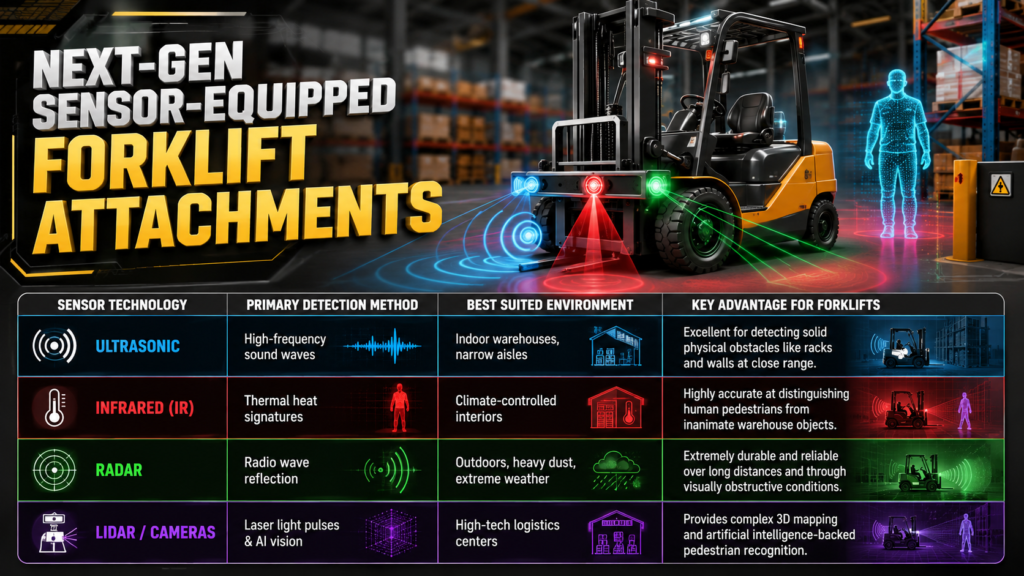
- Ultrasonic Sensors: These systems emit high-frequency sound waves that bounce off nearby physical obstacles, calculating the exact distance to prevent reverse collisions and side-swipes in narrow aisles.
- Infrared Detection: By detecting the thermal heat signatures of human bodies, infrared sensor-equipped forklift attachments can accurately distinguish between a stack of inanimate pallets and a warehouse worker stepping into a blind spot.
- Radar Technology: Utilizing radio waves, radar sensors offer long-range, omnidirectional detection capabilities that remain highly reliable regardless of poor lighting, thick dust, or extreme warehouse temperatures.
Key Benefits of Upgrading to Smart Safety Attachments
The decision to invest in sensor-equipped forklift attachments yields an unparalleled return on investment, primarily through the drastic reduction of workplace injuries and costly product damage. Every year, thousands of forklift-related accidents result in severe injuries, devastating fatalities, and millions of dollars in OSHA fines and workers’ compensation claims. By outfitting your fleet with sensor-equipped forklift attachments, you create an active shield around your machinery.
These systems establish a virtual perimeter, often referred to as an “exclusion zone,” which instantly alerts operators the moment a pedestrian breaches the safe operating distance. Beyond human safety, these smart attachments heavily mitigate damage to inventory and facility infrastructure. For instance, fork leveling sensors prevent operators from spearing products or dragging pallets, while proximity sensors stop accidental impacts with warehouse racking.
Furthermore, equipping your fleet with sensor-equipped forklift attachments inherently fosters a robust culture of safety. When employees see management investing in next-gen protective technology, it boosts morale, increases overall operational confidence, and drastically reduces the anxiety associated with working alongside heavy industrial machinery.
- Proactive Hazard Detection: Instead of relying on a driver to notice a hazard in a split second, the technology proactively identifies threats from all angles and initiates preventative alerts before an accident happens.
- Significant Cost Reductions: Preventing just one major collision pays for the investment in sensor-equipped forklift attachments by avoiding damaged inventory, broken racking systems, and costly medical or legal liabilities.
- Improved Regulatory Compliance: Utilizing advanced sensor technology helps warehouses easily meet and exceed stringent local safety mandates and OSHA regulations, ensuring a fully compliant and protected workforce.
Comparing the Core Sensor Technologies
Understanding the nuances of the hardware powering your sensor-equipped forklift attachments is essential for selecting the right configuration for your unique industrial environment. Not all warehouses operate under the same conditions; cold storage facilities, dusty construction sites, and bustling e-commerce fulfillment centers all face distinct environmental challenges.
Therefore, the effectiveness of a sensor system heavily depends on its underlying technology. Below is a comprehensive tabular breakdown of the primary sensor types used in modern forklift safety attachments to help facility managers make informed decisions.
Table: Next-Gen Sensor-Equipped Forklifts Attachments
| Sensor Technology | Primary Detection Method | Best Suited Environment | Key Advantage for Forklifts |
| Ultrasonic | High-frequency sound waves | Indoor warehouses, narrow aisles | Excellent for detecting solid physical obstacles like racks and walls at close range. |
| Infrared (IR) | Thermal heat signatures | Climate-controlled interiors | Highly accurate at distinguishing human pedestrians from inanimate warehouse objects. |
| Radar | Radio wave reflection | Outdoors, heavy dust, extreme weather | Extremely durable and reliable over long distances and through visually obstructive conditions. |
| LiDAR / Cameras | Laser light pulses & AI vision | High-tech logistics centers | Provides complex 3D mapping and artificial intelligence-backed pedestrian recognition. |
- Environmental Matching: Choosing the right sensor-equipped forklift attachments requires assessing your facility’s specific climate; for example, avoiding optical cameras in highly dusty environments where lenses can easily be obscured.
- Multi-Sensor Integration: The most robust safety setups do not rely on just one technology; they combine ultrasonic and infrared capabilities to ensure foolproof detection of both structural objects and human workers.
- Customizable Exclusion Zones: Modern sensor technologies allow managers to program specific alert distances, ensuring that warnings are tailored precisely to the speed limits and aisle widths of their particular facility.
Implementing Sensor-Equipped Forklift Attachments into Your Workflow
Purchasing high-quality sensor-equipped forklift attachments is only the first step; successful implementation requires strategic integration and comprehensive workforce training. Introducing new technology into an established warehouse routine can sometimes face resistance, especially if operators feel the safety alarms are too sensitive or disruptive to their speed of work. To overcome this, management must prioritize proper calibration of the sensor-equipped forklift attachments, ensuring that exclusion zones are set accurately to minimize “false positive” alarms that lead to alert fatigue. Furthermore, a holistic safety approach must be adopted. Operators need hands-on training to understand how the visual, haptic, and audio signals function, while pedestrians must be educated on how the system protects them. Routine maintenance is equally critical. Just as operators inspect tires, fluid levels, and hydraulics during their daily pre-shift checks, the lenses, wiring, and software interfaces of the sensor-equipped forklift attachments must be examined to guarantee they are functioning flawlessly.
- Combatting Alert Fatigue: Sensors must be precisely calibrated to the specific environment to avoid constant, unnecessary alarms, ensuring that when a warning triggers, operators take it seriously.
- Comprehensive Staff Training: Both forklift operators and floor pedestrians must be extensively trained on how the sensor-equipped forklift attachments work and what specific actions to take when an alarm sounds.
- Mandatory Pre-Shift Inspections: Daily maintenance routines must be updated to include wiping down sensor lenses, checking for frayed wiring, and testing the audio-visual alarms of the attachments before starting a shift.
FAQs Sensor-Equipped Forklift Attachments
What is a pedestrian warning system for forklifts?
A pedestrian warning system is a comprehensive safety mechanism designed to alert both the forklift operator and nearby workers of each other’s presence to avoid collisions. Utilizing sensor-equipped forklift attachments, these systems project visual cues (like blue or red LED spotlights on the floor), emit audible alarms such as buzzers, and use proximity sensors to detect movement. They are essential in high-traffic industrial environments where blind spots are prevalent.
What are the pedestrian rules for forklifts?
While sensor-equipped forklift attachments greatly improve safety, strict pedestrian rules must still be enforced. Workers should always use designated walkways, make deliberate eye contact with the forklift operator before crossing their path, and never walk directly behind a moving forklift. Additionally, wearing high-visibility clothing and avoiding mobile phone distractions in active zones are critical foundational safety rules.
What is a pedestrian detection system?
A pedestrian detection system is an advanced technological solution that actively identifies and tracks human presence near heavy machinery. Using infrared, ultrasonic, or radar-based sensor-equipped forklift attachments, the system can differentiate between objects and people. If a person steps into a predefined danger zone, the system triggers immediate warnings and may even interface with the forklift to automatically slow the vehicle down.
How do sensor-equipped forklift attachments improve safety?
These attachments eliminate the margin of human error by providing 360-degree real-time monitoring of a forklift’s environment. By automatically detecting hazards, sounding alarms, and projecting warning lights before an operator even sees the obstacle, sensor-equipped forklift attachments drastically reduce the likelihood of fatal crushes, structural collisions, and costly inventory damage.
What types of sensors are used in forklift safety attachments?
The most common technologies embedded in sensor-equipped forklift attachments include ultrasonic sensors (which use sound waves for close-range obstacle detection), infrared sensors (which detect human heat signatures), and radar sensors (which use radio waves for long-range detection in challenging environments). Some modern systems also utilize AI-powered optical cameras.
How do forklift proximity alert systems work?
Proximity alert systems work by generating a digital “exclusion zone” or virtual bubble around the forklift. Using sensor-equipped forklift attachments, the system constantly measures distances to nearby objects or tracking tags worn by pedestrians. If the safe boundary is breached, the system instantly triggers flashing lights, loud sirens, and seat vibrations to halt operations safely.
Do sensor-equipped forklift attachments replace driver training?
Absolutely not. While sensor-equipped forklift attachments are incredibly powerful tools that enhance safety, they are meant to supplement, not replace, certified operator training. Operators must still undergo rigorous OSHA-compliant training to understand load capacities, center of gravity physics, and proper maneuvering techniques, while utilizing the sensor technology as an advanced secondary safety net.
Keywords Optimization:
- Focus Keyword: sensor-equipped forklift attachments
- Primary Keywords: forklift safety, prevent forklift accidents, forklift pedestrian alert systems, warehouse safety equipment
- Secondary Keywords: next-gen forklift technology, forklift proximity sensors, OSHA forklift compliance, industrial material handling, forklift blind spots, pedestrian detection system