
How to Negotiate a Better Deal on a Forklift Purchase in 2026
Walking into an equipment dealership without a game plan in 2026 is an easy way to burn tens of thousands of dollars. The industrial equipment market has changed dramatically over the last couple of years. We aren’t dealing with the severe supply bottlenecks of the early 2020s anymore; production lines caught up, dealer yards have machines sitting on the pavement, and the rapid shift toward lithium power and onboard telemetry has rewritten the pricing playbook. Here comes the best Forklift purchase in 2026 for efficient and productive work process.
At the same time, dealers are trying to make up for lost margin by pushing bundled software packages, proprietary charger setups, and aggressive service retainers. If you treat a forklift purchase in 2026 like buying a used pickup truck, you are going to get fleeced on back-end fees, freight charges, and inflated battery replacement costs.
Getting a serious discount requires knowing what the dealer actually paid, what their inventory carrying costs look like, and how to pick apart their quote line by line. Platforms like americanforklifts.org give buyers an immediate edge by laying out real market comps before anyone ever steps foot on a showroom floor, turning what used to be an opaque guessing game into a straightforward business transaction.
The 2026 Forklift Market Reality Check
Before you start haggling over numbers, you have to realize what dealers are up against right now. Interest rates haven’t made floor-planning cheap, meaning every month a machine sits unsold under a dealer’s canopy, it eats away at their profit margin.
Electric machines—specifically integrated lithium-ion trucks—are now outselling internal combustion units in almost every light-to-medium indoor warehousing category. Because manufacturers have flooded the market with electric models, dealers are under heavy corporate pressure to hit volume bonuses on their battery-electric inventory.
Meanwhile, standard propane and diesel units have become niche workhorses for lumber yards, ports, and heavy fabrication shops, which means their pricing moves differently. If you are shopping for electric gear, your leverage comes from excess supply and competing battery chemistries; if you are shopping for heavy-capacity diesel, your leverage lies in finding older inventory that a dealer wants off their books before quarterly tax assessments hit. Factoring these realities into your upcoming forklift purchase in 2026 changes your entire negotiation posture from defensive to offensive.
- Dealer Inventory Glut: Most local regional dealerships are carrying surplus inventory of Class I and Class II electric lifts, giving you room to push for immediate invoice markdowns.
- The Battery Packaging Game: Sales reps often quote basic lead-acid or undersized lithium packs to keep the initial price looking artificially low, only to hit you later with massive charger upgrade charges.
- Software and Telematics Push: Dealers receive kickbacks from manufacturers for signing customers up for monthly fleet telemetry subscriptions, giving you an easy bargaining chip to trade away or discount.
Doing Your Homework Before You Talk Numbers
Nothing kills your bargaining power faster than telling a salesperson, “I need something that lifts around five thousand pounds.” That single sentence tells them you haven’t calculated your duty cycle, your clear mast clearance, or your aisle dimensions, which invites them to spec out an oversized, overpriced machine with options you will never use.
Before requesting a single quote, pull your team together and log actual warehouse metrics: your heaviest routine pallet, your maximum rack beam height, the exact width of your tightest cross-aisle, and how many hours a day that truck will actually have forks under load.
If your operators are running two-hour sporadic shifts unloading box trucks at a dock, you don’t need an industrial-duty, sealed-cabin pneumatic unit with rapid opportunity charging. Conversely, buying an under-spec machine to save four grand upfront guarantees blown hydraulic seals and premature mast wear within eighteen months.
Running your numbers through the sizing guides on americanforklifts.org will help you pinpoint the exact capacity and mast configuration you need, preventing expensive dealer upsells before discussions even start.
- Audit Actual Lift Heights: Measure your top rack shelf plus six inches of lifting clearance; over-specifying mast height adds substantial steel weight, lowers overall battery run-time, and inflates the base price.
- Track Shift Duty Cycles: Document whether your machine runs continuously across three shifts or intermittently across one, which determines whether expensive fast-charging battery packs are genuinely required.
- Inspect Surface Conditions: Document every floor transition, ramp slope, and outdoor gravel strip to ensure you negotiate the correct tire compound—cushion versus pneumatic—without paying for field retrofits.
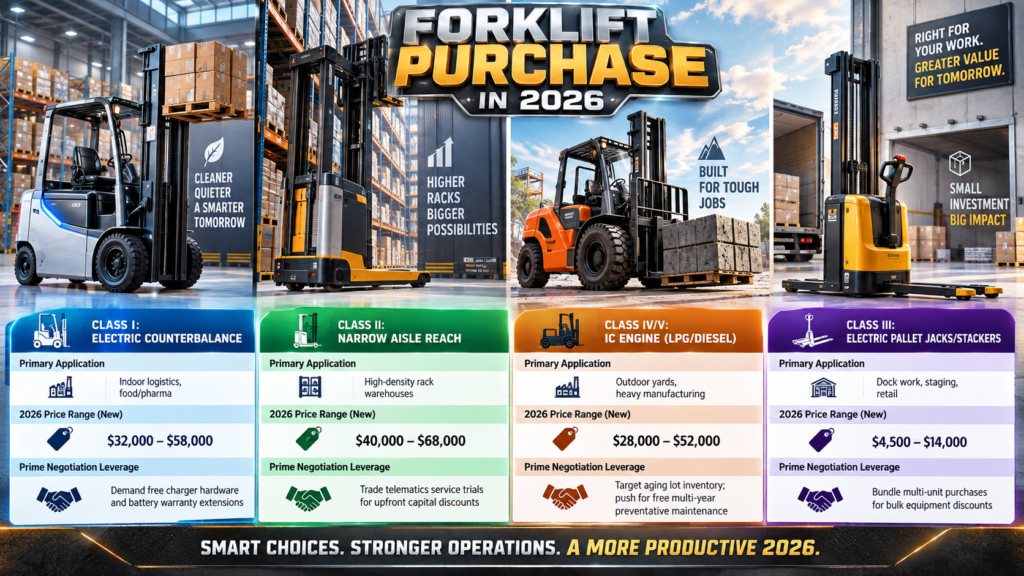
Table: Forklift Purchase in 2026
| Lift Category | Primary Application | 2026 Price Range (New) | Prime Negotiation Leverage |
| Class I: Electric Counterbalance | Indoor logistics, food/pharma | $32,000 – $58,000 | Demand free charger hardware and battery warranty extensions |
| Class II: Narrow Aisle Reach | High-density rack warehouses | $40,000 – $68,000 | Trade telematics service trials for upfront capital discounts |
| Class IV/V: IC Engine (LPG/Diesel) | Outdoor yards, heavy manufacturing | $28,000 – $52,000 | Target aging lot inventory; push for free multi-year preventative maintenance |
| Class III: Electric Pallet Jacks/Stackers | Dock work, staging, retail | $4,500 – $14,000 | Bundle multi-unit purchases for bulk equipment discounts |
Practical Haggling Tactics That Move the Needle
When you are ready to solicit bids, never ask for a single machine quote from a single regional dealer. Get three competing quotes for similarly spec’d units from different brands, and make sure each dealer knows they are actively competing against other local suppliers.
The key to securing a serious discount on your forklift purchase in 2026 is unbundling their pricing sheet. Sales reps love to drop a single “out-the-door” figure that quietly buries freight, prep, battery installation, and dealer documentation fees.
Tell them you want an itemized breakdown showing the chassis cost, the mast and carriage, the battery and charger, the destination freight, and dealer prep. Once those line items are out in the open, start chipping away. Dealer prep is almost pure markup, freight can often be handled cheaper through your own freight broker, and battery chargers are routinely marked up by forty percent over direct-from-manufacturer costs.
- Target the Last Week of the Quarter: Sales representatives and branch managers have aggressive manufacturer quotas tied to volume kickbacks; timing your final purchase order for late March, June, September, or December yields instant price flexibility.
- Challenge Hidden Add-On Fees: Scrutinize charges labeled as “PDI” (Pre-Delivery Inspection), “Rigging,” or “Local Delivery,” and refuse to pay retail rates for tasks the dealer’s shop does as standard intake.
- Play Brand Agnostic: Even if your drivers love a specific color of paint, maintain that you are willing to switch to a competitor’s machine if the total numbers make more operational sense.
Financing, Leasing, and Protecting Cash Flow
How you pay for your equipment dictates how much room the dealer has to play with the numbers. Paying cold cash does not always guarantee the lowest price anymore because dealerships make substantial back-end commissions by placing finance paper with their captive lenders.
If you walk in offering straight cash, the sales manager loses their financing spiff, which might actually make them firmer on the equipment’s base price. A smarter tactic is negotiating the bottom-line asset cost first while letting them believe you plan to use their in-house financing, then comparing their interest rates against your credit union or commercial bank.
If you are considering leasing, watch out for fair-market-value (FMV) lease traps where the end-of-term residual is left vague, or return clauses that charge you exorbitant fees for minor paint scratches and regular mast roller wear. Always negotiate the return conditions and hour-overage rates before signing on the dotted line.
- Weigh $1-Buyout vs. FMV Leases: Opt for a capital lease ($1 buyout) if you intend to run the machine into the ground, or an FMV lease only if you cycle equipment every three to four years to avoid battery degradation.
- Scrutinize Hour-Meter Penalties: Typical leases cap usage at 1,500 to 2,000 hours per year; negotiate higher operational thresholds upfront if your warehouse runs extended or double shifts.
- Secure Guaranteed Buyback Pricing: If purchasing outright, make the dealer put a written, minimum trade-in value into the contract for year three and year five, safeguarding your future equity.
Using AmericanForklifts.org to Level the Playing Field
The single biggest disadvantage buyers face on the dealership lot is asymmetric information: the sales manager knows what every machine within two hundred miles sold for, and you only know what they are telling you. That power dynamic vanishes when you use americanforklifts.org.
By researching verified pricing distributions, equipment specs, and dealer reviews across a broad digital network, you enter discussions with hard market data. You can pull up actual transaction averages for specific lift capacities, spot regional pricing differences, and discover whether a nearby dealer is holding excess refurbished units that deliver the same operational throughput for half the capital outlay. Rather than letting a local sales rep dictate what represents a “good deal,” you can benchmark their proposal against nationwide inventory standards, ensuring you extract every bit of value from your capital expenditure.
- Cross-Reference Regional Pricing: Use real-time marketplace data to see what comparable lift trucks are commanding in adjacent markets, forcing local dealers to stay competitive.
- Filter Certified Pre-Owned Units: Compare new inventory pricing directly against thoroughly vetted, low-hour refurbished machines to see if buying used makes better financial sense.
- Direct Dealer Contact Without Middlemen: Connect with accredited sellers who understand that online buyers expect clear, upfront numbers rather than traditional showroom back-and-forth games.
Frequently Asked Questions – Forklift Purchase in 2026
What is the average cost of a forklift in 2026?
Expect to pay between $28,000 and $45,000 for a standard 5,000-lb capacity internal combustion forklift running on LP gas. If you are stepping up to an electric counterbalance unit with a lithium-ion battery and an industrial high-output charger, base pricing typically runs from $38,000 to $62,000 depending on mast stage options and hydraulic accessories. Specialty warehouse equipment like narrow-aisle reach trucks generally starts around $42,000, while basic electric walkie stackers can be picked up between $6,000 and $12,000.
Is it better to buy a new or used forklift in 2026?
It comes down strictly to your annual operating hours. If the machine will run for more than four hours a day across a standard five-day work week, buy new or certified low-hour pre-owned; the warranty coverage and avoided downtime easily offset the higher capital cost. If you just need a yard truck to unload two flatbeds on Tuesdays and Thursdays, spending top dollar on a new machine is a waste of money. A clean, inspected used unit with under 4,000 operating hours will handle intermittent duty for years at a fraction of the cost.
How long do lithium-ion forklift batteries actually last?
Under typical warehouse working conditions, a quality lithium-ion battery pack delivers between 3,500 and 5,000 full charging cycles before its capacity drops down to eighty percent. In a single-shift facility that practices consistent opportunity charging during breaks, that equates to roughly eight to ten years of reliable daily service. They comfortably outlast traditional lead-acid batteries by more than double the lifespan, completely eliminate the need for dedicated watering stations, and do not suffer from acid spill corrosion.
What factors make up the true total cost of ownership (TCO) for a forklift?
The initial purchase price represents only about twenty to thirty percent of what that machine will cost your business over its working life. The remainder goes toward operator wages, preventative maintenance, replacement tires, hydraulic fluid flushes, unplanned breakdown repairs, and utility or fuel expenses. This is why spending an extra few thousand dollars upfront on an energy-efficient electric truck often saves tens of thousands in fuel and reduced mechanical maintenance over a five-year window.
Are there government tax incentives for buying electric forklifts in 2026?
Yes. Depending on your state and county regulations, there are substantial clean-energy grant programs, utility rebates, and accelerated depreciation allowances designed to push diesel and propane fleets toward zero-emission electric. Regions with strict air-quality rules frequently offer clean-fuel voucher programs that can slash several thousand dollars off the purchase price of an electric machine and its charging infrastructure. Check with your accountant about Section 179 deductions as well, which allow immediate expensing of qualified equipment.
Should I rent or buy a forklift for a growing business?
Rent if you are dealing with short-term seasonal surges, working on an off-site contract with an uncertain end date, or trying to protect cash reserves while securing commercial bank financing. Rental agreements carry zero maintenance liability for standard wear and tear, making costs predictable. However, if your equipment utilization is steady and ongoing, renting becomes a money pit after twelve to eighteen months. At that point, financing a purchase build equity and gives you an asset you can borrow against or resell down the line.
How do I negotiate maintenance and warranty packages during the purchase?
Never accept the basic one-year factory bumper-to-bumper warranty without pushing for more. Demand that the dealer throw in a three-year or 5,000-hour powertrain and structural mast warranty as a condition of the sale. When it comes to scheduled service contracts, refuse flat-rate hourly billing; instead, negotiate a capped, fixed-rate preventative maintenance plan that covers routine fluid changes, filter replacements, and safety inspections for the first twenty-four months of operation.