Outdoor Forklifts: Choosing the Right Model for Construction and Yard Work
Take a standard warehouse forklift out onto an active job site, and you will get it stuck within ten minutes. Anyone who has ever watched a cushion-tire lift sink up to its drive axle in soft clay knows the sinking feeling—and the repair bill—that follows.
Warehouses are predictable, paved, and dry. Job sites and outdoor supply yards are anything but. Between rain-soaked gravel roads, ruts left behind by haul trucks, hidden curbs, and shifting grades, moving materials outdoors requires a completely different class of machinery. That is where purpose-built outdoor forklifts come in.
At American Forklifts, we spend our days helping project managers, yard supervisors, and contractors match their daily workloads with iron that can take a beating without quitting halfway through a shift.
If your crew spends their mornings unloading 60-foot flatbeds in the mud or stacking dense dimensional lumber in driving sleet, picking the right outdoor forklift isn’t just an equipment purchase—it determines whether you stay on schedule or lose money waiting on a tow rig.
What Actually Separates Outdoor Forklifts from Warehouse Rigs?
The basic premise looks familiar: you have a mast, a set of forks, a counterweight, and an operator station. But underneath the sheet metal, an outdoor forklift is built like an earthmover rather than an indoor material mover.
Indoor models rely on hard, compact cushion tires that bear massive weight over flat concrete, leaving barely three or four inches of clearance below the chassis. Run that over a rock or a discarded 2×4 on a job site, and you will bottom out or punch a hole in the steering axle.
Outdoor forklifts—often classified under OSHA Class VII rough-terrain equipment—are designed with heavy steel plating, reinforced articulated steer axles, and massive structural frames designed to flex without cracking when a wheel suddenly drops into a six-inch rut. The weight distribution sits lower and broader, offsetting the dangerous lateral sway that happens when carrying bundles of rebar or structural framing across uneven grades.
- Deep-Lug Pneumatic Tires: These tires provide the footprint you need on soft soils, absorbing surface shocks and maintaining traction where smooth tires simply spin out.
- High Ground Clearance: With standard clearance running anywhere from 8 to 14 inches, the undercarriage skips right over curbs, deep mud ruts, and scattered job site scrap without high-centering.
- Locking Differentials & 4WD: When one wheel starts slipping in wet silt, power shifts automatically to the wheels that still have purchase, keeping the machine moving forward with a full load.
Picking the Engine: Diesel Muscle, Propane Versatility, or Electric Quiet?
The engine debate comes down to where you work and how fast you need to refuel. For pure outdoor grit on unpaved ground, diesel remains the undisputed king across construction sectors.
Modern Tier 4 Final diesel engines deliver unrelenting low-end torque, letting you push through thick slush and climb steep site ramps without stalling out. The drawback? You have to manage DEF, exhaust regen cycles, and fuel delivery logistics on remote sites.
If your machine splits time between open-air storage yards and enclosed staging sheds, liquid propane gas (LPG) hits the sweet spot. You swap out a 33-pound steel tank in three minutes and keep moving, without smoking your indoor crew out with heavy diesel fumes.
Meanwhile, heavy electrics have quietly become serious contenders. Older battery platforms couldn’t survive rain or supply the continuous draw needed for rough terrain, but modern 80-volt and lithium-powered outdoor forklifts now carry sealed, water-resistant drive components that shrug off wet conditions while slashing routine fluid maintenance to near zero.
- Diesel Engines: The gold standard for raw pulling power and constant multi-shift operation on muddy commercial sites, especially when lifting over 8,000 pounds.
- Propane (LPG): Clean enough for open breezeways and warehouse doorways, with fast tank swaps that avoid downtime from battery charging cycles.
- Sealed Heavy Electric: Offers zero emissions, instant torque off the line, and drastically fewer moving parts, provided you have reliable 480V charging power set up on-site.
Construction Site Demands: Rough Ground, Ramps, and Rapid Logistics
A construction site is a logistical bottleneck waiting to happen. Delivery flatbeds show up on highway tires; they cannot drive into the mud pits where framing or foundation work is happening. The outdoor forklift acts as the site’s dedicated freight shuttle, taking materials off the trailer at the curb and hauling them straight to the trades.
This work introduces dynamic forces you never encounter in a distribution facility. When you haul three pallets of cinder blocks across a 15% gravel incline, your lift truck’s brakes, transmission cooling, and mast rigidity get tested to their absolute limits.
If your site involves multi-story staging, a straight-mast rough terrain forklift might not cut it, pushing you toward a telehandler or a variable-reach outdoor model that can boom out across scaffolding, second-story floor decks, or foundation walls without forcing the machine to drive onto freshly backfilled trenches.
- Offloading and Staging: Safely stripping down 40-foot flatbeds stacked with drywall, structural timber, or mechanical equipment right at the site perimeter.
- Navigating Unpaved Inclines: Managing heavy payload transfers up cut-dirt access ramps without overheating transmissions or suffering runaway rollback.
- Elevated Placement: Using high-reach masts or telescopic booms to feed materials straight to second-floor decks, masonry scaffolds, or flat commercial roofs.
Running Busy Yards: Lumber, Structural Steel, and Bulk Materials
Industrial yards present a totally different set of headaches than raw dirt sites. A lumber yard or pipe distribution facility might have packed gravel or weathered asphalt, but the sheer physical size of the loads makes the job stressful. Long loads—like 24-foot glulam beams or 40-foot steel channel—create severe tipping leverage if the operator hits a bump while turning.
Counterbalanced outdoor forklifts operating in these environments need extra-wide fork carriages, hydraulic fork positioners, and side-shifting attachments so the driver can adjust their pick without hopping down into the mud twenty times a shift. In agricultural chemical yards or bulk aggregate storage, dust is the silent killer.
A fine cloud of limestone, fertilizer dust, or sawdust will choke standard warehouse radiators within days. Dedicated yard forklifts run heavy-duty cyclone pre-cleaners and reversible cooling fans that blow accumulated debris out of the radiator cores automatically.
- Long-Load Stabilization: Utilizing wide carriages and dual front drive tires to stop wide bundles of pipe or lumber from bouncing off the forks.
- Dust and Particulate Defense: Outfitted with specialized engine air pre-cleaners and sealed alternators that prevent abrasive grit from chewing up the engine internals.
- Continuous Heavy Cycling: Operating 10 to 12 hours a day across hot, baking blacktop or crushed limestone without experiencing hydraulic fluid fade.
Load Capacity and Mast Geometry: Avoid the Derating Trap
One of the costliest errors buyers and fleet renters make is reading the data plate at face value. A machine rated for 6,000 pounds does not mean you can pick up any 6,000-pound object anywhere you want.
Forklift capacities are almost universally calculated around a 24-inch load center—meaning the balance point of the load sits two feet out from the vertical face of the forks. When you pick up a broad pallet of insulation, a heavy mechanical skid, or an 8-foot prefabricated truss, your load center jumps to 36, 48, or even 60 inches out.
That shift turns your load into a long lever working against the machine’s counterweight, dramatically lowering its real-world lifting ceiling. Elevating that load adds another layer of physics; as the mast stages extend upward, chassis sway multiplies, and the safe operating capacity drops further. If you routinely lift 5,000 pounds, buying a 5,000-pound capacity outdoor forklift is cutting it dangerously close. Spec your machine for at least 20% to 25% above your heaviest real-world pick.
- Load Center Calculation: Always verify how wide and deep your typical product bundles sit; a 24-inch rating quickly loses half its safe lift capacity on oversized skids.
- Mast Height Derating: Account for capacity drop-offs when running three-stage masts past 15 feet in the air, where counterweight balance shifts rapidly.
- Attachment Tare Weights: Factor in the deadweight of added attachments; side-shifters, fork positioners, or heavy carpet poles all steal capacity away from your actual payload.
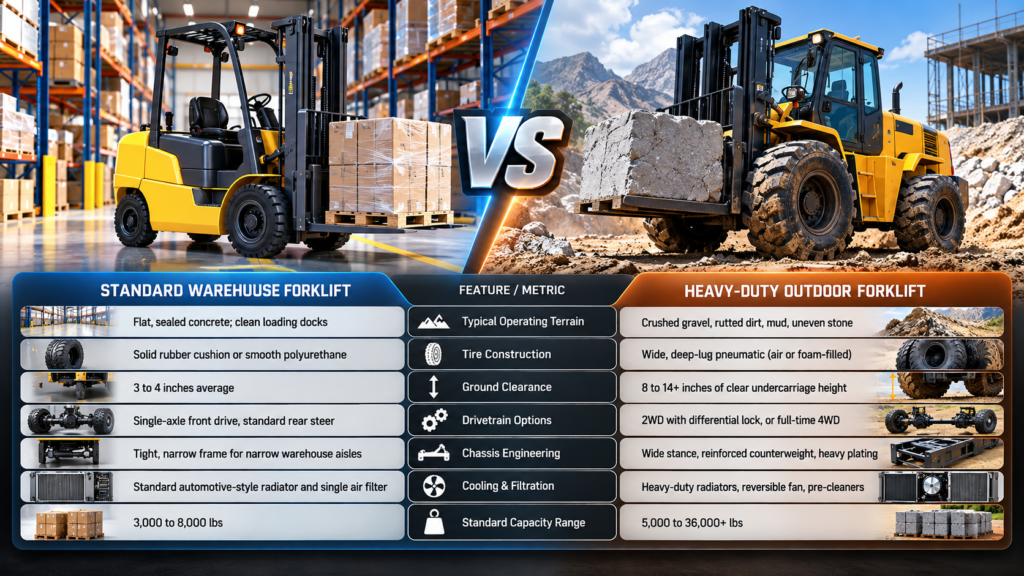
Direct Comparison: Warehouse Rigs vs. Outdoor Rough Terrain Forklifts
| Feature / Metric | Standard Warehouse Forklift | Heavy-Duty Outdoor Forklift |
| Typical Operating Terrain | Flat, sealed concrete; clean loading docks | Crushed gravel, rutted dirt, mud, uneven stone |
| Tire Construction | Solid rubber cushion or smooth polyurethane | Wide, deep-lug pneumatic (air or foam-filled) |
| Ground Clearance | 3 to 4 inches average | 8 to 14+ inches of clear undercarriage height |
| Drivetrain Options | Single-axle front drive, standard rear steer | 2WD with differential lock, or full-time 4WD |
| Chassis Engineering | Tight, narrow frame for narrow warehouse aisles | Wide stance, reinforced counterweight, heavy plating |
| Cooling & Filtration | Standard automotive-style radiator and single air filter | Heavy-duty radiators, reversible fan, pre-cleaners |
| Standard Capacity Range | 3,000 to 8,000 lbs | 5,000 to 36,000+ lbs |
- Tire Footprint: Cushion tires exert intense ground pressure on tiny contact patches, while outdoor pneumatics distribute mass over a broad area to float across soft pack.
- Maneuverability vs. Stability: Warehouse units turn on a dime in 10-foot aisles, whereas outdoor rigs sacrifice ultra-tight turning radiuses to gain the wide-track stability required on slopes.
- Environmental Sealing: Outdoor wiring harnesses, alternators, and brake drums carry specialized marine-grade or weather-sealed boots to block washouts from rain and salt.
Field Maintenance: Keeping Mud and Grit from Eating Your Bottom Line
When equipment works outside, neglect turns into catastrophic failure faster than anywhere else. Mud is not just dirty; it is an abrasive paste that grinds down steer axle pins, dries out hydraulic cylinder wiper seals, and packs inside brake drums until the shoes seize up.
If your operators don’t pressure-wash the undercarriage and mast channels regularly, you will chew through bronze bushings in a single season. Fluid checks take on double importance outdoors.
Condensation builds up inside hydraulic reservoirs and fuel tanks when hot machines sit outside in cold night air, introducing water that destroys high-pressure injection pumps. Operator daily walkarounds must become non-negotiable.
Checking tire pressures on pneumatic rigs is critical: a 10 PSI drop on one front tire can introduce a dangerous lean when hoisting an 8,000-pound load twenty feet in the air.
- Daily Mast and Seal Inspections: Checking hydraulic cylinder rods for mud scoring, pitting, or dried grit that can tear internal seals and cause fluid leaks.
- Air Cleaner Blowouts: Emptying the dust evacuator valve on engine pre-cleaners daily when running in high-particulate lumber or dry grading sites.
- Tire Pressure and Lug Torque: Verifying air pressures on pneumatic tires every morning to keep the machine level, while checking lug nuts for vibration loosening on rough terrain.
FAQs: Outdoor Forklifts for Equipment Buyers and Fleet Managers
Can you run a regular warehouse forklift outside on gravel or packed dirt?
You can occasionally cross a flat, dry asphalt patch, but taking a cushion-tire warehouse lift onto gravel or unpaved dirt is asking for trouble. Cushion tires have virtually no traction on loose stone and will spin until the machine high-centers on its own belly pan. Furthermore, warehouse steer axles lack the articulation needed to track over uneven ruts, putting intense structural stress on the frame.
What is the difference between an outdoor forklift and a telehandler?
A straight-mast outdoor forklift lifts loads purely straight up and down along vertical mast rails, making it exceptionally fast and stable for loading flatbeds from the ground. A telehandler (or reach forklift) uses an extendable hydraulic boom that projects loads upward and forward. Telehandlers are better for placing loads across scaffolding or onto roof decks, but straight-mast forklifts offer higher lift capacities for their size and cost significantly less to maintain.
Are foam-filled tires worth the extra cost for outdoor yard work?
If your yard or job site has scrap lumber with nails, metal shavings, rebar offcuts, or banding wire, foam filling is worth every single dollar. Foam-filled pneumatic tires give you the large footprint and aggressive off-road tread of an air tire without the risk of an unexpected blowout. The trade-off is a rougher ride for the operator and slightly more wear on axle bearings due to the extra unsprung weight.
How much lifting capacity do I actually need for a lumber or supply yard?
Most general building supply yards find their sweet spot with a machine rated between 8,000 and 12,000 pounds. While individual pallets of mortar or roofing shingles might only weigh 3,000 to 4,500 pounds, lifting full truckload bunks of wet framing timber or deep packs of plywood pushes load centers far past the standard 24-inch mark, requiring substantial reserve capacity.
Do operators need a different certification to drive outdoor or rough-terrain forklifts?
Yes. Under OSHA standard 1910.178, forklift certification is specific to the machine class and operational environment. An operator certified solely on a Class I or Class IV indoor warehouse truck is not legally certified to operate a Class VII rough terrain forklift. Operators must undergo training that covers the physics of dynamic off-road balancing, grade traversal, and handling uneven surface hazards.
Can heavy electric forklifts survive freezing rain and winter conditions outside?
Modern outdoor-rated electric forklifts built with IP-rated (Ingress Protection) sealed enclosures can easily handle rain, snow, and wet slush. However, freezing ambient temperatures do impact battery discharge rates, particularly on older lead-acid setups. Lithium-ion systems with internal heating elements perform much better in sub-zero climates, provided you have a dry staging location for plug-in charging.
What is the typical lifespan of an outdoor forklift on an active construction site?
A well-built diesel rough terrain forklift operating in commercial construction usually logs 10,000 to 14,000 operating hours before needing a major engine or transmission overhaul. Reaching that milestone requires strict adherence to fluid change intervals, religious grease application on all steering and mast pivot points, and immediate repairs to damaged dust seals.