Electric Forklifts Meet Smart Attachments: The Future of Zero-Emission Material Handling
Walk through a busy distribution hub today, and the difference is immediate. The deafening rumble of internal combustion engines and the heavy smell of exhaust that used to hang over loading docks are largely disappearing.
Facilities across North America are trading propane tanks and diesel fuel pumps for quiet, high-efficiency battery packs. Yet swapping engines is only half the battle. If you drop standard mechanical forks onto a modern battery chassis, you are running yesterday’s operational methods on tomorrow’s power platform.
Real transformation happens when operations pair electric forklifts with smart attachments—sensor-packed clamps, multi-pallet positioners, and weighing forks that communicate directly with onboard systems.
This shift toward zero-emission material handling gives warehouse managers clean indoor air while eliminating the blind guesswork that leads to dropped loads, ruined goods, and battery drain. With real-time telemetry and automated pressure controls, electric forklifts are operating as integrated digital terminals right on the warehouse floor.
- Clean Air Standards: Transitioning to electric forklifts eliminates tailpipe soot and toxic gases, keeping indoor loading bays well within strict OSHA and EPA air quality guidelines.
- Intelligent Mechanics: Equipping zero-emission material handling trucks with smart attachments bridges physical lifting and warehouse management data.
- Lower Running Costs: Eliminating fuel deliveries, engine overhauls, and crushed merchandise creates payback timelines that traditional setups cannot match.
The Evolution of Zero-Emission Material Handling
For decades, plant managers treated battery trucks like fragile indoor runabouts. If you had to haul heavy steel coils, damp paper rolls, or double-stacked beverage skids in the rain, you ordered an engine truck and put up with the exhaust.
Early lead-acid packs struggled through cold-storage shifts, demanded dedicated acid-wash rooms, and spent half their lives tied to overnight trickle chargers. That entire dynamic flipped once lithium-ion packs and sealed AC drive motors arrived.
Today, electric forklifts deliver instantaneous torque off the line, match heavy-capacity diesel rigs pound for pound, and support fast opportunity charging during a standard 20-minute operator break. With power and runtime concerns resolved, operations began targeting the front end of the mast.
Traditional hydraulic attachments, while sturdy, were blunt instruments. Operators relied on gut instinct to set clamping pressure, which inevitably meant bent carton corners, squeezed product, or leaking hydraulic oil on clean epoxy floors. Zero-emission material handling evolved past simple battery swaps when engineers wired pressure sensors, wireless transmitters, and digital flow valves directly into the forklift’s primary electrical bus.
- Next-Gen Chemistry: Lithium-ion technology allows electric forklifts to run multi-shift rotations using brief opportunity charging sessions without battery swaps.
- Parity Under Heavy Loads: Modern high-voltage electric forklifts routinely match the continuous draw and breakout force of diesel equivalents on heavy industrial runs.
- Cleaner Working Floors: Eliminating propane exhaust, cooling fluids, and engine oil keeps indoor inventory clean and removes carbon monoxide exposure risks for ground staff.
How Smart Attachments Enhance Electric Forklifts
When you install smart attachments on modern electric forklifts, the front end of the truck gains tactile sensitivity. Consider handling delicate paper rolls or stacked appliances: if an operator pinches too hard with manual hydraulic levers, the core crushes and turns thousands of dollars of stock into scrap paper.
If they clamp too lightly, the load slips off the carriage over the first dock leveler. Smart attachments solve this through closed-loop feedback. Built-in micro-sensors read load resistance and structural density within milliseconds, adjusting the hydraulic clamp force to the minimum pressure required to hold the load securely.
Beyond preventing damaged stock, this design protects battery life. Traditional hydraulic setups pump fluid continuously at peak pressure, pulling heavy amperage from the battery whether the truck is handling lightweight tissue cartons or dense metal drums.
Smart attachments talk directly to the truck’s central computer, drawing only the exact electrical energy needed for each movement. The result is longer operational shifts, reduced wear on hydraulic seals, and far less battery strain over a multi-shift day.
- Automated Pressure Governors: Intelligent paper roll clamps and carton clamps measure load resistance to apply exact holding force without operator intervention.
- Active Battery Conservation: Smart attachments regulate hydraulic pump demand, preventing the excessive power spikes that drain electric forklifts during heavy clamp-and-shift cycles.
- Integrated Workflow Tracking: Built-in scale attachments record load weights during transit, sending verified weights to the ERP before the pallet touches racking.
Key Benefits of Upgrading to Electric Forklifts with Smart Attachments
The direct payoff of combining electric forklifts with smart attachments shows up quickly in day-to-day warehouse performance. Consider freight check-in: in a standard warehouse, a driver picks up an inbound pallet, carries it across the floor to a stationary floor scale, lowers it, waits for a ticket, picks it back up, and finally drives to a staging bay.
Smart scale attachments let the operator lift, scan, weigh, and verify a load while driving, cutting minutes off every cycle. Safety gets an immediate lift as well. When attachments feature tilt-angle monitors and dynamic center-of-gravity calculations, the truck can warn the operator or throttle lift speeds if a load approaches a tipping point.
For fleet managers, the embedded telematics offer clear operational visibility. You can see whether operators are clipping door frames, identify which trucks sit idle during peak hours, and spot thermal spikes in hydraulic lines long before a seal breaks on the floor.
- Fewer Handling Touches: Dynamic weighing attachments and hydraulic fork positioners cut travel time and let drivers adapt to odd-sized pallets without stepping off the truck.
- Actionable Telematics: Onboard sensors track impacts, excessive clamping, and motor temperatures, pinpointing operator coaching needs and preventing costly equipment damage.
- Lower Product Loss: Regulated clamping pressure and automated leveling keep products square and intact, drastically reducing inventory write-offs.
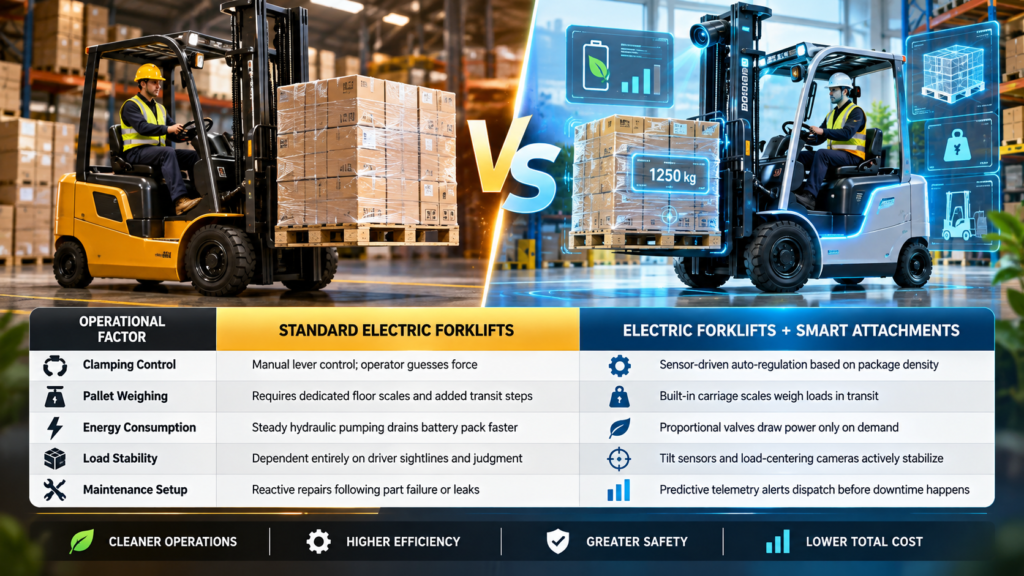
Equipment Overview: Standard vs. Smart Zero-Emission Configurations
| Operational Factor | Standard Electric Forklifts | Electric Forklifts + Smart Attachments |
| Clamping Control | Manual lever control; operator guesses force | Sensor-driven auto-regulation based on package density |
| Pallet Weighing | Requires dedicated floor scales and added transit steps | Built-in carriage scales weigh loads in transit |
| Energy Consumption | Steady hydraulic pumping drains battery pack faster | Proportional valves draw power only on demand |
| Load Stability | Dependent entirely on driver sightlines and judgment | Tilt sensors and load-centering cameras actively stabilize |
| Maintenance Setup | Reactive repairs following part failure or leaks | Predictive telemetry alerts dispatch before downtime happens |
Industries Leading the Charge in Sustainable Warehouse Equipment
The pivot to zero-emission material handling using electric forklifts and specialized smart attachments is accelerating fastest in industries with high cleanliness demands and tight operating margins.
The food and beverage sector is a prime example. In commercial bakeries, beverage packaging facilities, and temperature-controlled cold-storage vaults, burning propane indoors is simply not an option due to soot and exhaust contamination.
Electric forklifts keep the air pristine, while smart multi-pallet handlers let drivers shift two to four pallet loads of canned goods at once without destabilizing stacks. In pharmaceutical logistics, maintaining cleanrooms and strict climate-controlled environments is required by law.
High-value medical shipments cannot tolerate erratic movements, sudden drops, or airborne oil mists. Smart rotators and precision clamps ensure high-cost active ingredients and medical vials move without vibration or container stress.
High-volume third-party logistics (3PL) and retail distribution centers rely on this pairing to handle erratic packaging dimensions, using automatic fork positioners to switch between small parcels and oversized pallets without forcing drivers out of the cabin.
- Food, Beverage & Cold Storage: Eliminates soot and engine emissions around open packaging, while cold-tolerant lithium packs perform reliably in freezing temperatures.
- Pharmaceutical Distribution: Provides clean, quiet transport for fragile medical inventory with precise clamping control to prevent packaging tears.
- High-Volume 3PL Facilities: Uses versatile attachments like slip-sheet push-pulls and intelligent paper roll clamps to handle shifting e-commerce load formats on short deadlines.
The ROI and Long-Term Value for Modern Warehouses
Upgrading to an advanced fleet of electric forklifts fitted with smart attachments involves real capital commitment, but focusing only on equipment purchase price misses the broader financial picture. Calculating the total cost of ownership reveals where the real savings accumulate.
First, electricity costs per kilowatt-hour remain far cheaper and more predictable than fluctuating propane or off-road diesel prices. Second, an electric motor has only a fraction of the moving parts found in a combustion engine. There are no oil filters to change, no cooling systems to flush, no catalytic converters to replace, and no starter motors to burn out.
Add smart attachments to the setup, and the financial returns grow even faster. Clamping force errors that used to cost tens of thousands of dollars in damaged freight drop toward zero.
Drivers handle more pallets per shift because their forks adjust, level, and weigh inventory without slowing down. When you combine reduced energy bills, lower labor touches, and minimal maintenance overhead, most operations reach break-even on the upgrade well within two years.
- Direct Fuel Savings: Cutting out propane cylinder rentals and bulk diesel deliveries yields immediate, steady reductions in monthly utility bills.
- Lower Shop Time: Fewer friction points and the absence of internal combustion parts keep electric forklifts running on the floor instead of sitting on shop jacks.
- Freight Claim Protection: Preventing damaged cartons and crushed product preserves supplier contracts and keeps insurance premiums down.
Frequently Asked Questions – Electric Forklifts
How long do electric forklifts run on a single charge when powering smart attachments?
Most modern electric forklifts powered by lithium-ion batteries easily run for an entire 8-to-10-hour shift with smart attachments installed. Because smart attachments rely on micro-valves and on-demand hydraulic pumps, they use power only when active, avoiding the continuous battery drain associated with older hydraulic systems. Brief opportunity charging during breaks can also keep trucks working around the clock.
Can you add smart attachments to older electric forklifts already in the fleet?
Yes, most manufacturers design smart attachments to fit standard ISO/ITA carriage plates on older electric forklifts. However, unlocking every digital feature—such as automated weight logging or speed throttling based on load mass—may require installing an auxiliary wiring harness and an aftermarket cabin display to interface with the attachment’s sensors.
What is the real cost difference between electric and combustion forklifts over time?
While the upfront price of electric forklifts and smart attachments runs roughly 20% to 35% higher than propane models, their operating costs are dramatically lower. Warehouses typically cut fuel expenses by 60% to 75% and reduce scheduled maintenance by up to 50%, allowing the truck to pay back its price premium within 18 to 24 months of regular use.
How do smart attachments help prevent workplace accidents?
Smart attachments reduce major warehouse safety risks by taking guesswork away from operators. Integrated load cells stop the mast from lifting if the weight exceeds safe limits, automated tilt-leveling keeps pallets horizontal during high-bay retrieval, and camera-equipped fork tips give drivers a clear view through blind spots around wide loads.
Can electric forklifts handle heavy outdoor yard work as well as diesel models?
Modern outdoor-rated electric forklifts handle rough terrain and wet weather without issues. Equipped with heavy pneumatic tires, sealed drive axles, and weather-protected AC motors, these machines deliver the torque, ground clearance, and pulling capacity required for lumber yards, brick yards, and outdoor storage docks.
Do smart attachments require specialized maintenance compared to standard forks?
Maintenance routines are straightforward. Technicians conduct standard visual checks on hydraulic hoses, clean sensor lenses, and ensure wire harnesses stay seated and free of dirt. Many smart attachments also feature self-diagnostic software that flags sensor errors or calibration drift directly on the operator’s display screen before issues disrupt the shift.
How do intelligent paper roll clamps stop rolls from dropping or deforming?
Intelligent paper roll clamps use contact pads embedded with friction and pressure sensors. As the arms close, the system calculates the minimum hydraulic force required to safely hold the roll based on its weight and paper grade, holding the roll secure without clamping so hard that it damages the core or causes out-of-round defects.