The Real Deal on Forklift Operator Jobs in 2026: Pay, Perks, and How to Get Hired
Warehouses are busier than ever right now, and if you’ve driven past an industrial park or a massive distribution center lately, you already know it. E-commerce isn’t just a trend anymore; it is how the world shops. Because of this massive shift, the people pulling the levers and steering the heavy machinery behind the scenes are in incredibly high demand for the forklift operator jobs.
Honestly, if you want a career where your physical skills directly translate into a steady, reliable paycheck without taking on decades of student loan debt, hunting down forklift operator jobs is one of the smartest moves you can make.
You aren’t tied to a cubicle, you get to stay active, and the overtime potential is huge. Whether you end up working in a freezing cold ice cream distribution center or a sunny outdoor lumber yard, the role is fast, hands-on, and critical to the economy.
Over at AmericanForklifts.org, we’ve seen a massive spike in people wanting to know exactly how to break into this field, what the forklift training looks like, and what kind of money is actually on the table. Let’s break down exactly what you need to know to land a great spot this year.
The Actual Daily Grind of Forklift Operator Jobs
When you clock in for your shift, you aren’t just sitting down and hitting the gas pedal like you’re driving a golf cart. Forklift operator jobs require serious focus, spatial awareness, and a lot of quick thinking. A normal day always kicks off with a mandatory safety check of your machine.
You’ll look for hydraulic fluid leaks, check the battery charge or propane tank, and test the brakes. Once your supervisor gives you the green light, it’s go-time. You might spend your morning unloading a line of 18-wheelers at the receiving dock, making sure you don’t puncture any of the fragile boxes hidden under the shrink wrap.
By the afternoon, you could be picking orders, pulling heavy pallets down from steel racks that sit three stories above the concrete floor. The pace is usually pretty fast because most warehouses track your “picks per hour” or how fast you turn around a truck.
You have to balance moving quickly with moving safely, constantly watching out for coworkers walking around blind corners. It’s hard work, but for people who hate sitting still, it beats a desk job every single time.
- Knocking out your daily OSHA pre-trip inspection checklist before you even think about turning the key in the ignition.
- Weaving heavy, weirdly stacked pallets through super tight aisles without bumping the racks or dropping the load.
- Teaming up with the folks on the loading dock and the truck drivers to get everything loaded and out the door on a tight schedule.
The OSHA Paperwork and Real-World Skills You Need
You can’t just walk into a warehouse with a regular driver’s license and expect them to hand you the keys to a 9,000-pound machine. To legally work any forklift operator jobs in the US, you have to get officially certified according to OSHA standards.
This isn’t just bureaucratic red tape; it is the training that literally keeps you and your coworkers alive. Getting your certification usually means sitting through a bit of classroom training—where you learn about load capacities, balance, and center of gravity—followed by an actual driving test on the warehouse floor.
But beyond the official paperwork, the best drivers have a specific set of skills. You need a rock-solid sense of space so you know exactly where your forks are at all times. You also need to be decent with technology. Gone are the days of paper clipboards; today, you’ll be using handheld RF scanners, mounted tablets, and warehouse management software (WMS) to scan barcodes and track exactly where every single box goes.
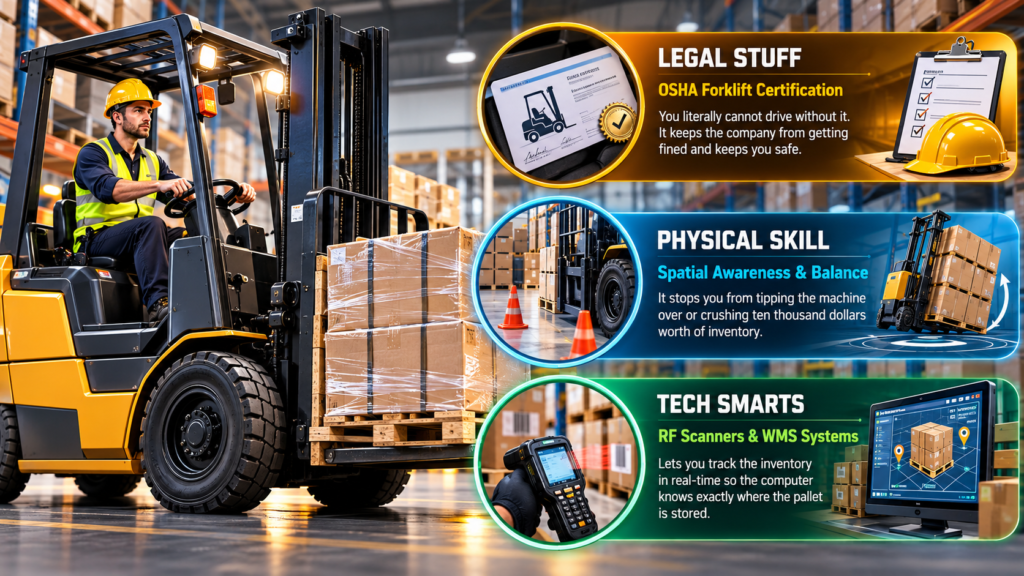
Table: Forklift Operator Jobs Requirements
| What You Need | The Specific Skill | Why It Actually Matters on the Floor |
| Legal Stuff | OSHA Forklift Certification | You literally cannot drive without it. It keeps the company from getting fined and keeps you safe. |
| Physical Skill | Spatial Awareness & Balance | It stops you from tipping the machine over or crushing ten thousand dollars worth of inventory. |
| Tech Smarts | RF Scanners & WMS Systems | Lets you track the inventory in real-time so the computer knows exactly where the pallet is stored. |
- Going through the official training to get your OSHA card for the exact type of machine you are going to be driving.
- Building up a gut feeling for weight distribution so you never try to lift a load that is too heavy for your machine.
- Getting fast and accurate with warehouse scanning guns so you don’t mess up the digital inventory counts.
Not All Machines Are The Same
One of the biggest mistakes rookies make is thinking a forklift is just a forklift. The truth is, the warehouse equipment world is huge, and the machine you drive completely changes what your day looks like.
At AmericanForklifts.org, we always tell new drivers to pay attention to the different equipment classes. For instance, Class I machines are electric riders. They are quiet, don’t spit out exhaust, and are mostly used inside clean environments like food storage.
Then you have Class II narrow aisle trucks, like reach trucks or cherry pickers. If you are afraid of heights, these aren’t for you, because you’ll be pulling pallets from dizzying heights in super cramped aisles.
On the flip side, if you want to work outside, you’ll probably be looking at Class IV or V trucks. These are the loud, heavy-duty gas or diesel machines with big rugged tires built to handle rough gravel yards, construction sites, and massive shipping containers. If you can learn to drive more than one type of machine, you instantly become way more valuable to hiring managers.
- Running quiet, battery-powered Class I electric trucks inside massive, climate-controlled grocery distribution centers.
- Mastering the tricky controls of a Class II reach truck so you can pull pallets out of racks that are thirty feet in the air.
- Driving the big, loud Class V internal combustion trucks outdoors in places like lumber yards or brick distribution lots.
Let’s Talk About the Money and Climbing the Ladder
If we’re being honest, you are looking into this career because you want to know if it pays the bills. The good news is that the financial upside for forklift operator jobs right now is highly competitive, especially if you don’t mind working the second shift, overnight shifts, or weekends.
Depending on where you live and what kind of machine you drive, starting pay is usually floating somewhere between $18 and $24 an hour. If you get into a union building, you might see even higher hourly rates plus killer health insurance and a pension. But the real secret to making money in this industry is the overtime.
When peak season hits—like the crazy holiday rush from October to December—warehouses basically offer unlimited overtime, meaning your paychecks can get massive very quickly.
Plus, nobody stays on a forklift forever unless they want to. Almost every warehouse manager, logistics planner, and shift supervisor out there started their career loading trucks. If you show up on time, don’t hit anything, and work hard, you can get promoted into management faster than in almost any other industry.
Table: Forklift Operator Jobs in 2026
| Where You Are At | Hourly Pay Estimate | What You Can Make a Year (With Good Overtime) |
| Just Starting Out (0-2 Years) | $18.00 – $21.00 / hour | $38,000 – $45,000 |
| Knowing Your Stuff (3-5 Years) | $22.00 – $26.00 / hour | $48,000 – $60,000 |
| The Veteran (5+ Years) | $27.00 – $32.00 / hour | $65,000 – $75,000+ |
- Locking down a solid starting wage that usually pays way better than entry-level retail or fast food gigs.
- Eating up all the overtime hours you can get during the holiday season to seriously pad your bank account.
- Using your time on the floor to prove you are reliable so you can eventually step into a supervisor or safety trainer role.
The Smart Way to Find the Best Forklift Operator Jobs
Throwing your resume into a giant online job board and crossing your fingers usually isn’t the best way to get hired. Because these roles require specific skills, you need to know exactly where the warehouse managers are looking for people. One of the best tricks is to hit up temporary staffing agencies that focus entirely on industrial work.
A lot of the biggest, best-paying distribution centers strictly hire through “temp-to-hire” contracts. You work for the agency for 90 days, prove you can do the job, and then the warehouse hires you on full-time with benefits. You also need to use your resources. Digging into sites like AmericanForklifts.org can give you a massive leg up because you can figure out exactly what kind of equipment a company uses before you even apply.
When you write your resume, don’t just say “drove forklift.” Be incredibly specific. List the exact models, the weight capacities you handled, and if you know how to use special attachments like barrel clamps or slip-sheets. That is exactly what recruiters are scanning for.
- Hooking up with local industrial temp agencies to get your foot in the door at the massive distribution hubs in your town.
- Doing your homework on AmericanForklifts.org so you know exactly how to match your skills to what the employer actually needs.
- Putting the exact names, classes, and attachments of the machinery you know how to drive right at the very top of your resume.
Keeping All Your Fingers and Toes Intact
Warehouses are dangerous places, and there is absolutely zero tolerance for people who want to goof off on the equipment. The single most important part of all forklift operator jobs is treating the machinery with respect.
A standard forklift weighs about as much as three regular cars. If you take a corner too fast or mess around, you can destroy thousands of dollars in property, or much worse, seriously hurt yourself or a coworker. Professional drivers know that moving safely is always more important than moving fast.
You have to understand the “stability triangle,” which is basically just the physics of how the machine keeps from tipping over when you lift heavy things high in the air. You also have to get used to constantly honking your horn at intersections, staying far back from the edge of the loading dock, and always making eye contact with people walking around you. A clean safety record is your absolute best bargaining chip when you walk into your boss’s office to ask for a raise.
- Always keeping the heavy part of your load tilted back and low to the ground so the machine doesn’t tip forward.
- Honking the horn aggressively every single time you come to a blind corner, a door, or a busy aisle intersection.
- Refusing to cut corners—like always wearing your seatbelt and never, ever trying to lift something heavier than the data plate allows.
FAQs – Forklift Operator Jobs
How do I actually get certified for forklift operator jobs?
You have to take an OSHA-approved class (which can sometimes be done online) and then pass a hands-on driving test given by a certified trainer. Usually, your employer pays for this and does it right there in their own warehouse.
Do I have to have a regular driver’s license?
Legally, OSHA does not require you to have a state driver’s license to drive a forklift. However, a lot of companies will still ask for one just as a general rule to get hired, so it totally depends on the specific warehouse.
What is the real average pay looking like right now?
It changes depending on where you live, but in 2026, most forklift operator jobs are starting between $18.00 and $24.00 an hour. The real money comes from time-and-a-half overtime pay during the busy seasons.
Is the job actually going to wreck my back?
It is definitely a physical job. Even though you are driving, you are constantly twisting your neck to look backwards, climbing up and down off the machine, and sometimes you have to hop off to manually move boxes by hand.
What is the easiest forklift to learn on?
The standard sit-down counterbalance forklift (Class I or Class IV) is generally the easiest for beginners because the steering wheel and pedals feel a lot like driving a regular car.
Will companies hire me if I have literally zero experience?
Yes, absolutely. A lot of massive distribution centers and temp agencies offer full, paid on-the-job training for people who show up on time, have a good attitude, and take safety seriously.
Does my certification ever expire?
Yes, standard OSHA certifications are good for three years. But, if you get caught driving recklessly, get into a crash, or switch to a totally different type of machine, you have to be retrained immediately.