Forklift Leasing for Startups: How to Keep Equipment Costs Down in 2026
Embarking on a new material handling, warehousing, or logistics business is a great idea, but it is no secret that the initial investment needed to set up is quite huge. For most new warehouse managers, getting the industrial machinery required to satisfy orders may totally deplete cash reserves even before the business starts to make a profit. Therefore, if you are trying to improve your daily warehouse throughput, you will be faced with the problem of scaling your operations while at the same time trying to keep your budget limits with a proper plan for forklift leasing for startups.
Fortunately, you don’t necessarily have to buy an entire fleet to be able to continue meeting customer demands. Forklift Leasing for Startups has proven to be the most effective way to keep working capital untouched, yet at the same time, get access to the best and the most advanced machines.
Startups, by choosing the proper financial arrangement, can be able to put the latest equipment into operation right away, thus circumventing massive depreciation and unexpected maintenance problems of the assets. The best way to keep equipment costs down is by first of all coming to grips with it and this is a crucial key to your survival during your first few years running the business.
Reasons to Keep Capital Uninvested Initially for New Logistics Ventures
Every penny counts in the life of a startup when launching in the hectic global logistics arena. Dropping tens of thousands of dollars on one piece of equipment alone leaves hardly any room for other critical startup expenses.
- Supports a Steady Cash Flow: The purchase of a normal industrial forklift entails a significant cash flow outlay that will immediately reduce the amount of money in your bank account. Forklift leasing for startups with flexible terms will allow you to spread this financial burden partly into monthly operating expenses which are more predictable, thus leaving your crucial capital open for marketing, inventory growth, and even immediate payment of wages.
- Enhances Loans Accessibility: Commercial banks usually require multiple years of tax returns showing profits, a good revenue history, and an established business credit rating before they consider granting an equipment loan. An equipment lease for new business, on the other hand, primarily uses the physical asset itself as collateral, which enables newer businesses with good personal credit to have access to funds.
- Makes Equipment Use Upon-Site Faster: Delays in waiting for a big bank loan could put a brake on your operation for several weeks and in turn, you would be missing some good initial client’s contracts. On the other hand, leasing processes for modern equipment are fast and it is possible to get the approval the very same day and receive delivery the next week to your commercial facility.
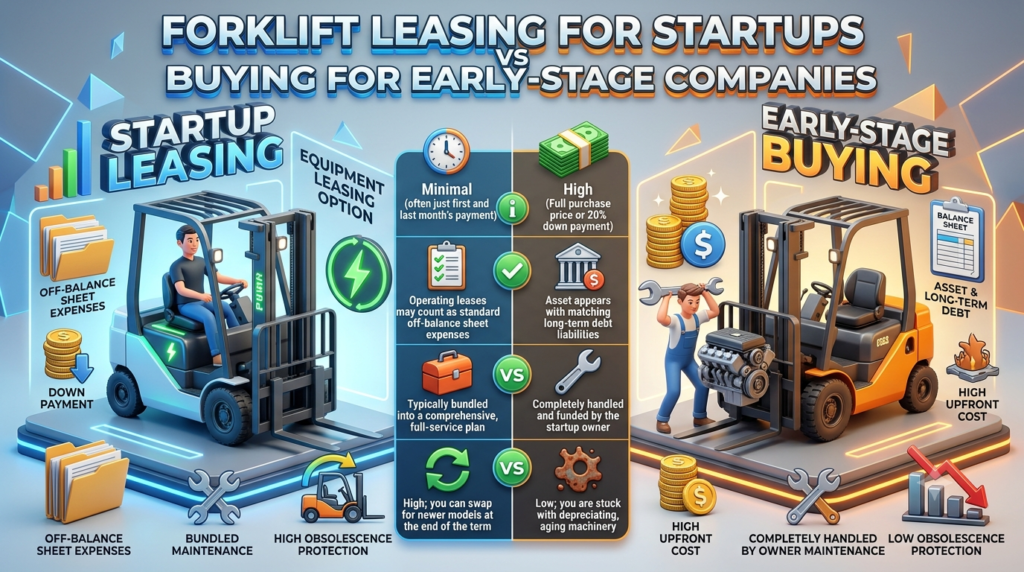
Forklift leasing for startups vs buying for early-stage companies
| Financial Factor | Equipment Leasing Option | Outright Purchasing Option |
| Upfront Cost | Minimal (often just first and last month’s payment) | High (Full purchase price or 20% down payment) |
| Balance Sheet Impact | Operating leases may count as standard off-balance sheet expenses | Asset appears with matching long-term debt liabilities |
| Maintenance Burden | Typically bundled into a comprehensive, full-service plan | Completely handled and funded by the startup owner |
| Obsolescence Protection | High; you can swap for newer models at the end of the term | Low; you are stuck with depreciating, aging machinery |
Selecting the Right Leasing Structure for Maximum Cost Control
Not all industrial equipment leases are the same. The exact plan you take will greatly influence your regular monthly financial commitments over a longer period as well as what the outcome will be regarding the machinery once the contract is completed. Carefully considering different forklift leasing alternatives will make sure that you do not end up paying a high price for a performance that you do not really use.
- Operating Leases (Fair Market Value Leases): This kind of lease results in the lowest possible monthly payments. In fact, it is considered to be the best option for startups that place a heavy emphasis on daily cash conservation because it has a cadge of the three options closest to current operating cash flows. You are given a limited period of time in which to use the equipment, and once the lease agreement ends, you have the option either to simply leave the equipment, negotiate a new lease, or make the purchase of the asset at its fair market value.
- Capital Leases ($10 Buyout Leases): You can think of a capital lease as being very much like a loan but with a twist. Your monthly payments are only slightly higher but when the contract is over, you get to buy the truck for a symbolic ten dollars.
- Full-Service Forklift Lease Plans: This top-to-bottom package very effectively combines both the underlying asset financing and the daily operational maintenance into one fixed invoice that is highly reliable. For the typical situations that work a double shift, a full-service forklift leasing for startups model has the potential to save thousands of dollars over several years in comparison with a purchase model that is not bundled by completely eliminating surprise breakdown repair fee.
Optimizing Machinery Types to Slash Monthly Overhead Costs
The key to taking control of your monthly costs is to properly assess the types of machinery that you are using and choose only those that will give the most benefit for the least expense.
Cost control in the context of equipment goes far beyond the simple step of getting a good price or good terms on a contract; it also involves getting the right powertrain for your particular setting.
Actually, good warehouse asset management means starting off with machines that save on your electricity bills, are gentle on the motor parts, and via the right selection, cause the least amount of operational expenditure.
- Go for Electric Vehicles That Are Powered by Clean Energy: State-of-the-art lithium-ion electric forklifts are not only perfect in terms of their space utilization in a warehouse but at the same time, they produce zero emission of harmful gases through the exhaust system and very little noise. This means that they help in making the indoor working environment quite comfortable while they also eliminate the running cost of fossil fuel.
- Make Storage Space Your Ally by Using Smart Equipment Designed for Narrow Aisles: Instead of leasing a massive, costly heavy machinery unit, closely look at specialized reach trucks or compact electric units. These nimble pieces of equipment are quite capable of working inside narrow spaces without any problems, which gives you the opportunity to maximize the vertical racking space and at the same time, shrink your warehouse footprint.
- Preparing for Real-World Warehouse Situations: If your business involves handling heavy lumber pieces, raw steel, or the outdoors with uneven surfaces, then you should forget about cutting costs with standard wheels in the warehouse. Go for a tough internal combustion vehicle coupled with large pneumatic high-traction tires so that your work site can keep moving smoothly even through the worst weather conditions.
Certified Material Handlers Make the Difference
No matter what forklift model your company decides to lease, remember that the safety of the operator is a prerequisite. Success with industrial material handling is not possible unless one has the stability triangle well in hand as well as a good management of the load center.
As a result of stressing industrial material handling safety and a good use of the ultraprecise advanced safety sensors, wide-view masts and on clear operating guidance, your startup not only reduces product damage but also saves on repair bills due to structural damage.
FAQs – Forklift Leasing for Startups
Which is better, forklift leasing for startups or buying a forklift second-hand?
Forklift leasing for startups is the biggest winner quite often second to buying because it keeps essential cash reserves intact as well as providing flexibility in terms of operational costs. Large one-off purchases would require an outlay so large at the onset that your young business becomes not only exposed to the immediate depreciation of the assets but also volatile maintenance costs. Leasing frees you up to keep your cash liquid for the near term scaling.
What is the typical monthly cost when using forklift leasing to keep equipment costs down?
The typical monthly leasing rate for standard 3,000 to 5,000-pound capacity electric or cushion tire models range from about $1,100 to $2,400. In case your operation requires specialized heavy-duty rough terrain telehandlers or high capacity internal combustion models, the monthly lease invoice may increase from $3,200 to $5,000 depending on your lease terms and conditions.
Can I include regular maintenance and repair costs into my lease agreement?
Sure, with a fully serviced forklift lease you can bundle all the routine preventive maintenance, mechanical repairs and spare parts into your monthly fixed rate.
How does proper warehouse asset management protect me at the end of a lease term?
Good warehouse asset management means keeping up with your equipment usage on a regular basis. In the case of signing an Operating (FMV) or Capital ($10 Buyout) agreement, you can drop off the old forklift and finish, extend the lease to keep the asset or buy the machine either at its fair market value or for the prearranged nominal fee.
Does prioritizing industrial material handling safety lower my leasing liabilities?
Without a doubt. Strict compliance with industrial material handling safety helps to avoid excessive wear and tear penalties in the return of the leased equipment and if a forklift accident is avoided due to a competent operator, you will keep equipment costs down by not having to do any end-of-term machinery repair.
Proactive Strategies to Lower Your Leasing Overhead
Implementing fleet management strategies will enable you to get the most out of your machinery lease. In other words, here are some of those strategies that will actually get you the best lease value from day one:
- Analyze Shift Cycles Carefully: This is the first strategy that will help you cut down on the overall equipment expenses. Reason? If you right-size your contract by the actual work hours, you will be able to avoid being charged for the equipment usage that exceeds the plan.
- Utilize Opportunity Charging: In case you have leased newer lithium-ion equipment, then your employees should be trained to recharge the units during short breaks so as to extend the total battery life, and also avoid the need for expensive spare batteries.
- Exit Before the Inflection Point: Figure out how long you must keep the equipment to avoid having to pay the high maintenance costs associated with older machines. This way you allow the leasing company to bear the decrease of the residual value from the secondary market.
Working with a knowledgeable partner like American Forklifts will give your startup access to honest reviews, transparent analyses, and thorough how-to’s to maximize your fleet. Concentrate on effective asset management, maintain your operation safety, and your business will continue to grow to new heights.