DIY Forklift Battery Care: Extend Your Battery Life by 50% Without a Pro
First things first, your forklift batteries are like the heart and soul of your material handling operations. They are often a major part of your equipment investment, with their cost sometimes being as high as 30% of the price of a new truck.
If you disregard these vital components, you are literally inviting early death of your batteries, which will not only cost you heavy losses due to production stoppages but will also greatly reduce your profit margins as a result of the replacement costs.
Nevertheless, in contradiction to what most people think, it is not always necessary to hire a pro technician to get the batteries serviced, you can easily enhance their lifespan if you have an understanding of batteries and if you are guided by a consistent routine.
By doing some strategic, self-initiated maintenance that is easy to do, you can increase the battery life of your forklift up to 50%, therefore, you get to use your fleet for a much longer period than the average industry lifespan.
Understanding Your Battery: Lead-Acid vs. Lithium-Ion
Firstly, it is very important that you first figure out what kind of battery your fleet is powered with because batteries have quite different requirements for their care and maintenance.
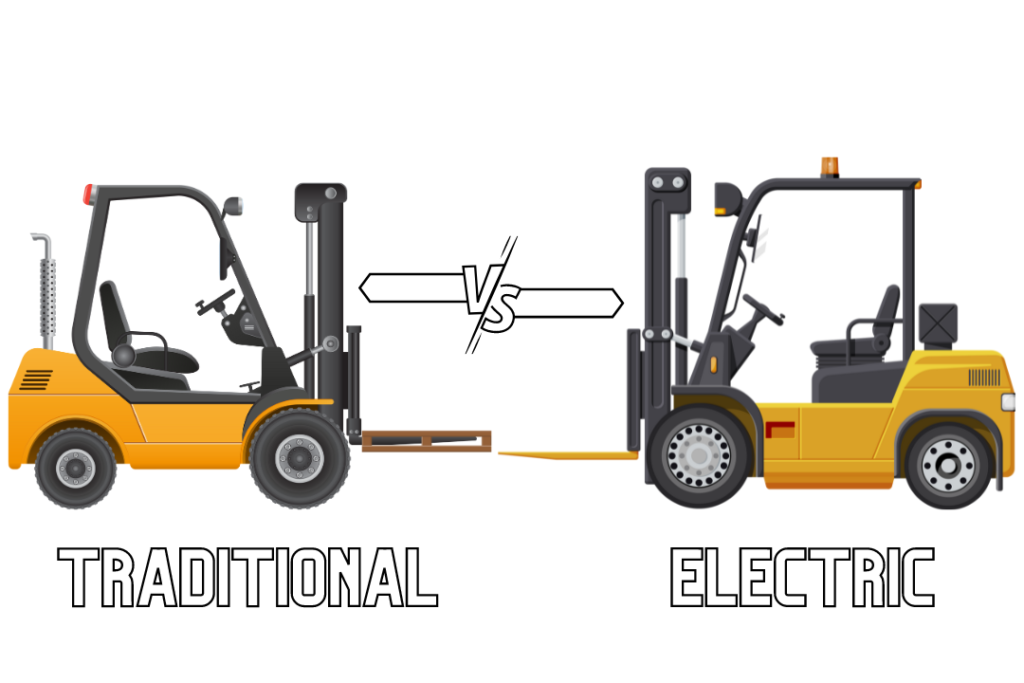
Lead-acid or traditional batteries have been the most common battery in the market for a very long time, people generally rely on them, they are relatively cheap, but if you want to keep them in great shape, you must always water them and do equalization.
Lithium-ion batteries are gradually becoming popular nowadays in the US market because of their “no maintenance” feature and the ability to be charged very often (opportunity charging) without hurting the battery.
It is very important that one knows exactly what kind of battery chemistry they are dealing with because this is the very first step in which a good battery care plan is created that will not only save the battery warranty but will also yield maximum efficiency.
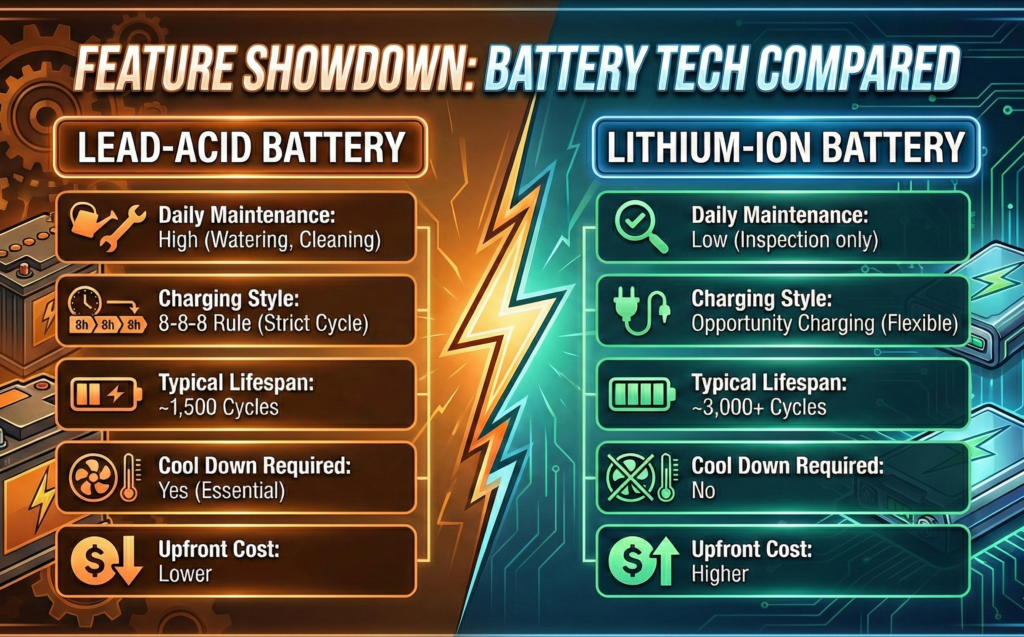
- Maintenance Obligation: Lead-acid batteries need watering and equalization weekly, whereas Lithium-ion batteries don’t need to be checked for fluids at all.
- Charging Behavior: Lead-acid batteries get damaged if they are opportunity charged (little bursts), whereas Lithium-ion batteries love to be charged during breaks or at shift changes.
- Lifetime: One lead-acid battery, that has been properly looked after, will provide a service of approximately 1500 charge-discharge cycles (5 years), but Lithium-ion batteries can go over 3000 cycles (5-10 years).
Table: Forklift Battery Types
| Feature | Lead-Acid Battery | Lithium-Ion Battery |
| Daily Maintenance | High (Watering, Cleaning) | Low (Inspection only) |
| Charging Style | 8-8-8 Rule (Strict Cycle) | Opportunity Charging (Flexible) |
| Typical Lifespan | ~1,500 Cycles | ~3,000+ Cycles |
| Cool Down Required | Yes (Essential) | No |
| Upfront Cost | Lower | Higher |
The Sacred Charging Rule: The 8-8-8 Cycle
Those who supply their forklift batteries with lead-acid cells only will find that the best single way to drastically increase the battery lifespan is following the 8-8-8 Rule to the letter!
This rule talks about the scheduling of battery use, it says a battery can be used for eight hours (discharged), then charged for eight hours, and be allowed to cool down for eight hours before it can be used again.
Usually, a lot of people skip the cool-down phase due to lack of time or other reasons and this is kind of a serious mistake because it allows for excessive heat to build-up which chemically destroys the battery plates thus, the unit’s operational life is drastically shortened.
Besides, strictly following this timetable will help you to avoid the chemical stress that is the main cause of the battery’s premature failure.
- Don’t do excuse charging: Don’t charge the battery, especially a lead-acid one, during lunch breaks; short cycles cause more heat and also count as one full charge cycle in terms of life expectancy.
- Give the battery time to cool: The rest period of eight hours enables the electrolyte to settle and lets the heat dissipate, thus preventing the lead plates from being warped.
- Depth of discharge: Only recharge when the battery reaches between 20% and 30%; recharging too soon or letting the battery power fall below 20% can cause irreversible damage.
Watering Skills to Perfection (Lead-Acid Only)
Watering is one of the regular forklift batteries maintenance tasks of lead-acid batteries, and at the same time, it’s the one which is most incorrectly done by untrained workers.
Inside a battery, the electrolyte is sulfuric acid mixed with water; when the battery gets charged, water evaporates and so water has to be added again to keep the lead plates immersed.
Adding water just before recharging must NEVER be done, you should absolutely know this, because the fluid increases in volume during the charge and will cause spillage, hence, you get acid burns and your battery loses its capacity.
- Only add after a full charge: Never before, always after charging and when the battery is cool.
- Water only: Use only distilled or deionized water, never tap water because it contains minerals that will create a layer on the plates which will reduce the performance of the battery.
- Check regularly: Only fill the battery up to the point where the plastic element protector is covered (about 1/4 inch above the plates); excess water will cause boiling over which will destroy the chemical balance of the battery.
Preventing Battery Corrosion and Sulfation
Corrosion is very little talked about as a problem and at the same time very deadly to forklift batteries as it is, it normally appears as a white or a blue crusty layer around terminals and cables.
This layer, in fact, acts as an electric resistance, this will cause the forklift to get tired faster and the battery to heat up, in essence, it chokes off the power flow.
Similarly, sulfation is a result of keeping a battery in a discharged condition for too long; this causes the crystals of lead sulfate to become very hard on the plates and as a result, the battery’s capacity to hold charge gets reduced permanently.
The quick and simple cleaning you can do by yourself with baking soda mixed with water will lead both to neutralizing of the acid residues and to your terminals being kept clean and in good electrical contact.
- Do regular cleaning: Mop the battery’s upper part once a month using a battery cleaner specially made for the purpose or neutralize acid by wiping with a baking soda solution.
- Tighten up connections: Check and tighten the terminal connections to ensure the tightening of the connectors; otherwise, loose connectors cause arcing and heat damage.
- Keep the battery fully charged: Do not leave a battery at low charge (below 20%) for long; if it happens to be discharged after a shift, the battery should be recharged right away to keep chemical reactions going.
The Super Secret: Equalization Charging
Equalization is basically an overcharge that is very tightly regulated and which acts like a “reset button” to your lead-acid battery cells.
When left for quite some time, the acid and water in the electrolyte solution can separate (stratification), and each cell voltage fluctuates, creating a state of imbalance that drags down the overall performance of the entire battery pack.
Most chargers nowadays are equipped with an equalization feature that, when switched on, mixes up the electrolyte and brings all the cells to the same voltage level.
This step performed regularly, say every 5 to 10 charge cycles, helps get rid of the initial sulfation and also ensures that each and every cell contributes effectively to the battery’s output.
- Have a set time for it: Equalization charging should be done once every 5 to 10 cycles, or as per the manufacturer’s guidelines.
- Keep an eye on the charge level: Since the process lasts longer than the regular charging and produces more heat, it is advisable for the equalization charge to be done when the battery is not expected to be used for a long period, say the weekend.
- Mind safety: Make sure the place is well ventilated when equalizing as the battery releases hydrogen gas at a much higher rate during equalization than during normal charging.
FAQs – Forklift Battery
How long does a forklift battery last on average?
A lead-acid forklift battery which has been handled properly would typically serve you for 1,500 charge cycles or about five years if it is used for one single shift per day. Lithium ion batteries on the other hand can last double, sometimes triple, the number of cycles of lead acid batteries or 7-10 years roughly.
What is the frequency of watering the battery?
The battery water level is generally checked every 5 to 10 charges and watering is done only when necessary. Also remember, only after charging (and not before), water is added to the lead acid battery.
What is the 8-8-8 rule?
In short, the lead acid battery is expected to be used 8 hours, charged 8 hours, and cooled for 8 hours in its life cycle according to the rule. This completely eliminates your battery from overheating and extends its chemical life.
Is it a good idea to charge my battery at the opportunity of it being unused?
If your forklift battery is of the lead-acid variety, then you should know that opportunity charging during your lunch break, or other short breaks is not recommended and actually discouraged because it will cause heat to increase and “waste” cycles. On the other hand, Lithium-ion batteries are made to get opportunity charges and, in fact, benefit from them.
How do you clean the battery in the best way?
Generally speaking, one would mix baking soda and warm water to make a solution, apply it to the battery terminals to neutralize the acid (bubbling is a sign of chemical reaction), gently scrub the terminals with a non-metallic brush and after that, wipe it with a damp cloth.
What is the main reason for sulfation of batteries?
Sulfation is caused by the crystallization of lead sulfate on the plates of the battery. This mainly happens when a battery is kept in an uncharged state for a prolonged period (discharged), or when undercharging is continuous, or when the electrolyte level is too low.
How often should I equalize my forklift battery?
You should equalize about every 5-10 cycles of charging for lead-acid batteries or approximately once a week if you are a daily user. This operation balances the voltage on the cells and mixes the electrolytes so that they do not separate into layers (stratification).
Final Verdict – Forklift Battery Maintenance Tips
Operating your own forklift battery maintenance is not rocket science, nor does it require you to have a professional in your payroll at all times; it only requires self-control and some chemical process awareness.
If you give proper importance to the 8-8-8 rule, become a pro at watering as well as keeping your equipment free from corrosion, then, for sure, the ROI of your fleet will change dramatically.
These DIY tasks are small daily commitments that accumulate over time, potentially giving your batteries several more years of productive use and saving your business a hefty sum of money which you would have otherwise spent on replacing them prematurely. It doesn’t matter whether you have one truck or a huge fleet, the power to extend your battery life by 50% is still up to you.