Heavy-Duty Heroes: Forklift Boom Attachment Turning Forklifts into Multi-Tool Workhorses
These days business people deal with efficiency in various sectors like warehousing, industrial logistics, heavy manufacturing, etc. that seems more a backbone of their operations than just a metric. Warehouse forklifts handle moving regular palletized goods from one place to another very efficiently yet they can become quite limited when faced with huge, oddly shaped, or non-standard items such as industrial pipes, bundles of structural steel, heavy machinery components, or even delicate granite slabs. This is precisely the point at which forklift boom attachment appears as a wonderful manufacturing floor asset.
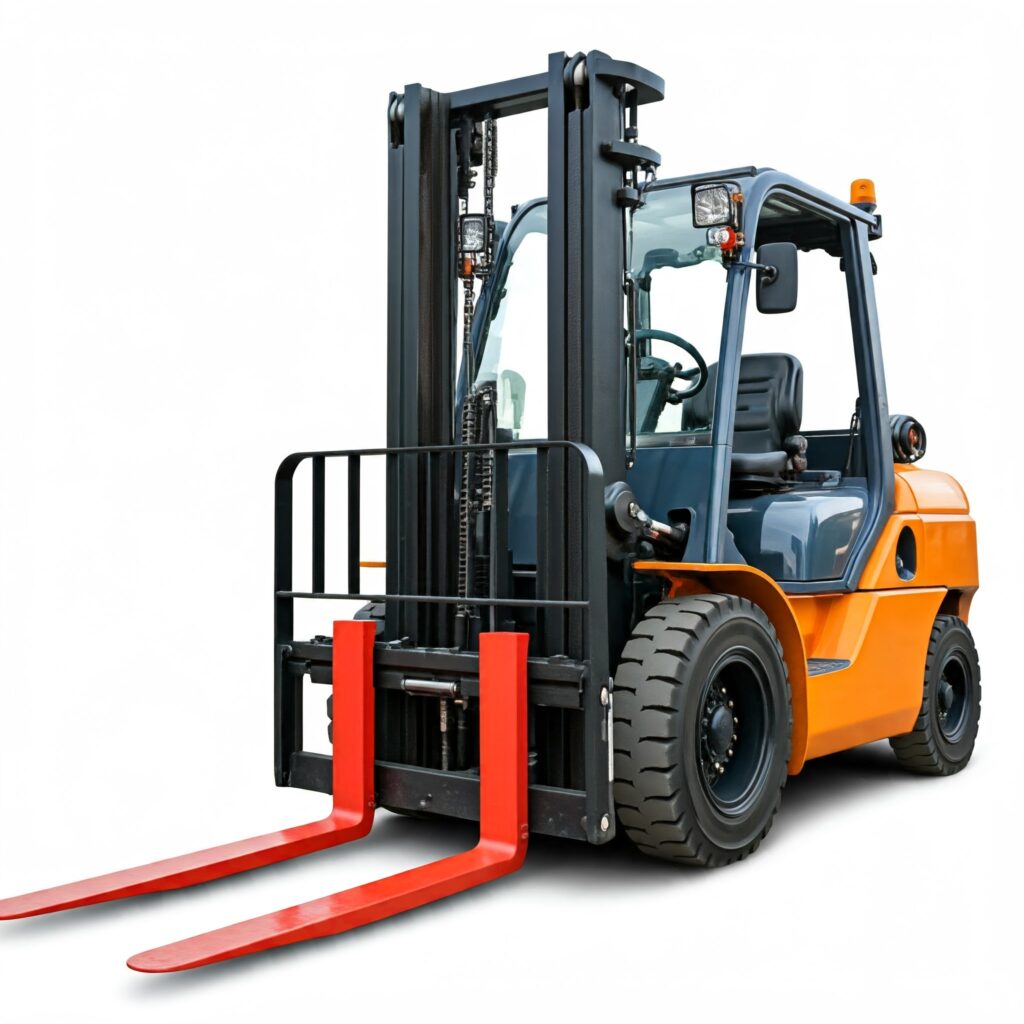
It slides right onto the fork tynes of your existing machine or gets mounted to the elevating load carriage. A good quality forklift boom attachment instantly converts a regular forklift into a very agile mobile crane. This gives logistics teams and warehouse managers nationwide the ability to massively increase their operational capacity without having to invest in costly specialized cranes or telehandlers.
Adding a heavy-duty forklift boom attachment to your equipment will not only enlarge your equipment’s functional space physically but also significantly improve safety within the warehouse and reduce labor cost. Handling large loads manually or using makeshift lifting setups often result in workers being subjected to heavy physical labor and increased risk of accidents at work.
Installation of a special forklift boom attachment will provide your operations with a better vertical reach and a very precise control over the structure of suspended loads thereby guaranteeing that even the irregular objects are handled very smoothly. You may be operating a construction site, a steel yard, or a stone distribution center, no matter what, if you understand the working of lift truck mechanics through these heavy-duty attachments, then it is very well possible for you to get your material handling services done in the most versatile manner while also being strictly OSHA compliant.
What is a Forklift Boom Attachment?
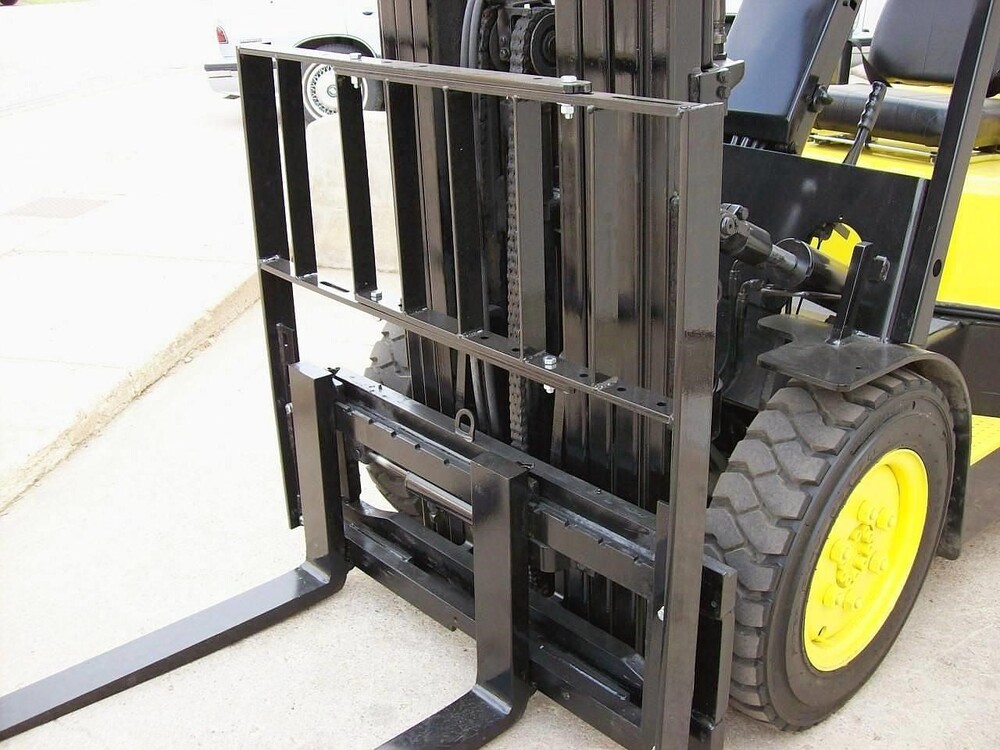
Basically, a forklift boom attachment is a really tough structural extension piece that one can find in the market which is meant to be fitted over normal forklift forks or get hooked directly onto the machine’s lifting carriage. With the help of this specialized accessory which is a rigid beam several feet long sticking out from the mast, it turns the machine’s main function from a bottom-supported lift to a top-suspended crane system. This structural configuration offers a high anchor point that is usually accompanied by heavy-duty shackles and high-capacity hooks, so the user can lift those loads that are extremely difficult to balance on traditional flat forks.
- Have the versatility of a crane: This device turns a basic industrial truck into a highly agile mobile crane that can reach over obstacles and into deep storage containers.
- Provision of a Tight Mechanical Lock: The attachment is fixed to the forklift chassis to prevent slippage using heavy-duty locking pins, safety restraint chains, or robust fork pockets.
- Handling of Unusual Loads: Along the beam length are multiple fixed or adjustable hook positions meant to allow the safe suspension of long, cylindrical, or extremely unbalanced materials.
The Main Types of Forklift Boom Attachments
Understanding which forklift boom attachment to go for is all about being very clear about what different lifting problems your industrial environment is faced with on a daily basis. These tools are made in several different kinds by manufacturers ranging from simple, rigid beams for familiar, frequent lifting jobs to intricate mechanical designs for tight spaces and high-levels. Picking the correct design ensures that you get the most out of your everyday work productivity as well as your baseline operating safety.
- Fixed-Length Booms: Provide a simple, very durable, and economical lifting framework perfect for dealing with the same load sizes at one, fixed distance from the mast.
- Telescopic Booms: Feature a manually or hydraulically extendable arm making it the most flexible choice and enable the operator to dynamically adjust the reach for various distances.
- Pivoting and Swivel Booms: Designed with an arm that can be altered to adjust the vertical angle or to laterally swing, thus offering great maneuverability in the warehouse or narrow stone yards.
Industry Applications: Where the Multi-Tool Workhorse Shines
A forklift boom attachment is so highly versatile that it can be a very helpful addition to just about any heavy industry in any part of the United States.
- Construction and Infrastructure Sites: Capable of elevating heavy structural beams, HVAC components, concrete forms, and commercial motors to upper building levels.
- Steel Yards and Industrial Machine Shops: The handling of bundles of long pipes, heavy steel rods, sheet metal coils, and massive engine blocks is done with very little effort even in the shortest of pathways.
- Granite and Stone Fabrication Facilities: Moves fragile, large stone slabs and delicate remnants between cutting workstations and delivery flatbeds without causing cracks in the structure.
The Key Principles of Forklift Boom Attachment Load Capacity
Management of forklift boom attachment operations should be well informed about industrial physics, especially the maximum load moment. The usual forklift has a counterbalanced design in which the heavy rear chassis counteracts the weight being lifted at the front, thereby it uses the front axle as a turning fulcrum. As soon as a forklift boom attachment is put on, the load center distance is extended way beyond the standard 24-inch industry rating that significantly increases the overturning force exerted to the front of the truck.
- Degraded Lifting Capacities: As the load is suspended at a farther point along the boom attachment, the actual safe lifting capacity of the forklift is reduced.
- Displaced Center of Gravity: Changing the lifting point displaces the natural stability triangle of the unit which results in acceleration, braking, and turning at low speed to become very critical in terms of safety.
- Mandatory Load Plate Update: OSHA insists that the manufacturer-approved and newly calculated data plate should be prominently displayed on the forklift whenever an attachment changes a truck’s capacity.
Safety Best Practices and OSHA Compliance
So, while a forklift boom attachment can transform your material handling truck into a very high productive piece of machinery, it also requires a very strict operation discipline in order to minimize accidents at the workplace. As loads that are suspended are capable of swinging and shifting their center of gravity, operators need to go through a training session that is more detailed than just a basic forklift license. Compliance to very stringent federal safety standards guarantees that your personnel will remain safe whenever they are handling large capacity, off-center loads.
- Pre-Shift Checks are Compulsory: Operators have to check boom structural welds for cracks, look for any signs of fatigue, and ensure that all safety pins, chains, hooks, and shackles are completely free of wear.
- Vertical Lifting Only Policy: Although a forklift boom attachment is designed for vertical lifting only and not for dragging, pulling, or swinging a load horizontally across the ground, unfortunately in many cases this unit is used for such purposes.
- Operation on Level Ground Only: As suspended loads drastically reduce lateral stability, it is strongly recommended that boom operation is carried out only on flat, smooth, and completely level surfaces so as to completely rule out tipping hazards.
Technical Characteristics: Boom Attachment Types
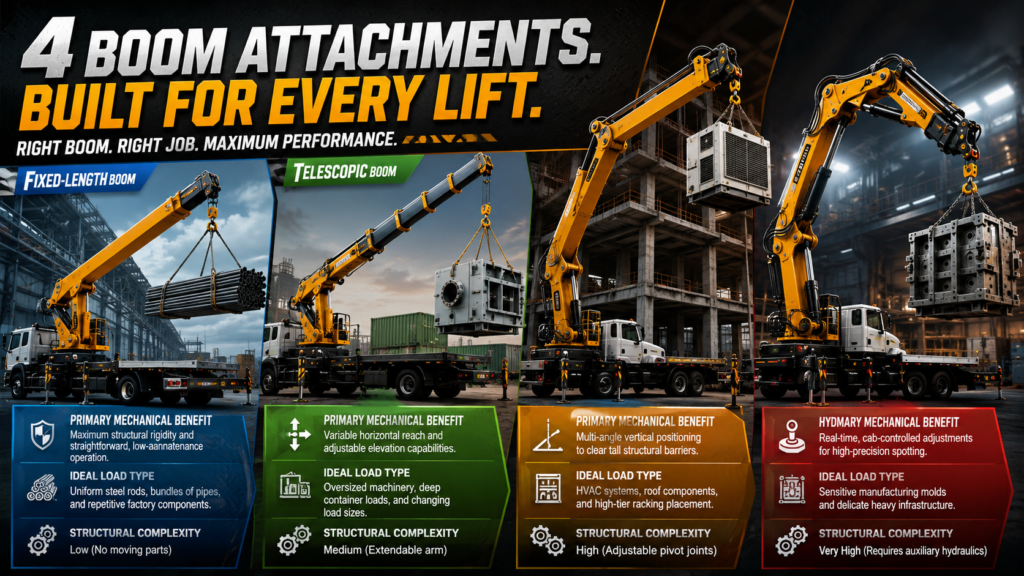
To help purchasing specialists and warehouse teams in finding the best equipment for their fleets, the following table summarizes the operational features, perfect load types, and mechanical advantages of the different forklift boom attachment variants that are well-known.
| Attachment Type | Primary Mechanical Benefit | Ideal Load Type | Structural Complexity |
| Fixed-Length Boom | Maximum structural rigidity and straightforward, low-maintenance operation. | Uniform steel rods, bundles of pipes, and repetitive factory components. | Low (No moving parts) |
| Telescopic Boom | Variable horizontal reach and adjustable elevation capabilities. | Oversized machinery, deep container loads, and changing load sizes. | Medium (Extendable arm) |
| Pivoting Boom | Multi-angle vertical positioning to clear tall structural barriers. | HVAC systems, roof components, and high-tier racking placement. | High (Adjustable pivot joints) |
| Hydraulic Boom | Real-time, cab-controlled adjustments for high-precision spotting. | Sensitive manufacturing molds and delicate heavy infrastructure. | Very High (Requires auxiliary hydraulics) |
Frequently Asked Questions (FAQs)
What capacities does a forklift boom attachment offer when it comes to lifting?
Ultimately, your forklift’s original base capacity, the physical length of the boom extension, and the specific hook position used determine the actual lifting capacity that can be done. Due to the fact that the load moment gets increased with the extension of the reach, the safe weight limit is much reduced compared to normal fork ratings.
Is it possible for any normal forklift to be fitted with a boom attachment without endangering safety?
Majority of industrial forklifts are capable of accepting a boom attachment provided that the said attachment perfectly matches the truck’s carriage size or fork dimensions. Nevertheless, OSHA mandates that there should be an official, written manufacturer’s approval as well as an updated capacity data plate before the combined set-up is allowed to be put into active service.
What impact does a forklift boom attachment have on overall machine stability?
When the load balance is extended forward away from the front axle fulcrum by a boom attachment, the natural stability triangle of the forklift is changed. This increase in extension also brings about a greater risk of the forklift tipping over forward, so operators must lift very smoothly, avoid use on slopes, and keep the load from swinging as much as possible during transport.
From the legal perspective, is a forklift that has a boom attachment classified as a crane?
OSHA officially clarified that a forklift with a boom attachment is not reclassified as a mobile crane at the legal level because it does not have multi-directional power-driven boom movements. It continues to be a powered industrial truck though specialized training for the operator is a must.
What are the key distinctions between fork-mounted and carriage-mounted booms?
Fork-mounted booms have the advantage of quick sliding directly over the existing tynes and then securing with a safety chain which makes them ideal for quick, intermittent jobs. On the other hand, carriage-mounted booms get rid of the forks entirely by pinning directly to the mast resulting in better stability and higher weight capacity for dedicated lifting.
What is the frequency at which a forklift boom attachment safety inspection should be conducted?
Every work shift, an operator must do a visual and mechanical inspection of a forklift boom attachment as part of the standard pre-operational routines. Besides this, it should also be subject to a comprehensive annual structural inspection by a proficient inspector to identify any hidden weld fatigue or steel deformation.
Which safety mechanisms are recommended to be paired with a forklift boom?
To get the best control in operation, the only always-shreds-on list the operators should never miss consists of high-quality rated shackles, heavy-duty safety swivel hooks, and very specific nylon or wire rope lifting slings. Besides these, attaching tag lines that are hand-held i.e., ground workers’ help in preventing the dangerous horizontal spinning of the load.