Boost Efficiency with Cushion Tire Forklifts
Material handling environments require the highest level of precision, speed, and safety to keep supply chains profitable. In the modern day fulfillment centers and production plants, the main factor that differentiates one optimized setting from another is the basic shape and size of your machinery. Hence, here comes the best cushion tire forklifts to boost efficiency.
Warehouse managers very often realize that the proper choice of running gear alone may significantly improve operational efficiency. This is a detailed study of high-efficiency material handling discussing how the right choice of configuration may simplify your operations.
Optimizing the indoor logistics depends on understanding how different tire arrangements may impact the work processes within the warehouse. Investigation of high-efficiency material handling methods shows that a certain engineering concept when implemented inside the building enclosure significantly outperforms other layouts without changing the space structure.
Getting the Grips of Cushion Tire Forklifts
First of all, you should learn a few basics about the core engineering logic of cushion tire forklifts if you want to boost the indoor material flow. The outside big models are run on pneumatic tires, whereas these indoor units are completely centered around a small footprint. Their differences in design influence the load dynamics as well as life cycle of the structure and all other aspects.
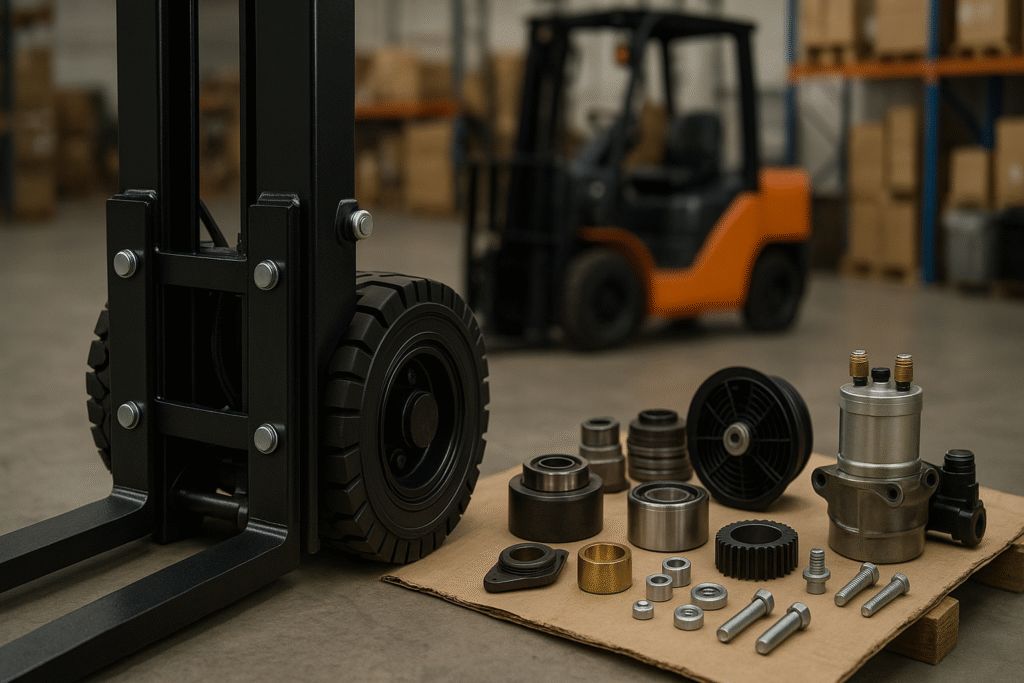
- Solid Rubber Construction: Comprising the core of the tire is a dense layer of top quality rubber that is vulcanized directly onto steel bands to form a unified whole which totally rules out the possibility of sudden air loss or flats in structure.
- Pressed on Rim Attachment: Such heavy-duty running surfaces are fixed directly onto the drive hubs by industrial hydraulic presses, which results in a tremendously rigid interface that prevents wheel slipping even when heavily loaded.
- Low-Clearance Chassis Alignment: By lowering the entire framework of the vehicle down to the floor level, the novel geometry of the chassis comes about and thereby safety is enhanced even when working with very high lifts.
Main Reasons to Make Cushion Models Your First
Operational merits of utilising cushion configurations on smooth concrete become evident during asset update discussions in warehouses. Below are some key benefits that will help you get the idea of how drastically can the cycle times be shortened and floor teams protected.
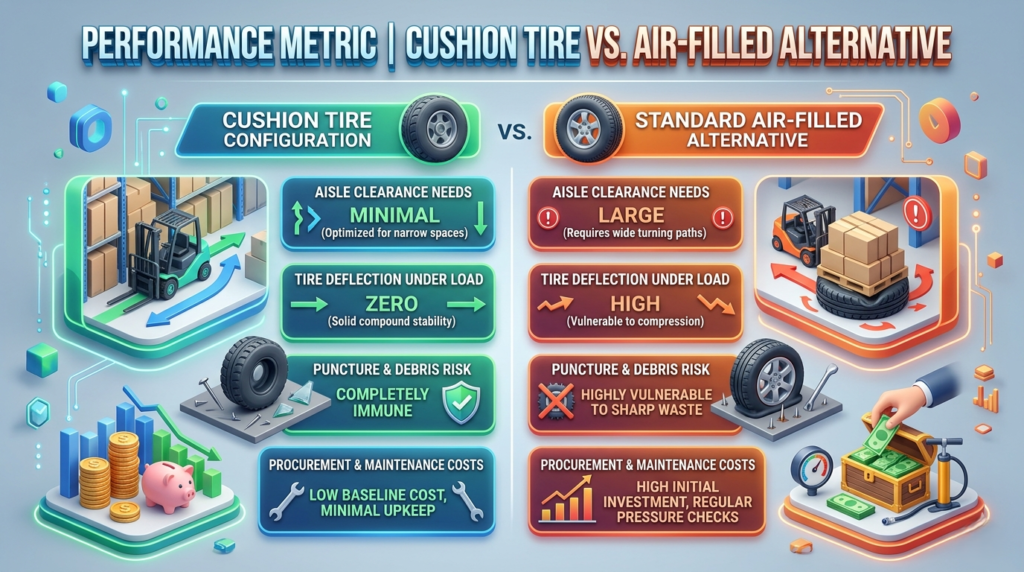
Table: Cushion Tire Forklifts Performance Metrics
|
Performance Metric |
Cushion Tire Configuration |
Standard Air-Filled Alternative |
|
Aisle Clearance Needs |
Minimal (Optimized for narrow spaces) |
Large (Requires wide turning paths) |
|
Tire Deflection Under Load |
Zero (Solid compound stability) |
High (Vulnerable to compression) |
|
Puncture & Debris Risk |
Completely Immune |
Highly Vulnerable to Sharp Waste |
|
Procurement & Maintenance Costs |
Low baseline cost, minimal upkeep |
High initial investment, regular pressure checks |
- Unrivaled Maneuverability Indoors: By virtue of their smaller size the wheel allows the use of a shorter wheelbase thus the chassis can be made in a way that allows for sharp turns even in narrow aisles.
- Absolutely Immune to Floor Debris: Assembly floors can be quite littered e.g. with metal pieces, wood splinters, or leftover straps from packaging, and these solid units simply roll right over a potential puncture without sustaining any damage.
- Improved Vertical Lift Equilibrium: Steel masts remain totally stable and do not sway even when lifting multi-ton pallets up to high racking locations, since there is a lack of tire flex.
Boosting Warehouse Space Utilization and Throughput
The fact that each and every square foot of floor space in contemporary logistics center accounts for a definite overhead cost cannot be emphasized enough. Switching from wide-clearance to narrow machinery makes it possible for you to redesign your whole warehouse plan for denser storage.
- Narrower Operating Aisles: Cutting down the width of the required turning lanes (even by just 24 inches) enables warehouses to mechanically pack more storage racks within the same overall building footprint.
- Accelerated Cycle Processing Speeds: Operators can drive confidently through tight spaces without constant stopping and backing up, speeding up truck loading and unloading times.
- Optimized Floor Area Yields: Maximizing vertical racking and tightening aisles boosts your total pallet storage capacity without needing an expensive building expansion.
Significantly Doable Cost Lowering on Fleet Maintenance
The running expenses are a lot more than the purchase cost of the equipment. The profitability in the long run depends on a continuous smooth running of the fleet without frequent maintenance breaks.
- Getting rid of pressure inspection: Maintenance will be able to save countless hours if regular tire pressure checking and flat tire repairs management are eliminated from their work schedules.
- Less wear and tear on drivetrain and components: Steering linkages, wheel bearings, and brake pads experience reduced wear when operating on smooth, predictable indoor surfaces.
- Working life extension: On concrete floors, the solid rubber compound wears slowly and evenly, resulting in long service life, which means that replacement tires are rarely required.
Creating a Ergonomic and Safe Operator Environment
Brand new ideas to create a work environment that is not only safe but also ergonomic for operators. Passing a safety check of forklifts is only the tip of the iceberg, good safety practice is about a complete work environment, which helps operators to remain focused and comfortable throughout their shifts.
| OPERATOR COMFORT & SAFETY FLOW |
| Low Center of Gravity –> Reduced Mast Sway & High Stability |
| Predictable Handling –> Smooth Acceleration & Braking |
| Reduced Flex Physics –> Lower Operator Fatigue & Strain |
- Lower Centre of Mass: Distribution of the weight of the chassis closer to the ground makes the vehicle quite stable even during abrupt stops or sharp turns.
- Traction on a Predictable Floor: The smooth, broad patch of rubber ensures a good grip on clean warehouse floors, which makes acceleration and braking easy and consistent.
- Less Body Strain: When operators get stable, predictable machine handling, they are exposed to fewer sudden bumps and jerks which help in avoiding fatigue and staying focused for long hours.
Picking Up Your Facility’s Perfect Tire Compound
Indoor floors come in many varieties and this is the reason why knowing which among the rubber formulations will work best for your forklifts is a very important decision that you make.
- Typical Dark Compounds: Extremely durable and well suited for warehouses with unpainted concrete floors where tire marks don’t matter.
- Non-Marking Special Materials: Being made with silica instead of carbon black and therefore these options are clean-running are perfect for pharmaceutical, food service, or clean-room environments where marking is not allowed.
- High-Traction Treaded Varieties: These have grooved surface patterns that allow more grip when crossing very slippery ramps, cold-storage areas, or occasionally washed dry zones.
Real-World Strategic Applications Across Industries
Cushion tire forklifts not only serve as average warehouse assistants; they are mainstay tools of supply chains across various industries.
- High-Density Consumer Logistics: In high turnover consumer goods centers handling constant stock rearrangements is a breeze for these agile machines.
- Automotive Sub-Assembly Plants: Next to manufacturing lines automotive parts-staging rows are narrow and these machines fit through them without disrupting nearby workers or processes.
- Paper and Heavy Packaging Storage: The super stable chassis is just what you need to handle safely with massive, top-heavy paper rolls without sway.
FAQs – Elevate your logistics with Cushion Tire Forklifts!
Can cushion tire forklifts be used outdoors on gravel or dirt?
Not at all, cushion tire forklifts are definitely not meant for use on unpaved surfaces such as gravel, dirt, or rough fields. The main reasons why these solid rubber tires which are of small diameter, have low ground clearance, and smooth profile cannot provide sufficient traction and proper shock absorption for uneven ground. Outdoor use of such models will most probably lead to the equipment getting stuck, mechanical damage as a result of the drivetrain impact, or even tipping over due to the instability of the ground. Their usage should be limited to indoor smooth and flat concrete floors only.
What is the main difference between cushion and pneumatic forklift tires?
Besides their internal making, sizes and types of targeted point of use, cushion tires are made of pieces of solid rubber that are pressed onto a steel band and because of their smaller profile, are intended solely for indoor concrete space use while pneumatic tires are considerably bigger, have treads deeply cut and are filled with air or solid foam. Thanks to their design which is meant for higher ground clearance and shock absorbing they are great for use on uneven and outdoor grounds.
How many hours do cushion forklift tires typically last before replacement?
On average, a premium cushion tire when used on clean indoor concrete floors, lasts from 2,000 up to 3,000 hours of operation. This may vary depending on the weights of loads carried, cleanliness of the floor, habits of driving, and travel distances done per day. Frequent inspections for flat spots, tearing, and checking for wear beyond the marked safety line will greatly help in the care and longevity of tires.
Can you swap cushion tires out for pneumatic tires on the same forklift frame?
This will not be allowed because forklift frames are designed to work with only one type of tire. Cushions tire models utilize the smaller chassis which has specific wheel wells, axle spacing, and steering clearances so if one tries to install the larger pneumatic tires, the wheels will be rubbing against the frame and the whole steering layout will be ruined in addition to the peril of a much higher center of gravity as well as the manufacturer’s warranty being voided.
Why do non-marking cushion tires wear out faster than standard black rubber tires?
Non-marking cushion tires have a lifespan of about 10% to 20% less than the standard black rubber tires because the former uses silica or chalk compounds instead of carbon black in order to prevent floor scuffs. Giving up carbon black makes the rubber softer and somewhat less heat resistant. To maximize the life of non-marking tires, always keep your floors clean of debris and switch to gentle driving style especially if it involves sudden braking or wheel spinning.
What are the clear signs that a solid cushion tire needs to be replaced?
Any one of the following conditions means that it is time for replacement: Significant wear to the safety line (the 60% wear line on the sidewall), large chunks of rubber missing, severe cracking, and visible separation from the steel band. Not attending to these issues will lead to reduced traction, increased strain on the axle bearing, and, worst of all, a sudden tire failure during lifts.
How do cushion tire forklifts help reduce overall warehouse energy costs?
Cushion tire forklifts help in reducing energy costs of the warehouse because solid rubber has significantly less rolling resistance on smooth concrete compared to the more flexible, air-filled tires. This stiff configuration results in a reduction of energy loss that normally happens due to tire flexing and thus electric forklifts need a lower power from the battery, and internal combustion ones consume a lesser amount of fuel per shift of operation. Hence your utility and fuel costs reduce.