Warehouse Forklift Safety Tips: Discover essential strategies for 2026! Keep your team safe and efficient!
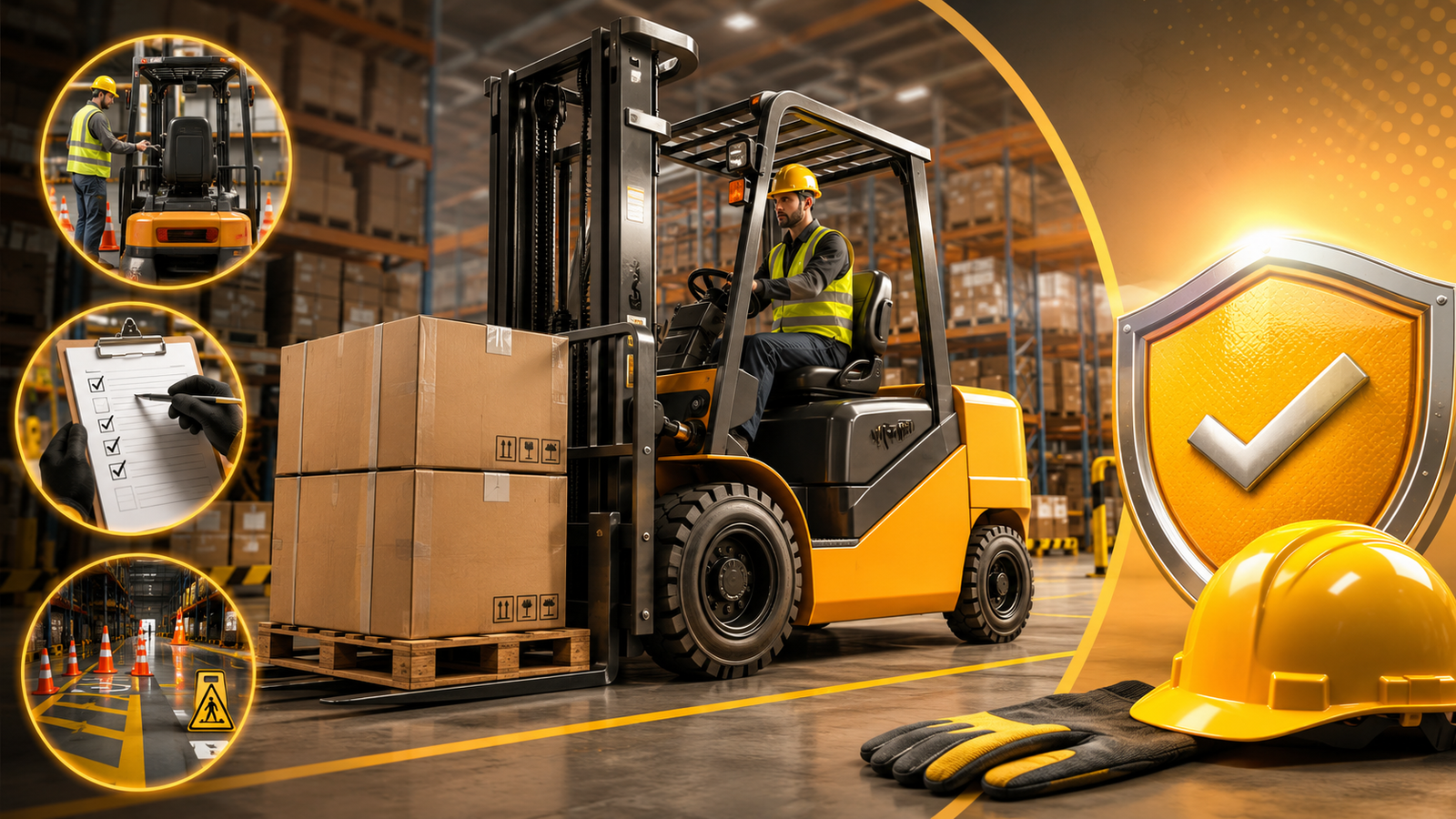
Forklift Safety Tips Every Warehouse Manager Needs to Know in 2026
Today’s fast-paced warehouse environment demands more than just quick fulfillment – it demands an uncompromising commitment to operational security and employee well-being. With the complexity of material handling in 2023 it’s more important than ever to put the safety of your people first while increasing everyday efficiency. Make the best Forklift Safety Tips 2026 part of your everyday activities to avoid workplace accidents, serious damage to equipment and costly downtime.
Warehouse managers are facing unprecedented challenges such as dealing with a high turnover workforce and properly integrating complex new gear into existing workflow systems. By knowing and practicing complete safety measures, your plant will not just meet tough regulatory requirements, but surpass them, establishing an energetic environment where each operator operates with confidence, respect and security.
American Forklifts is here to be your resource for these heavy-duty ins and outs, to arm you with the knowledge you need to make smart choices. Warehouse managers can take their organization to greater heights by focusing on the latest technology and basic safety concepts.
Why is it important to prioritize forklift safety tips 2026?
Warehouse managers are stressing Forklift Safety Tips 2026 to improve the long-term sustainability and profitability of their entire supply chain organization. Today’s warehouse is a high-stakes battlefield where every second counts. But rushing without the right safety measures always results in horrible catastrophes and massive financial losses.
A strong safety culture reduces tip-overs, rack collisions and pedestrian injuries which are still among the most frequent and completely preventable events in the material handling business. Strict compliance with safety standards can go a long way in reducing the number of workers’ compensation claims and avoid the heavy legal fines and the irreparable damage to the inventory and the lifting equipment itself.
A secure environment also intrinsically boosts morale for the employees. Workers who are physically safe on the floor tend to be more engaged, more productive and highly committed to the purpose of the company.
- Fewer Workplace Accidents: The latest safety features mean fewer crashes and tip-overs, keeping operators and pedestrians safe on the warehouse floor.
- Longer Equipment Life: Rigorous operator safety and load handling habits minimize the daily wear and tear on your expensive material handling fleet.
- Improved Employee Morale and Productivity: Safe employees are more confident and can focus on their work rather than worrying about preventable hazards.
- Cost Savings and Regulatory Compliance: Warehouse managers can keep up with the latest safety regulations to avoid steep penalties and serious legal consequences of workplace negligence.
Advanced Forklift Training and Certification Procedures
One of the most important Forklift Safety Tips 2026 is to proactively upskill your workers with robust forklift training and current certification criteria. A single, broad-based training session is no longer adequate for workers who must safely operate today’s increasingly complex warehouse equipment.
Training programs now have to address the different nuances of several types of forklifts, including traditional counterbalance and reach trucks, as well as more specialized pallet jacks.
Here at American Forklifts, we always remember that a safe work environment starts with vibrant, ongoing education. Warehouse managers need to ensure that every operator knows how to control the basic steering and how much weight the load can be, as well as the dynamics of load stability and emergency shutdown procedures for the individual models they operate.
Through regular refresher training and review of on-floor performance, management can identify and correct problematic driving behaviors before they result in hazardous incidents.
- Model-Specific Training: Operators must be trained and certified on the specific model of the forklift they will be operating and understand the operating mechanics and physical constraints specific to that model.
- Ongoing Refresher Courses: Every employee will be mandated to take retraining classes twice a year or on an annual basis to sharpen their skill set and stay up to date with the latest safety practice and industry norms.
- Realistic scenarios simulations: training today has to include realistic simulations of typical warehouse risks, teaching the operator how to react, quickly and safely, to unexpected situations.
- Full Pedestrian Awareness: Not just for drivers, floor workers need extensive training on safe distances, blind spots and proper communication signs when working around operating forklifts.
Using New Forklift Technologies and Accessories
One big defining part of our Forklift Safety Tips 2026 is to be ahead of the curve on today’s material handling with the latest technology breakthroughs. The advent of modern accessories has totally revolutionized the accuracy of order fulfillment.
Laser-guided forklift attachments, in particular, can help operators position loads with pinpoint accuracy and reduce the chances of dropping large pallets from high elevations.
The industry-wide transition to quieter electric forklifts is also resulting in a massive transformation in warehousing, with vastly reduced harmful emissions and noise pollution, and much improved verbal communication on the floor. Specialist add-ons like tough forklift boom attachments are a good option for warehouse managers to convert their machines into multi-tool workhorses.
To select the best attachments, forks and cushion tires to enhance safety without impairing optimal performance, managers may turn to sites like American Forklifts for independent assessments of these technologies.
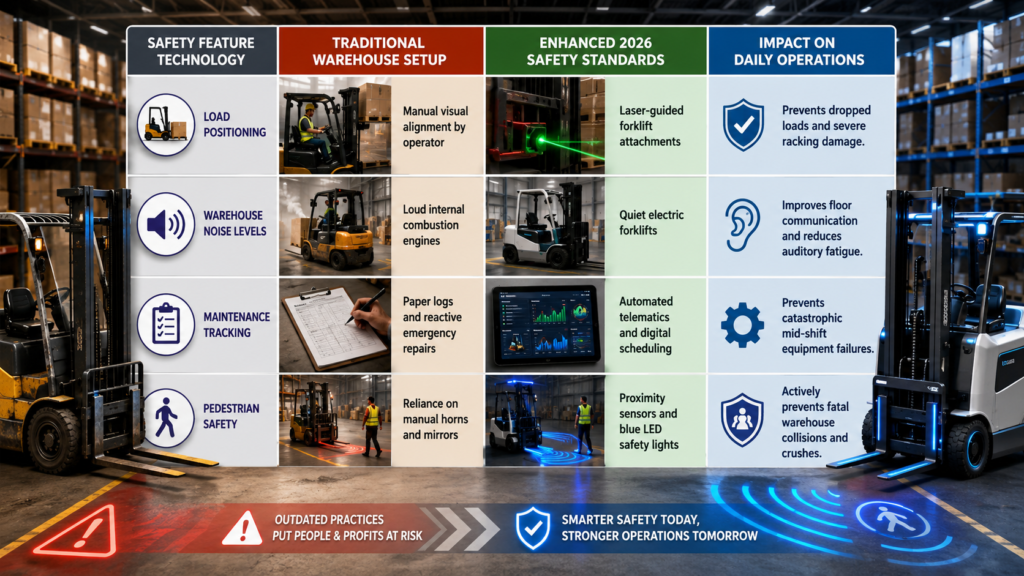
Table: Warehouse Forklift Safety Tips Features
| Safety Feature/Technology | Traditional Warehouse Setup | Enhanced 2026 Safety Standards | Impact on Daily Operations |
| Load Positioning | Manual visual alignment by operator | Laser-guided forklift attachments | Prevents dropped loads and severe racking damage. |
| Warehouse Noise Levels | Loud internal combustion engines | Quiet electric forklifts | Improves floor communication and reduces auditory fatigue. |
| Maintenance Tracking | Paper logs and reactive emergency repairs | Automated telematics and digital scheduling | Prevents catastrophic mid-shift equipment failures. |
| Pedestrian Safety | Reliance on manual horns and mirrors | Proximity sensors and blue LED safety lights | Actively prevents fatal warehouse collisions and crushes. |
- Integration of Laser-Guided Attachments: Laser guides assist operators in positioning forks precisely onto pallets, preventing challenging lifts and hazardous load imbalances at elevated heights.
- Quiet Electric Forklift Transition: Lowering the noise levels in the warehouse improves the general awareness of the surroundings so that all important warning signals and verbal communication are clearly audible to everyone.
- Cushion Tire Forklifts: When operating on smooth indoor floors, using the correct tires, such as cushion tires, will provide increased stability, a smoother operation and a great reduction in operator fatigue.
- Use Telematics and Proximity Sensors: Integrate advanced sensor technology to automatically detect pedestrians and nearby objects to proactively avoid accidents in dangerous blind spots.
The focus is on routine service and maintenance inspections of forklifts
Forklift Safety Tips 2026 is built on one of the foundations of rigorous and consistent attention to daily routine care and proactive forklift maintenance. Routine forklift servicing is the lifeblood of any material handling equipment fleet’s efficiency and safety.
Failure to perform regular equipment checks may result in abrupt mechanical breakdowns while lifting high loads causing life threatening scenarios to all those in near area. Legal requirements for warehouse managers should include daily checklists for the most vulnerable aspects of the machinery’s functioning.
Specialists in equipment at American Forklifts say it’s important to check battery connections, tires and hydraulic fluid levels on a regular basis. The best way to avoid mid-shift disasters is to catch a small hydraulic leak, a cushion tire that’s wearing out fast, or a battery that’s getting too hot—before the forklift even starts its shift.
If you want to guarantee the life of your forklift and a safe working environment, then practical maintenance recommendations for your forklift are simply non-negotiable.
- Pre-Shift Inspections: Operators are asked to fill out an extensive checklist of visual and operational inspections before beginning their shift, to ensure all mechanical and electrical systems are in prime condition.
- Complete Hydraulic System Inspections: Regularly inspect hydraulic hoses, valves and cylinders for leaks or wear to prevent an unexpected loss of load control while lifting high.
- Battery and Power Source Maintenance: Regular charging, cleaning, and watering (for conventional lead-acid batteries) will avoid dangerous acid leaks, electrical fires and abrupt, fatal power failures.
- Tire Tread and Condition Monitoring: iand pneumatic tires for missing pieces, severe wear or unexpected deflation ensures optimal stability and grip on the slippery warehouse floor.
Design an Effective and Safe Office Layout
Even for the most well qualified of workers, the best Forklift Safety Tips 2026 will not help in a chaotic and badly ordered workplace. Warehouse managers are required to take a holistic, top-down approach to organising the workplace, deliberately designing the layout of the facility to minimise hazards.
That means designing crystal clear, well-defined pathways that keep human traffic and heavy machinery physically separated at all times. Accidents are infamous in parts of high traffic, in blind corners, and in very small aisles and must be controlled by physical safety barriers, curved mirrors positioned in critical locations and adequate overhead illumination.
Keeping the busy lanes free of dirt, discarded shrink wrap and loose pallets also helps avoid unexpected swerving and potentially hazardous possible tip-overs. A safe work environment is a properly designed environment. The material handling flow is well optimized for fast pace and optimal human safety.
- Designated Pedestrian Walkways: Paint safe zones for foot traffic and barricade them solidly to physically separate vulnerable floor workers from busy forklift operation areas.
- Installing Convex Mirrors at Blind Intersections: Placing dome mirrors at strategic locations in the warehouse helps the operators see around tight corners, greatly reducing the chance of blind, high-speed accidents.
- Keeping Clear Operating Aisles: Strict daily cleaning rules prevent loose debris or obstructions from causing forklifts to swerve unexpectedly, lose traction or tip over while loading.
- Enhance warehouse lighting: Making all work areas brighter, particularly busy loading docks and deep storage aisles, enables operators to see hazards and read vital safety information.
Partner With American Forklifts For The Best Forklift Solutions
Warehouse managers will need a trusted, authoritative source for industry information and equipment knowledge to successfully implement all these comprehensive Forklift Safety Tips 2026. By choosing to work with American Forklifts, you’re opening your business up to a community of like-minded forklift enthusiasts and a team that is passionate about forklifts.
American Forklifts is your one stop shop for all the information you need. We bring you unbiased reviews, detailed equipment reviews and comparisons of the latest forklift models from all the major brands.
Whether your team is looking for detailed specifics on counterbalance forklifts, desperately needs help unlocking significant forklift tax benefits, or just wants to intelligently explore the latest forklift boom accessories, our site is elegantly designed to empower you.
With our carefully curated resources, warehouse managers can make informed and confident choices with a strong emphasis on worker safety and operational performance, taking their organization to amazing new heights!
- Impartial Equipment Reviews: Count on our comprehensive and unbiased reviews to guide your choices for equipment that delivers the safest features and dependable operation for your requirements.
- Comprehensive Safety and Maintenance Guides: Our massive and constantly updated library of articles will keep you fully informed on the latest maintenance procedures, training needs and industry news.
- Expert advice on forklift accessories: Find out which accessories will really boost your operating safety – like laser guides and specialist heavy-duty forks – and which will just add dead weight.
- Community Engagement and sector Support: Engage directly with a vibrant learning community of peers, sharing practical insights and personal stories to create a much safer sector overall.
Frequently Asked Questions: Warehouse Forklift Safety 2026
What are the top forklift safety precautions for 2026?
To summarize, the top 4 forklift safety tips for 2026 are: pre-shift equipment inspections, operator certification for the specific model being operated, use of high-tech safety features (such as proximity sensors and laser guides), and clear separation of pedestrian walkways and heavy machinery zones.
How frequently do forklift operators need safety training?
OSHA regulations and current best practices in the industry require that forklift drivers receive formal, comprehensive training and certification at a minimum of every three years. If the operator is observed to be operating unsafely, is involved in any accident, or is newly assigned to a different type of equipment, the operator shall be required to attend refresher training immediately.
What is checked in a standard forklift maintenance service?
Qualified technicians will service a forklift by thoroughly checking the battery for charging efficiency and dangerous leaks, the tires for proper tread and structural integrity, and the high-pressure hydraulic systems for fluid leaks and proper lifting capabilities. Other important safety checks are the brakes, the steering system, warning lights and the condition of the forks.
How warehouse managers make pedestrians safer around forklifts?
There is much that can be done to improve pedestrian safety in warehouses by installing heavy duty physical barriers, painting highly visible designated walkways, equipping all forklifts with blue safety spotlights and loud audible backup alarms, and enforcing strict, standardized communication protocols between floor workers and equipment operators.
Silent electric forklifts vs. normal gas forklifts – Are they safer?
Yes, electric forklifts do have several big safety benefits, and they are quiet. They don’t generate harmful indoor exhaust fumes, thereby improving overall air quality within the warehouse. They are also much quieter, lessening the auditory strain on workers and allowing for crystal clear verbal communication and increased awareness of warning noises on the busy floor.
What should an operator do if a forklift starts to tip over?
Never, ever attempt to exit the cabin if your forklift starts to tip over in a fatal manner. The correct, life-saving safety procedure is to remain seated, press their feet down hard on the floorboard, clutch the steering wheel very tightly and deliberately tilt their body in the precise opposite direction of the fall so that they may remain safely within the overhead protective cage.
Why is the pre-shift check of forklift so important?
Pre-shift checks are very important as they can catch serious mechanical failures, such as sudden hydraulic leaks or worn brakes or electrical battery problems, before the equipment is used to actually lift big weights. Detecting these issues early on can avert catastrophic equipment failures during the middle of a shift, actively saving lives and preventing huge losses of merchandise.