Choosing the Correct Forklift Capacity for Indoor Storage & Loading
Choosing the right material handling equipment is an important must for maintaining constant operational efficiency and worker safety while running a busy warehouse, a crowded distribution center or a small manufacturing plant.
Heavy industrial machinery may be a very daunting world. The first and most important step towards building a safer working environment is to learn the individual measurements of your equipment. Picking the correct forklift capacity for interior storage and loading is a determined, careful knowledge which should be handle according to the project and work capacity.
Introduction To Dynamics Of Material Handling Indoors
Choosing the correct forklift capacity for interior storage and loading is a determined, careful knowledge of the physical restrictions of your facility, the precise nature of what you move everyday, and the rigorous technical limitations of the lifts themselves.
By evaluating your specific material handling needs, you avoid the disastrous potential for injury in the workplace, the danger of destroying valuable inventory, and you greatly increase the lifetime of your heavy equipment.
Here at American Forklifts, we love to remind our customers that a forklift’s published lifting capacity is not just a loose recommendation; it is a hard mathematical and structural limit that defines the very way in which warehouse operations must be handled.
As you dig into this in-depth study you will learn the critical details of weight distribution, spatial awareness, and equipment classifications that all go into making the best educated purchase or rent choice for your company operations.
- Realising the essential need of adjusting machine strength exactly to your daily inventory and lifting needs.
- Proper capacity planning to prevent catastrophic equipment failure, lateral rollovers and injuries at the work site.
- Invest in long-term equipment with high levels of expertise using materials compiled by americanforklifts.org
Understanding the Basics of Forklift Capacity
Knowing a forklift’s capacity — a specific technical grade that indicates the exact maximum lifting capabilities of a forklift — is essential for safe and highly efficient material handling. If you’re looking for the optimum forklift capacity for interior storage, you need to understand the difference between a machine’s base capacity and its net capacity.
The base capacity is the highest weight the machine can theoretically lift with ease under ideal testing circumstances. Generally , this is computed with a specified , unmodified mast height and a standard load center. However, real-world warehouse operations seldom reflect these ideal factory circumstances.
Net capacity, or payload capacity, or derated capacity as the industry calls it, is the real true weight the forklift is able to lift safely, once you have factored in the height of your storage racks, any special front-end attachments you have added, and the specific physical size of the pallets you are dealing with. Your best practical source of truth here is the manufacturer’s data plate, which clearly states the exact weight restrictions for different lifting heights and load centers.
One of the most typical (and deadly) warehouse mistakes is overlooking the critical information on this data plate, which may rapidly create huge tipping dangers or long-term damage to the mast and hydraulic lift cylinders. Tailored to match the capacity of your forklift to your unique load needs, you avoid overload, retain critical machine stability and give your operators the confidence to navigate narrow, crowded corridors.
- Legally and conspicuously displaying the maximum safe weight limit on the manufacturer’s data plate.
- Clear distinction between theoretical base capacity and actual world net (derated) capacity for safe operations.
- Understanding how the intrinsic nature of excessive vertical mast extension drastically limits the machine’s safe weight threshold.
Assess Your Indoor Storage Area and Layout
Indoor surroundings provide a completely different set of operating issues than those of huge outside lumber yards or wide-open building sites, making careful spatial appraisal a vital step before concluding any equipment procurement. It is essential to carefully evaluate aisle widths and door heights and the maximum height of their complicated racking systems to methodically determine the necessary forklift capacity for interior storage and loading.
A high-capacity forklift will naturally have a considerably bigger steel chassis, a lot greater turning radius and a much more robust rear counterweight. If your facility today is designed for tight aisles to optimize the density of vertical storage, investing in a big, high-capacity lift can only result in severe bottlenecking, costly structural collisions and severely limited daily mobility.
But, inside activities may frequently benefit greatly from specialist equipment that is cleverly engineered with cushion tires instead. Cushion tires are particularly designed for smooth interior concrete floors. They have a much reduced turning radius and provide great mobility in tight, restricted situations.
Of course, they can’t provide the robust, all-terrain grip of pneumatic tires used outdoors, but they’re so much better in terms of lifespan and are just perfect for maneuvering around the tight confines of today’s distribution facilities. You will also need to know the required mast height and if you need an overhead guard to protect the forklift operator from falling loads and debris.
The overhead guard also must be compatible with the lowest ceiling clearance and highest rack level in your facility so it can operate freely.
- Know the turning radius of the machine so that it will fit your facility’s aisle widths while turning with a loaded vehicle.
- Directly compare your maximum storage rack heights with the maximum vertical mast and load backrest extension of the forklift.
- Evaluating the state of your interior flooring to decide whether smooth, highly maneuverable cushion tires are suitable for your setting.
Load Centers and Dimensions and Their Effect on Lifting Capacity
A highly misunderstood area of material handling is the significant, scientifically proved effect the load center has on the equipment’s total lifting capability. The lift capacity of the forklift is directly related to the size of the forks needed to securely and efficiently move the load.
The size of the load itself is the absolute limiting factor as to how much weight may safely be lifted. cargo center is defined as the precise horizontal distance between the vertical face of the prongs of the forklift (the shank) to the exact center of gravity of the cargo. Most North American forklift capabilities are based on a 24 inch load center, which is exactly the same as a conventional 48 inch warehouse pallet.
However, if you are actively transporting big items, odd-shaped manufacturing components or extra-long industrial boxes, the center of gravity is moved much farther from the carriage. This external shift leads to a hazardous teeter-totter effect which severely reduces the mechanical lifting force of the machine.
To provide maximum stability and to avoid cases of falling forward during the performance of lifting operations, it becomes necessary to methodically choose prongs of the forklift, which are at least two-thirds the length of the largest load being handled.
Accurate measurements of fork width, length and thickness, frequently painstakingly checked using specialist instruments like fork calipers, provide correct evaluation and guarantee that your forklift can manage the exact dimensional needs of your indoor stock without failing.
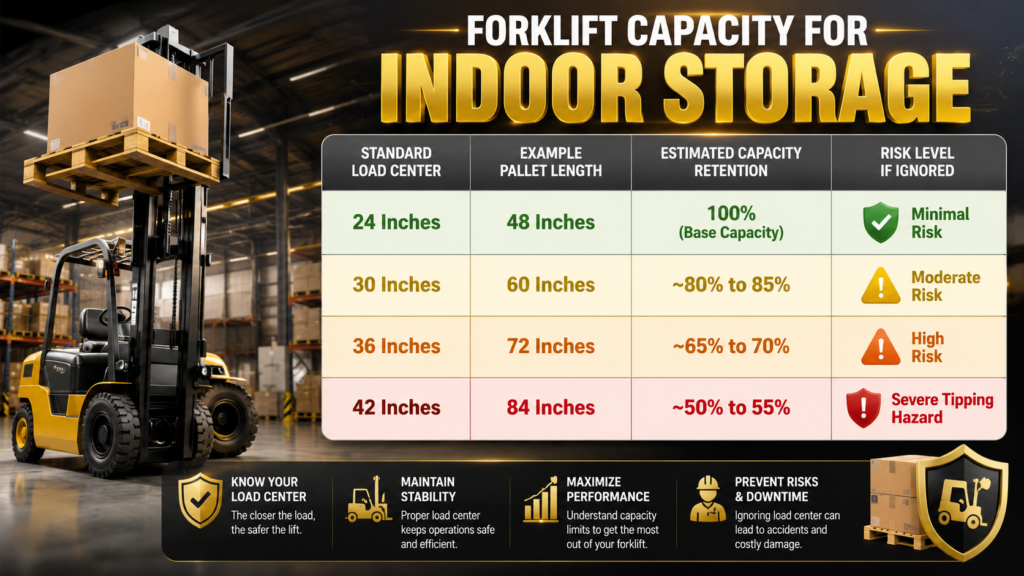
Table: Forklift Capacity for Indoor Storage
| Standard Load Center | Example Pallet Length | Estimated Capacity Retention | Risk Level if Ignored |
| 24 Inches | 48 Inches | 100% (Base Capacity) | Minimal Risk |
| 30 Inches | 60 Inches | ~80% to 85% | Moderate Risk |
| 36 Inches | 72 Inches | ~65% to 70% | High Risk |
| 42 Inches | 84 Inches | ~50% to 55% | Severe Tipping Hazard |
- Establishing the precise center of gravity of your facility’s most common and heaviest palletized commodities.
- Understanding the effect of lengthy, abnormally long load lengths on the overall safe lifting capability of the apparatus.
- Always keep chosen forks a minimum of 2/3 the overall length of your longest continuous load.
Selecting the Proper Power Source for Indoor Operations
Just as important as figuring out raw weight restrictions for interior storage and loading is carefully identifying the suitable forklift capacity and picking the most appropriate power source. Electric forklifts are also the vastly better option for exclusively inside applications; they have a fully zero-emission output and run with a very quiet daily operation.
They are quite strong, but they give out dangerous fumes (carbon monoxide, etc.) that build up fast in confined warehouses unless you have expensive, professionally-installed ventilation systems.
Large industrial batteries easily power electric forklifts, and it is very important to have a good grasp of battery capacity in order to precisely determine your maximum run time. Battery capacity is a direct measurement of the entire electrical charge contained in the cells, and rigorously dictates exactly how many continuous hours the machine may safely operate before needing a needed recharge.
Carefully monitoring battery life and ensuring that the battery compartment size properly matches your chosen equipment guarantees a flawlessly continuous warehouse operation and absolutely eliminates unexpected, tremendously expensive downtime. With standardized battery model identification codes, you can easily tell the right battery for your electric forklift. The model identification code will tell you the battery style, cell specs and voltage requirements.
- Assess the whole battery capacity to guarantee no disruption to workflow for a whole busy indoor shift.
- Taking into account the physical size of the battery compartment and its direct effect on the footprint of the chassis of the forklift.
- Electric-powered material handling equipment should be used in enclosed locations wherever possible to avoid very harmful exhaust emissions.
Forklift Attachments and Carriage Types Considerations
Customizing your material handling equipment with highly specialized attachments may dramatically increase your overall operating efficiency, but it inevitably complicates the delicate process of choosing the proper forklift capacity for interior storage.
Attachments such as side-shifters, hefty paper roll clamps, carton clamps or specialty hook forks inherently add a lot of physical weight to the front end of the forklift. This additional dead weight and the fact that attachments almost invariably move the load centre farther away from the mast, combine to provide a much decreased net capacity that operators need to respect.
The forklift carriage—the immensely important front-end structural platform that firmly holds the load backrest, prongs, and any attachments—is very critical for loads stability and correct daily material handling. If you are looking to buy new equipment or accessories proactively, knowing the carriage class of your particular forklift is very important to make sure that they are mechanically compatible with the very specific demands you have.
You also get an in-depth grasp of the fluid mechanics of the hydraulic lift cylinders that regulate the mast, forks and carriage elevation, to fully comprehend the enormous hydraulic force needed to manage big loads safely, time after time. If your facility needs sophisticated attachments to handle unpalletized commodities, you need to get a forklift with a much greater base capacity to manage the expected deration easily.
- Establishing the actual weight of any extra attachments such as side-shifters or specific material handling clamps.
- Assessing your individual carriage class structural compatibility before to acquiring any new front-end lifting equipment.
- Refining your derated capacity estimates for the unavoidable forward shift in the load’s center of gravity.
FAQs: What You Should Know About Forklift Capacity for Indoor Storage
What is the right way to determine the maximum lifting capability of a forklift?
The original manufacturer uses detailed structural engineering, the mass of the rear counterweight, the overall hydraulic cylinder strength, and a standard, unshifting load center (usually 24 inches in North America) to compute a forklift’s capacity with precision. This intricate mathematical computation securely assumes the palletized weight is absolutely equally distributed and impeccably centered precisely on the forks.
How does the load center influence my forklift’s total lifting capacity?
The load center defines rigidly the crucial mechanical balance of the heavy machinery. If an industrial load is very lengthy or too unevenly shaped, the actual center of gravity is instantly shifted far further from the carriage. If the load center is much larger than the typical 24 inch load center, then the total safe lifting capability drops fast and dramatically to keep the machine from tipping dangerously forward for every inch the load center is exceeded.
What are the immediate physical hazards of overloading an interior forklift to a dangerous degree?
Overloading a big forklift quickly throws the delicate balance of the machine off making it prone to catastrophic forward tipping hazardous sideways rollovers and enormously smashed goods. It puts immediate and severe and irreversible stress on the vertical mast, front carriage and hydraulic lift cylinders and may shatter the steel forks, allow the heavy load to tumble uncontrolled and, sadly, result in deadly industrial casualties.
How can I proactively choose the perfect forklift capacity for my warehouse needs?
You must methodically study the absolute maximum peak weight of your ultimate heaviest inventory, precisely measure your maximum vertical rack heights and correctly identify the exact physical dimensions of your regular facility loads to choose the absolutely ideal capacity. Be sure to always figure in the dead weight of any front end attachments that you may need mathematically, and boldly speak with a highly respectable, trusted dealer like American Forklifts to completely guarantee your ultimate net capacity precisely fits your daily demands.
Can an operator legally or technically enhance the lifting capability of a normal forklift?
No, you cannot legally or irresponsibly alter a forklift’s official lifting capacity by adding additional rear counterweights or illegally modifying the hydraulic lift cylinders, as this would completely destroy the original manufacturer’s structural integrity and would be in strict violation of any standard OSHA regulation. A machine that can lift 8,000 pounds is not the same as a machine that can lift 8,000 pounds safely. If you really need to handle much greater warehouse loads you have to invest legally and securely in a higher capacity equipment.
What precisely does ” derated capacity ” entail in the material handling sector ?
Derated capacity (formally net capacity) is the maximum safe lifting limit for a large fork lift that has been structurally decreased after carefully considering the real-world changes to the warehouse. This is solely a mechanical addition of specialized front end attachments, sometimes using unusually long forklift prongs or routinely lifting big loads fast above conventional manufacturer heights, both of which significantly reduces the machine’s factory base strength.
Conclusion: How to Maximize Safety and Efficiency in Your Warehouse
Choosing the precise suitable forklift capacity for interior storage and loading is much more than a simple, daily purchase choice. It’s a key, fundamental pillar of long-term warehouse safety and continuous operational success.
By taking the time to thoroughly evaluate your specific facility’s square footage, fully understanding the very complex relationship between varying load centers and derated machine capacities and considering the very unique power requirements of indoor environments, you protect your hard working employees and your valuable, expensive inventory.
Never forget that rigorous equipment standards such as suitable carriage class, maximum mast height, sufficient electric battery capacity and availability of appropriate cushion tire all play tremendously essential roles in the safe, everyday operation of your logistics fleet.
The only way to assure exceptionally reliable productivity in safe, fluid, and fully compliant material handling operations is to rely solely on highly accurate manufacturer-provided data plates and to have a complete grasp of the specific mechanical terminology meticulously laid out by industry leaders.
Here at American Forklifts, we are profoundly and passionately devoted to helping you continue to get the important instructional tools and high quality industrial equipment that you so badly need to effectively and securely negotiate these incredibly difficult warehouse size regulations. You’re not going to abandon your everyday operational safety to blind guessing.
Take a carefully calculated, data-driven approach to your complete fleet management. And, certainly, always give priority to the exact mathematical bounds of your heavy industrial machines.
- Work with renowned, authorized industry vendors like American Forklifts to get professional, tailored equipment sizing.
- Strictly enforce the weight thresholds on the data plate to ensure the safety of the daily warehouse operators.
- Review the capabilities of your whole handling fleet often and comprehensively as your company inventory and physical storage demands change.