Forklift Safety Checklist: Daily Pre Use Inspection for Your Team
Operating a forklift in a busy warehouse, retail floor or outdoor construction site is a big responsibility. Ensuring these powerful equipment are running optimally is not only a compliance issue, it is a basic necessity for the safety and productivity of your whole supply chain. Forklift Safety Checklist Your first line of defense against catastrophic mechanical failures and workplace catastrophes.
The approach is less about reactive maintenance and more about proactive fleet management by bringing the managers and operators into a daily pre-use check. American Forklifts is in favor of this forward-thinking attitude, noting that little oversights now might turn into big dangers tomorrow.
A daily check-up helps keep your team running, your costly goods secure and, most importantly, every worker home safe at the end of a shift. This comprehensive guide will take you through the important points of a forklift safety checklist and how regular inspections can keep your equipment running at maximum efficiency.
Why Your Team Needs a Daily Use Inspection
Proper material handling and warehouse safety starts with daily pre-use inspection. Every change brings new obstacles and potential for more wear and tear on your industrial equipment.
Operators who faithfully fill out a forklift safety checklist are doing their part to help develop a safety culture that puts well-being before quick productivity. Without these vital checks, fluid leaks may be missed, braking systems might be compromised or structural fatigue can develop which dramatically increases the chances of tip overs and collisions.
Not inspecting a motorized industrial vehicle before usage is an obvious infraction of industry regulations and OSHA legislation that might lead to hefty fines and dire repercussions. Daily inspections also complement your long term planned maintenance programs by identifying acute issues rapidly, filling in the gap for those 250-hour or 500-hour full service intervals.
- Avoids catastrophic failure: Detecting minor issues such as a frayed hydraulic line or a loose lug nut helps avoid significant breakdowns during heavy lifting activities.
- Maintains regulatory compliance: A recorded forklift safety checklist performed daily makes your facility compliant with strict rules and protects against legal penalties.
- Encourages a safety-first culture: When operators take responsibility of their daily pre-use checks, it encourages broad accountability and heightened situational awareness throughout the whole team.
Important Elements of a Forklift Safety Checklist
Creating a successful forklift safety checklist involves a systematic process that encompasses all essential parts of the equipment. Usually the inspection can be classified into two broad types. One is the visual walk-around examination when the engine is off and the other is the operational inspection while the equipment is operating.
This two-pronged strategy covers all bases, from the integrity of the overhead guard to the responsiveness of the steering column. Your checklist has to be readily available, very thorough, and adaptable to the sort of equipment your team uses, whether it’s internal combustion (IC) engines or electric motors.
A detailed checklist is a solid guide to assist the operator in systematically checking the chassis, mast, tires, forks and power sources. This technique, standardized, allows managers to simply monitor the health of their fleet over time, and to plan expert treatments exactly when they are required.
- Standardized documentation: Use the same checklist for all shifts to maintain consistency and to have a detailed history of maintenance on every equipment in your fleet.
- Categorical assessment phases: Dividing the examination into visual and operational phases avoids operators from feeling overburdened and enables a systematic and complete check.
- Fuel type customizations: The best forklift safety checklist will include specific checks for electric batteries, propane tanks or diesel engines.
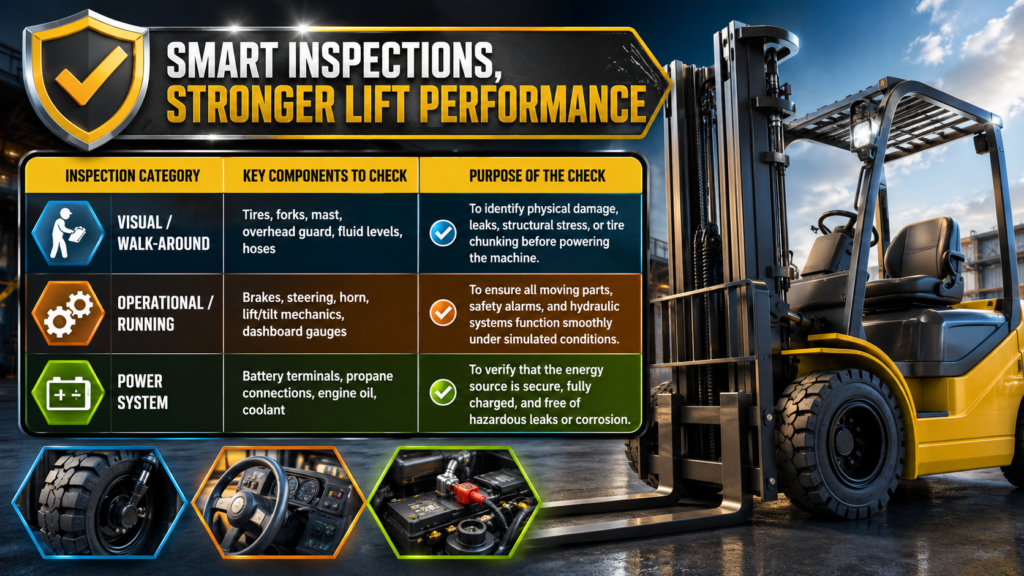
Table: Forklift Safety Checklist: Daily Pre Use Inspection
| Inspection Category | Key Components to Check | Purpose of the Check |
| Visual / Walk-Around | Tires, forks, mast, overhead guard, fluid levels, hoses | To identify physical damage, leaks, structural stress, or tire chunking before powering the machine. |
| Operational / Running | Brakes, steering, horn, lift/tilt mechanics, dashboard gauges | To ensure all moving parts, safety alarms, and hydraulic systems function smoothly under simulated conditions. |
| Power System | Battery terminals, propane connections, engine oil, coolant | To verify that the energy source is secure, fully charged, and free of hazardous leaks or corrosion. |
Visual Inspections What to Check Before Starting the Engine
Before the key is even placed in the ignition, you must do the visual part of your forklift safety checklist thoroughly. Operators need to do a 360-degree walk-around, actively looking at the floor for pools of oil, coolant, or hydraulic fluid, which might be indicators of a growing leak. The other major problem is the state of the tyres.
Depending on your surroundings you may be employing cushion tires for smooth inside warehouse concrete or pneumatic tires for rugged outside lumber yards. Operators should measure total rubber height, check pressed rim fit, and look for chunking, deep ripping or embedded debris.
Forks and mast assembly must also be visually inspected. Operators should examine the forks for cracks, bends and uneven wear, and mast chains for optimum tension and lubrication.
The overhead guard and load backrest extension should be in the position and free from structural bending, since they are the principal safety nets to protect the operator from falling merchandise.
- Tire health and traction: Checking solid and pneumatic tires for safe wear lines prevents the chassis from taking on too much vibration which increases the wear and tear on other mechanical elements.
- Hydraulic integrity: An inspection of all high-pressure hoses, O-rings and cylinder seals for active leaks will confirm that the lifting mechanisms will not fail under a severe load.
- Structural soundness: Checking for hidden stress cracks on the mast, forks and overhead guard verifies that the equipment can safely support its full rated weight capacity.
Operational checks – testing your kit in motion
If the visual inspection is successful, the operators then need to proceed with the operational part of the forklift safety checklist. This means starting the engine or switching on the electric motor to evaluate the dynamic capabilities of the device.
The first thing is that the braking system has to be very carefully and strictly assessed. They should also examine the service brakes and parking brake, listening for loud screeching noises and feeling for soft or sluggish pedal action. The steering should be precise and responsive, not too much free play.
Then, the hydraulic lifting force has to be tested. To check for jerky, stuttering movements or exceptionally slow lifting speeds that suggest internal pump friction, operators may raise, lower and tilt the mast assembly under a simulated load. If your hydraulic pump is running properly it should growl in a low controlled manner not scream like a banshee.
Finally, all safety gadgets such as the horn, backup alarms, turn signals and dash warning lights must be inspected to ensure they are completely working for pedestrian awareness.
- Braking and steering response: Good brakes that stop smoothly and steering that isn’t too loose avoid catastrophic crashes and fast load tipping.
- Hydraulic Motion Testing: The lift, lower, and tilt controls are tested to ensure mast chains and carriage rollers move smoothly and don’t stutter in a risky way.
- Audible and visual alerts: Horns, backup alarms and indication lights must operate properly to help maintain safe traffic management in busy locations.
Examination of Battery and Power Systems
The power system is the lifeblood of your material handling equipment and its condition is a significant part of any thorough forklift safety checklist. For electric versions, battery maintenance is much more than just putting the device into a charger at the end of the shift. Inspect the battery case for physical damage and acid leaks that might pose a hazard to the equipment and workplace.
It’s important to make sure operators are not operating the units below the recommended 20% capacity since this results in excess heat and lasting damage to internal components. Lead acid batteries need to have the electrolyte levels checked and filled with distilled water to maintain the proper chemical equilibrium. Check battery terminals, cables and connections for corrosion to ensure safe and efficient power supply.
If you are using internal combustion engines, especially propane, inspect the fuel lines, tank brackets and make sure there is no black residue on the exhaust. However, by carefully monitoring these power elements, companies may benefit from the excellent longevity of these parts, which can last up to five years or around 1,500 charge cycles for well-maintained electric batteries.
- Electrolyte and charge monitoring: Proper watering and charging of electric batteries avoids irreversible heat damage to internal power cells.
- Terminal and cable hygiene: Removing rust from the battery connections and ensuring that the electrical harnesses are intact, ensures power is transmitted efficiently to the drive motors.
- Fuel line safety: Thorough inspection of propane tanks and diesel fuel lines for tight couplings and leakage averts catastrophic fire threats in the plant.
How Team Training Helps You Implement Effective Safety Protocols
A very precise forklift safety checklist is just half the fight, the other half is all about the ability and commitment of your staff. The only thing that can really be done to make sure every person behind the wheel knows precisely what they are examining and why it is important is comprehensive operator training.
Operators must be able to tell the difference between a modest cosmetic scratch and a major structural fracture on a lifting fork. Training programs must include equipment-specific operating methods, danger detection, principles of load stability, and emergency response protocols.
This helps the staff grasp the mechanical logic behind the forklift safety checklist and makes it significantly more likely that they will take the inspection seriously rather than regarding it as a meaningless paperwork exercise.
Regular reviews of inspection records by supervisors can help detect severe operator behaviours, signalling training opportunities that will eventually decrease long-term wear and tear on the equipment. The most effective diagnostic tool a warehouse can have is a well-trained workforce.
- Mechanical literacy: Educating operators on how hydraulic pumps and brake systems operate enables them to recognize danger indicators during their daily inspection.
- Accountability and logging: Training personnel to properly complete and submit inspection paperwork creates a dependable paper trail for compliance and repair scheduling.
- Continuous behavioral improvement: Daily records let management identify reoccurring concerns that may be addressed with tailored training interventions to remedy destructive driving practices before they ruin the machine.
Commonly Asked Questions About Forklift Daily Inspection
What’s on the daily forklift safety checklist?
Visual condition of tires, forks, and the mast should be included in a complete forklift safety checklist. It must also involve inspections of the brakes, steering, warning systems such as horns and backup alarms and checks of fluid levels (hydraulic, oil, coolant).
How frequently do forklifts have to be inspected legally?
Standard industry requirements require that forklifts be examined at least once a day before being brought into use. If the forklift is used on a 24-hour, multi-shift basis, it must be inspected before each shift.
What should the operator do if a flaw is found during the inspection?
If a flaw is found which impairs the safe operation of the vehicle, the operator should immediately withdraw the forklift out of use. They should lock out or tag out the equipment and notify their supervisor of the problem so certified personnel may do the repairs.
Is the checklist the same for electric and IC forklifts?
There are many common parts like as brakes, tires and forks, but the checks on the power system are quite different. IC versions need inspections of engine oil, coolant and fuel tank connections but electric models need battery terminal, water level and charge cycle checks.
If there is an issue on the checklist, can anybody do maintenance?
Nope. Repairs and deep maintenance on forklift trucks should only be carried out by professionally skilled and licensed persons, such as a dealer service engineer or a well trained in-house mechanic to ensure optimum safety and compliance.
What is the difference between daily checkups and scheduled periodic maintenance?
Daily pre-start checks are short visual and functional inspections completed by the operator to identify imminent safety threats. Planned maintenance consists of a sequence of mechanical diagnostics and part replacements conducted by qualified personnel at scheduled hour intervals (e.g., 250 or 500 hours).