Why Unsafe Forklift Operation Cost More Than New Equipment
Material handling equipment is the very lifeblood of everyday production in the fast-paced world of warehousing, shipping and manufacturing. Facility managers and company owners are always looking for ways to save expense and increase profit margins, which typically means delayed equipment improvements or hurried operator training. But the cold, hard truth is that neglecting aging equipment and insufficient training procedures paves the way for calamity.
Introduction to the Truth of Unsafe Forklift Operation
Unsafe forklift operation is not just a compliance concern, it is a ticking time bomb that may obliterate a company’s bottom line quicker than any market slump. There is a serious misperception on the part of many decision-makers. They feel that they just cannot afford to buy new, upgraded equipment. Indeed, the financial, legal and operational ramifications ensuing from one workplace disaster far outweigh the initial outlay necessary to update a fleet.
When leadership allows dangerous forklift operating to become the established standard on the warehouse floor, they are unintentionally exposing their whole organization to huge dangers that often result in bankruptcy, harsh regulatory crackdowns and permanent reputational harm.
- The financial realities of workplace mistakes: Violating safety rules represents a concrete, uncertain cost drain that dwarfs capital expenditures.
- The psychological cost for warehouse operators: A dangerous atmosphere demoralizes the staff, which results in increased staff turnover and decreased daily output.
- Expense of liability vs investment in machinery: The expense of just one serious accident may easily pay for the purchase of a full fleet of brand new, technologically sophisticated forklifts.
The financial cost of Unsafe forklift operation
An accident caused by an improper forklift operation creates a financial shockwave that is only the tip of the iceberg. According to industry data and safety groups, the average cost of a single forklift accident is around $135,000.
The human cost is just as important as the financial cost of injuring an employee. The immediate costs—emergency room hospital expenses, continuing medical care and normal workers’ comp claims—are astonishing ranging between $38,000 and $41,000 each event. But the real financial is in the domain of indirect expenses.
An accident immediately cripples a facility. The area is sealed off for inquiry, and productivity grinds to a standstill. Any structural damage to racking systems or inventory is also an expensive and rapid repair or replacement to the damaged forklift.
Businesses also have to hire and train temporary workers to cover for the injured worker, while suffering from a drop in team morale and disruptions to supply chains. Add up the total cost of damage caused by unsafe forklift operation and it becomes painfully obvious that running outdated equipment is the most expensive operational mistake a company can make.
- Direct costs: Medical expenses and workers’ compensation. The immediate cost of caring for and recovering employees can wipe out cash reserves overnight.
- Indirect expenses (downtime, temporary labor): The initial financial losses are exponentially increased by the requirement to stop operations and hire emergency workers.
- Insurance premiums will rise long-term: Insurance companies really hammer firms with poor safety records and you will pay for the accident for years to come.
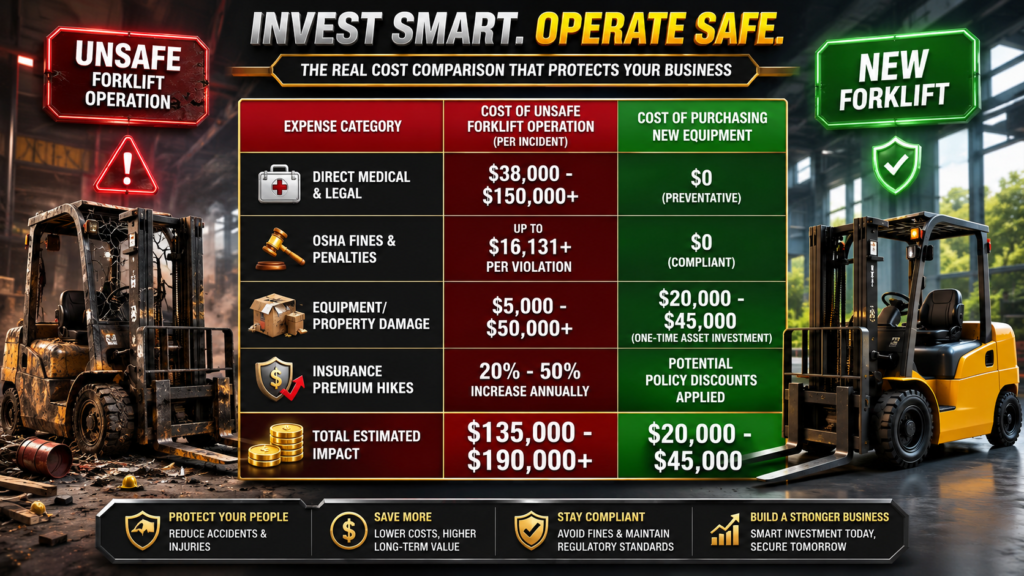
Table: Unsafe Forklift Operation Vs New Forklift
| Expense Category | Cost of Unsafe Forklift Operation (Per Incident) | Cost of Purchasing New Equipment |
| Direct Medical & Legal | $38,000 – $150,000+ | $0 (Preventative) |
| OSHA Fines & Penalties | Up to $16,131+ per violation | $0 (Compliant) |
| Equipment/Property Damage | $5,000 – $50,000+ | $20,000 – $45,000 (One-time asset investment) |
| Insurance Premium Hikes | 20% – 50% increase annually | Potential policy discounts applied |
| Total Estimated Impact | $135,000 – $190,000+ | $20,000 – $45,000 |
OSHA Fines and Legal Penalties for Unsafe Forklift Operation
OSHA has strict rules about handling materials and they won’t tolerate dangerous forklift operations. When a firm is discovered to be operating out of compliance, whether that be using defective equipment, failing to certify personnel, or skipping daily inspection processes, the regulatory hammer hits with devastating power.
OSHA’s penalties for major safety infractions may be as high as $16,131 per violation. If an investigation decides that the dangerous forklift operation was a “willful” or “repeated” violation, those fines may soar, greatly compounding the financial suffering.
In the last several years, OSHA has levied more than $8 million in fines for forklift safety breaches across US sectors, issuing thousands of tickets. And besides government penalties, firms have opened themselves up to severe personal injury litigation. Injured workers, or third-party contractors affected by improper equipment operation, have the right to pursue aggressive financial compensation.
The legal expenses alone to fight the firm in court may financially destroy smaller businesses, making the option to not buy new equipment seem exceedingly short-sighted.
- Astronomical punishments for knowing violations: Repeated carelessness will multiply penalties significantly imposed on a company’s gross sales.
- Negligence personal injury lawsuits: The law holds employers to a high standard for not providing safe, properly working equipment.
- Strict post-accident regulatory audits: After an event, activities will be subjected to severe, continuous review by government safety inspectors.
The Ripple Effect on Productivity and Morale
A warehouse is only as good as the symbiotic rhythm between the people and their equipment. Poor forklift operation may seriously damage this fragile ecology. Employees are working in a constant state of fear, having to operate old, broken-down forklifts that have no contemporary safety features such as proximity sensors, ergonomic controls or reinforced overhead guards.
This latent dread slows their operational speed and general output considerably as they are forced to continually adjust for the limitations of the equipment. The management’s unwillingness to replace harmful equipment also conveys a poisonous psychological message to the workforce: their safety is less essential than saving a few bucks.
The real cost of hazardous forklift operating is made much worse by the hidden expenses of finding, hiring, and training new employees to replace those who left a dangerous workplace.
- Loss of valuable contracts owing to safety record blemishes: High-profile customers routinely evaluate the safety record of their partners and will terminate contracts if the procedures are unsatisfactory.
- Negative public relations and media exposure: An accident at the workplace could get local media attention, leading to a long-lasting negative impact on the brand’s image.
- Getting the best warehouse staff is a challenge: Skilled forklift operators want safe working conditions and will stay away from organizations with old equipment.
American Forklifts: Investing Money in Safety and New Equipment
To address the concerns of hazardous forklift operating, you need a proactive and committed relationship with industry specialists that understand the complexities of material handling. At American Forklifts, we’re dedicated to helping companies migrate from high-risk situations to updated, highly efficient powerhouses.
Buying new equipment from our large inventory isn’t only for the shiny machines. It’s a business decision that minimizes risk and maximizes lifespan. Today’s forklifts come with modern safety features such automatic speed controls, greater panoramic vision, load stability sensors and pedestrian recognition alarms to avoid accidents before they occur.
American Forklifts provides the best equipment, but also stresses the significance of proper operator training. You put in a fresh new fleet in a warehouse, it has to come with extensive certification processes that meet OSHA standards to make sure that each driver knows the power of the equipment.
Partner with us to actively reduce the liabilities of dangerous forklift operating, converting your warehouse into a shining example of safety, efficiency and significant profitability.
- Complete OSHA compliance operator certification programs: Making sure every worker has the information to operate machines without putting themselves or others in danger.
- Latest forklift equipment: Access gear fitted with the latest safety sensors, ergonomic designs and automatic stabilization features.
- Facility safety assessments to reduce hazards: Proactive evaluations that eliminate structural and operational concerns before they become expensive workplace casualties.
FAQs about Unsafe forklift operation
How Much Does a Forklift Injury Cost?
The average cost for forklift injuries for companies is between $40,000 and $150,000 depending on the severity of medical care, property damage, and legal ramifications due to the occurrence.
Can Businesses be Held Responsible for a Forklift Crash?
Yes, businesses are often confronted with serious litigation from wounded workers, visiting contractors or third parties if gross carelessness or dangerous forklift operating is proved to have caused the disaster.
How can forklift certification help reduce insurance premiums?
Insurance companies are willing to reward businesses with reduced premium rates when they see that the operators are completely trained. Proper training dramatically decreases the statistical risk of claims and shows that a firm is taking a proactive approach to risk management.
What are the leading causes of avoidable forklift injuries?
The leading, fully avoidable causes include vehicle tip-overs, hitting pedestrians, illegal stacking of loads, failure to wear the necessary seatbelt and driving with poor visibility owing to obsolete equipment.
How much do forklift accidents cost the economy every year?
Industry data shows that forklift accidents result in a huge economic impact of almost $135 million annually across sectors in the US alone, making a need for better safety solutions.
How does automaker safety compare to conventional safety?
In addition to conventional safety, recent innovations include RF-tag pedestrian detection systems and visual AI monitoring that actively notify cars to workers nearby and automatically check facility speed restrictions.
What are the indirect expenses of a missed workday injury?
In addition to the direct medical expenditures, firms lose around $38,000 in indirect costs for each missed workday injury. That includes facility downtime, emergency equipment repairs, administrative fees and employing temporary workers.
Conclusion: The Right Investment for Your Fleet for Unsafe Forklift Operation
Ultimately, the option between keeping old, risky gear running or investing in fleet modernization is a choice between gambling with your company’s future or ensuring its success.
Unsafe forklift operation is a systematic, chronic problem that is silently draining a company’s resources via lost productivity, continuous maintenance and the ever-present risk of catastrophic liability. Business owners need to look beyond the initial sticker price of new equipment and see the great return on investment that comes with a safe, efficient and compliant work environment.
Partnering with American Forklifts for modern, technologically sophisticated equipment ends dangerous forklift operating and safeguards your most important assets: your people and your hard-earned wealth. The math is not lying. The expense of medical claims, legal settlements, OSHA penalties and destroyed reputations far exceeds the cost of buying dependable new equipment. Choose wise and authoritative for your firm now and safety will determine your revenue tomorrow.
- Human life should be prioritized before operational shortcuts: Remember no deadline is worth the bodily and financial devastation of an accident.
- Realise that operating forklifts unsafely is a huge financial liability: Begin to change the business attitude to see fleet modernisation as a wealth-protection strategy.
- Invest in periodic equipment updates & continual employee education: Collaborate with American Forklifts to keep your site at the forefront of industry safety protocols.