Forklift Customization made easy! Explore branding, lighting, and safety features
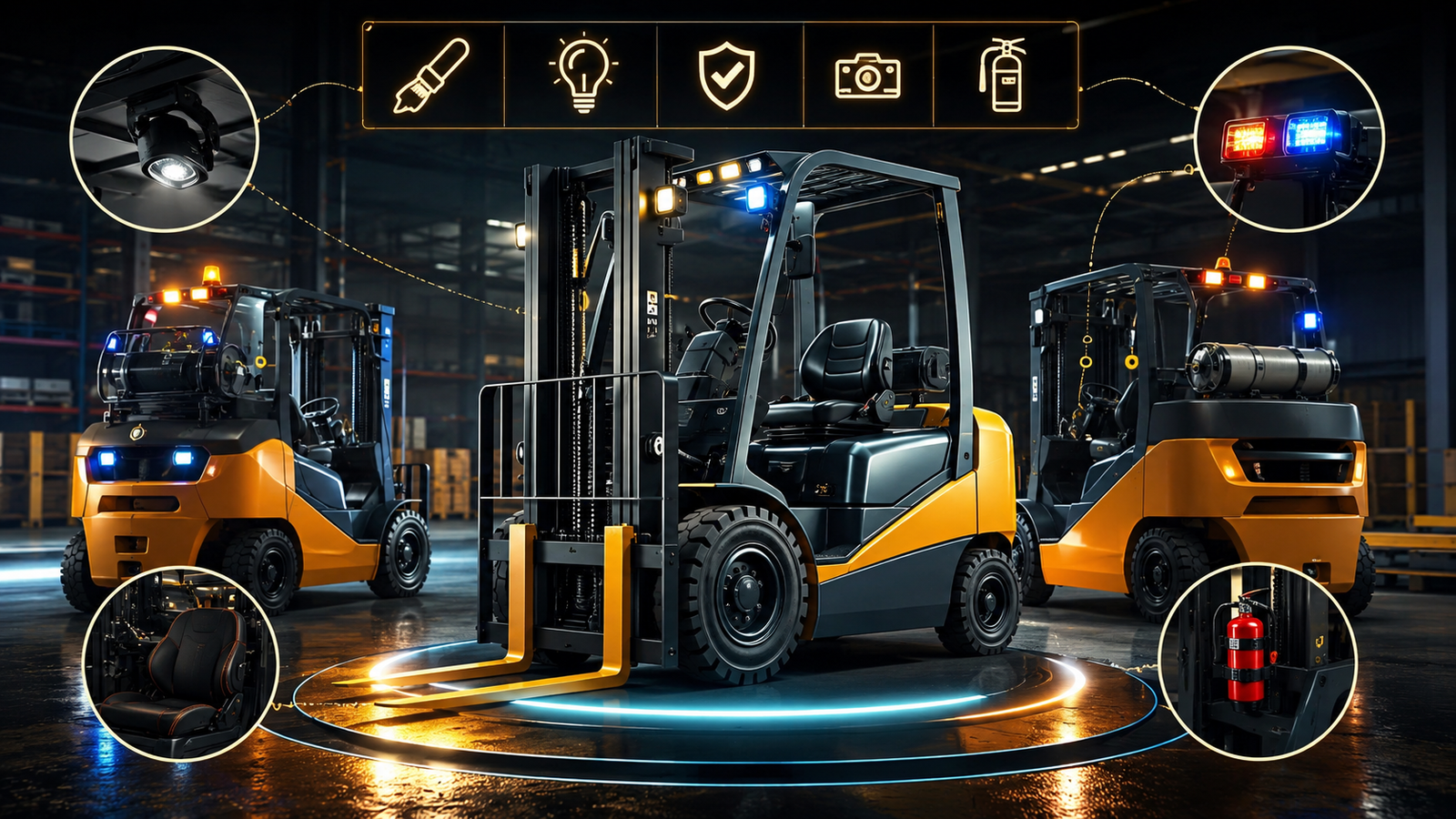
Forklift Customization Options: Adding Branding, Lighting, and Safety Features
Let’s be honest about buying new material handling equipment. When a shiny new lift truck rolls off the delivery flatbed, it looks great and works exactly how the manufacturer intended. But standard, out-of-the-box machinery is built for an imaginary, perfectly flat, perfectly lit warehouse that doesn’t actually exist. In the real world, you are dealing with blind corners, slippery loading docks, weirdly shaped inventory, and operators who have to sit in that seat for eight hours straight which can be solved using forklift customization options.
That is exactly why settling for a vanilla machine usually ends up costing you more in the long run. Exploring practical forklift customization options isn’t about making your equipment look flashy; it’s about making it actually work for your specific building and your specific crew. At americanforklifts.org, we see firsthand how tweaking a machine to match its environment can completely change the vibe of a warehouse floor. You stop fighting the equipment and start getting things done safely.
- Tailoring your machines to fit your actual floor plan means fewer scraped racks and less dropped inventory.
- Giving your operators comfortable, ergonomic upgrades keeps them focused and reduces the physical toll of long shifts.
- Modifying your fleet protects the massive financial investment you’ve made in your heavy machinery.
Why Tailoring Your Fleet Actually Saves You Money
I talk to facility managers all the time who think custom add-ons are just a luxury meant for massive corporate distribution centers. But think about what actually eats into your profit margins every month.
It’s the damaged pallets, the worn-out tires from the wrong floor types, and the sheer amount of time operators waste trying to maneuver a generic machine into a tight spot. When you invest in forklift customization options, you are basically putting a stop to those hidden daily losses.
If your guys are moving odd-sized lumber or heavy auto parts, standard forks are going to slow them down. Slapping on the right hydraulic attachment or upgrading the carriage saves minutes on every single lift. Over a year, those saved minutes turn into serious labor savings.
Plus, there is the maintenance side of things. If you are running a truck in a dusty manufacturing plant without customized filter guards, that engine is going to choke out way before its time. Customizing isn’t just bolting stuff on; it’s protecting the core of the machine.
When the equipment matches the job, your hydraulic lines don’t blow as often, your tires last longer, and your mechanics aren’t working overtime fixing preventable damage.
- Customized attachments mean your operators spend less time adjusting loads manually, speeding up daily quotas.
- Matching tires and engine protection to your specific environment drastically cuts down on surprise repair bills.
- When a machine is dialed in for a specific task, operators are less likely to force it to do things that break it.
Forklift Branding: It’s Not Just About Looking Good
When I bring up forklift branding to warehouse owners, they usually laugh and ask why they need to paint a workhorse. But hear me out on this one. If you have vendors, clients, or freight drivers constantly walking through your facility, what kind of message does a fleet of scratched up, mismatched trucks send? Custom paint jobs, company logos, and specific color schemes turn a basic piece of iron into a professional asset.
It tells anyone walking the floor that you run a tight ship. But beyond just looking professional, using branding as part of your forklift customization options actually solves a ton of logistical headaches, especially if you have a massive facility.
Think about how annoying it is when a machine meant for the clean shipping area ends up covered in grease over in the maintenance bay. By color-coding your trucks—say, blue for receiving and yellow for the loading dock—you can instantly see when a machine is out of bounds.
It keeps your departments organized without you having to micromanage. And honestly, it changes how the operators treat the equipment. When a guy gets assigned to a clean, branded truck with his department’s logo on it, he is way more likely to take pride in it and stop treating it like a bumper car.
- Branded equipment completely changes the aesthetic of your warehouse, impressing visiting clients and partners.
- Color-coding your fleet makes it incredibly easy for managers to spot missing or misplaced equipment from across the floor.
- Operators tend to take much better care of machines that look professional and are tied to their specific department.
Forklift Lighting Options: Seeing What’s Actually There
Let’s talk about warehouse lighting, because nine times out of ten, it’s terrible. Standard factory headlights on a lift truck are basically just enough to pass basic inspection. But when an operator is driving out of the bright afternoon sun straight into a dark, unlit fifty-foot shipping container, those factory halogen bulbs are practically useless.
This is where upgrading your forklift lighting options changes the game. Swapping out the old stuff for high-output LED work lamps means your driver can actually see the back of the trailer or the top tier of the storage rack without straining their eyes.
But it’s not just about seeing the racks; it’s about making sure other people see the forklift. Warehouses are loud. People wear earplugs. Backup alarms get drowned out by the noise of machinery and radios.
Adding visual warning lights is probably one of the smartest forklift customization options you can invest in. When you have strobes and boundary lights projecting onto the floor, a pedestrian walking out from a blind aisle sees the light before the truck even turns the corner. It takes the guesswork out of intersections.
- Swapping to heavy-duty LED work lights pulls less battery power while throwing out way more usable light in dark areas.
- Adding directional spotlights helps operators perfectly align their forks when pulling inventory from high, shadowed racking.
- Using flashing amber beacons ensures your equipment is highly visible, even in environments with overwhelming background noise.
Forklift Safety Features: Keeping Your Crew Intact
At the end of the day, nothing matters more than sending your crew home in one piece. The statistics on warehouse accidents are pretty grim, and most of them happen simply because someone didn’t look, or an operator couldn’t see them.
This is where you really need to prioritize your forklift safety features. Standard seatbelts and horns are great, but they aren’t enough to prevent a guy from getting squeezed against a rack. Adding smart aftermarket safety tech creates a bubble of awareness around the machine that wasn’t there before.
We always tell our clients at American Forklifts that investing in safety isn’t just about avoiding a nightmare scenario or maintaining OSHA compliance; it actually speeds up work. When operators know they have cameras covering their blind spots, they move with more confidence.
When pedestrians clearly see the safe distance they need to keep, they don’t hesitate at crosswalks. It smooths out the entire traffic flow of your building.
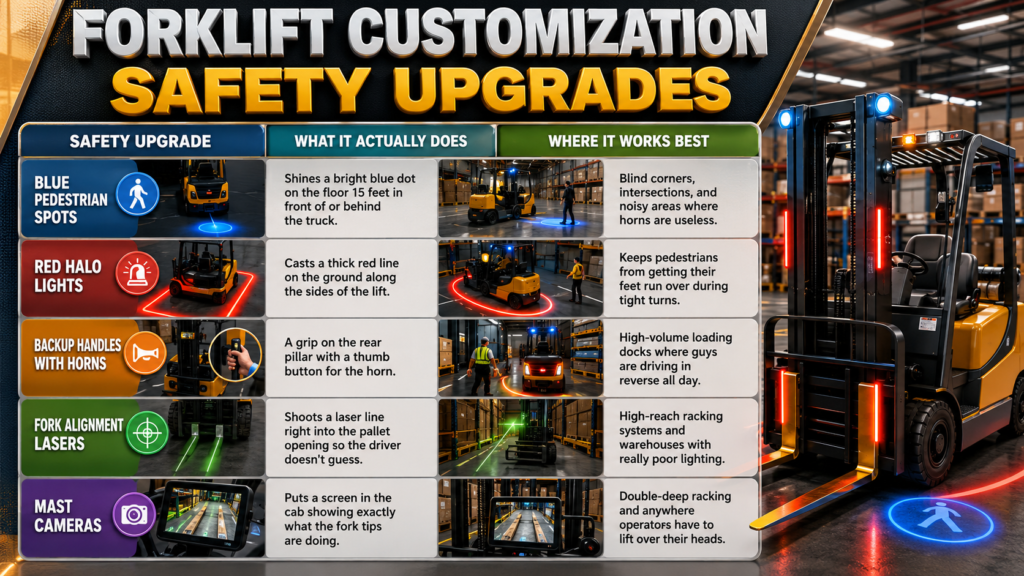
Table: Forklift Customization Options Safety Upgrades
| Safety Upgrade | What It Actually Does | Where It Works Best |
| Blue Pedestrian Spots | Shines a bright blue dot on the floor 15 feet in front of or behind the truck. | Blind corners, intersections, and noisy areas where horns are useless. |
| Red Halo Lights | Casts a thick red line on the ground along the sides of the lift. | Keeps pedestrians from getting their feet run over during tight turns. |
| Backup Handles with Horns | A grip on the rear pillar with a thumb button for the horn. | High-volume loading docks where guys are driving in reverse all day. |
| Fork Alignment Lasers | Shoots a laser line right into the pallet opening so the driver doesn’t guess. | High-reach racking systems and warehouses with really poor lighting. |
| Mast Cameras | Puts a screen in the cab showing exactly what the fork tips are doing. | Double-deep racking and anywhere operators have to lift over their heads. |
- Visual warning boundaries completely remove the ambiguity of how close a person can safely stand next to a working machine.
- Ergonomic backup handles save your operators from horrible neck and back pain, keeping them productive all week.
- Fork cameras and lasers pretty much eliminate the chance of an operator blindly pushing a pallet off the back of a high rack.
Making It Work in Auto Shops and Odd Spaces
If you run an auto parts distributor or a heavy repair shop, you already know that a standard forklift is going to struggle. Your floors are probably covered in slick oil spots, the aisles are crammed with toolboxes, and you are trying to pick up engine blocks that are heavy on one side and light on the other.
This is exactly why utilizing specific forklift customization options for harsh environments is so critical. You can’t just treat an auto shop like a clean grocery warehouse. You need material handling equipment that fights back against the mess.
The first thing you have to look at is traction and stability. Putting non-marking, slip-resistant tires on your trucks stops them from spinning out on greasy concrete. Then, you have to look at attachments.
Trying to balance a weirdly shaped transmission on two flat pieces of steel is an accident waiting to happen. Grabbing an aftermarket boom or a specialized engine hoist attachment turns that dangerous balancing act into a safe, routine lift. Adding enclosed cabs or heavy-duty overhead guards also keeps shop debris and leaking fluids off your driver.
- Swapping to aggressive, oil-resistant tires keeps your machines moving safely, even when the shop floor gets messy.
- Specialized hooks and booms take the danger out of lifting weirdly shaped, off-center automotive parts.
- Upgraded overhead guards and protective screens keep falling bolts, tools, and fluids away from the person driving the machine.
FAQs- Forklift Customization Options
What are the most common forklift customization options people actually buy?
Most folks start with the practical stuff. High-output LED lights, blue safety spotlights, and ergonomic seats are huge. After that, we see a lot of people adding custom attachments like side-shifters or specialized clamps, and getting custom paint jobs to match their company colors.
How do these upgrades actually improve warehouse safety?
It mostly comes down to visibility. Safety features like red boundary lights and backup cameras let the driver see what they normally couldn’t, and they let guys walking on the floor see the machine coming long before it turns a corner.
Will adding this stuff help with my OSHA compliance?
Absolutely. OSHA loves it when you take proactive steps. Making sure your horns work, adding backup alarms, and upgrading your lights to ensure safe operation in dark trailers are all things that keep the inspectors happy and your guys safe.
Are these customizations worth the money for a smaller business?
Yes, they really are. You don’t have to be a giant corporation to benefit. Spending a little bit on a laser fork guide is way cheaper than replacing a $5,000 rack of inventory because someone couldn’t see what they were lifting.
Which forklift lighting options are the most important?
If you only buy one thing, get the blue pedestrian warning spotlights. After that, swap your dingy factory headlights for bright LED work lamps, and throw an amber strobe on the roof so everyone knows when the truck is moving.
Can I easily add my company logo and branding to my existing trucks?
For sure. A lot of our clients use heavy-duty commercial vinyl wraps or custom decals. It’s an easy way to make a used truck look brand new, and it helps you keep track of which machine belongs to which department.
Is bolting aftermarket forklift accessories onto my truck going to void the warranty?
Generally, non-invasive stuff like bolting on a safety light, changing the seat, or adding mirrors won’t hurt your warranty at all. But if you are doing major structural welding or messing with the hydraulics, you definitely need to clear it with the manufacturer first.
Wrapping It Up – Forklift Customization Options
Trying to force a standard piece of machinery to do a specialized job is just bad business. It frustrates your workers, tears up your facility, and leads to accidents that nobody wants to deal with.
By taking a hard look at forklift customization options, you can take a basic piece of iron and turn it into a tool that perfectly handles whatever weird, heavy, or awkward tasks your warehouse throws at it.
Whether it’s adding better lighting so your night crew can actually see, wrapping the fleet in your company colors, or bolting on safety tech that keeps pedestrians out of harm’s way, it all pays off. At americanforklifts.org, we’re here to help you figure out exactly what your fleet is missing. Don’t just settle for standard—make your equipment work for you.
- Take ten minutes today to ask your forklift operators what their biggest daily annoyances are—they’ll tell you exactly what needs customizing.
- Reach out to the folks at American Forklifts to figure out which aftermarket parts fit your specific make and model.
- Start small by upgrading your safety lights and seats, and watch how much smoother your daily operations run.
