How to Finance a Forklift Without Hurting Your Cash Flow
Let’s be honest, managing the finances of a warehouse, logistics hub, or manufacturing plant is a lot like walking a tightrope. You absolutely need reliable, heavy-duty equipment to keep the products moving and the revenue flowing, but dropping a massive chunk of cash on a brand-new machine can completely wreck your working capital. When an aging lift finally gives up the ghost, or you land a huge new contract and need to expand fast, you have to figure out how to finance a forklift without bankrupting your day-to-day operations.
Here at American Forklifts (americanforklifts.org), we talk to business owners every single day who are stressed about this exact problem. The good news? Securing the right material handling equipment doesn’t have to drain your bank account. By getting smart about your financing strategy, you can get your crew the tools they need while keeping enough cash in reserve for payroll, marketing, and unexpected rainy days. Let’s break down exactly how you can make that happen.
- Keep your safety net intact: Choosing to finance a forklift means you aren’t emptying your business savings account, leaving you well-prepared for any seasonal dips or sudden expenses.
- Make budgeting a breeze: When you have a fixed, predictable monthly payment, forecasting your expenses for the quarter or the year becomes incredibly easy.
- Stop settling for junk: Financing gives you the buying power to get a safer, more efficient, modern machine instead of settling for a worn-out used model just because it was cheap upfront.
Breaking Down Your Main Financing Options
When it comes time to finance a forklift, you aren’t just stuck with one rigid path. Most folks usually pick between an operating lease, a standard equipment loan (buying it outright over time), or just renting one for a bit. Think about how you actually use the equipment before you sign anything.
Are you running the machine into the ground 24 hours a day, or just using it to unload a single truck every afternoon?
Understanding the difference between these paths is the first real step to protecting your cash flow. A traditional loan lets you own the asset right away, while a lease acts more like a long-term rental where you give it back at the end. Rentals are your quick-fix band-aids for temporary spikes in warehouse traffic.
- The standard equipment loan: You own the machine from day one, you build real equity with every payment, and when it’s finally paid off, it’s yours to keep, sell, or modify however you want.
- The operating lease: Think of this as paying only for what you use; you get incredibly low monthly payments and can easily swap it out for a shiny new model every few years.
- The short-term rental: This is perfect for those crazy holiday rushes or temporary projects. You pay a bit more per day, but you can send the machine back the second you don’t need it anymore.
Why Leasing is a Massive Cash Flow Saver
For a huge chunk of the companies we work with, deciding to finance a forklift through an operating lease is an absolute no-brainer. Why? Because you are completely dodging the nasty hit of depreciation.
Instead of a massive down payment that eats into your growth budget, you get manageable, predictable monthly bites. This setup is a lifesaver for businesses that need tough, reliable machinery right this second but just can’t stomach a heavy upfront hit.
Plus, leasing keeps your fleet fresh. If your warehouse operations shift or grow, you aren’t stuck trying to sell a ten-year-old rust bucket on the secondary market. When the lease is up, you simply hand the keys back to the dealer and sign a new agreement for the latest ergonomic model.
- Keep your cash in the bank: Most leases require little to practically zero money down, meaning you get the equipment on the floor working for you without writing a giant check first.
- Kiss surprise repair bills goodbye: You can usually bundle your planned maintenance (PM) right into the lease agreement, meaning one flat fee covers your machine and your peace of mind.
- Don’t worry about depreciation: Because the lender technically owns the equipment, they take the hit on its loss of value, completely removing the headache of trying to resell it later.
The Section 179 Tax Loophole (Legally!)
Okay, nobody really likes talking about taxes, but if you own a business, you need to know about Section 179. It’s basically the government’s way of rewarding you for investing in your own company’s growth.
When you finance a forklift, Section 179 lets you deduct the entire purchase price of that equipment from your gross income in the exact same year you put it to work. We are talking about potential deductions well over $1.16 million for recent tax years.
The crazy part is how this pairs with financing. You don’t have to pay all cash to get the deduction. If you set up a qualified financing deal, the massive tax savings you get in year one can actually end up putting more cash back in your pocket than the total monthly payments you made that year.
- Write off the whole thing immediately: Instead of slowly spreading the depreciation out over five or seven long years, you get to take the massive deduction right upfront.
- Yes, it works beautifully with financing: A “Section 179 Qualified Financing” deal lets you claim the full tax break while only making small monthly payments, giving you an immediate cash flow injection.
- Bonus depreciation is your friend: Even if you somehow max out the standard limits, bonus depreciation can step in to knock down your tax bill even further on qualifying equipment.
Sizing Up the Options: A Quick Cheat Sheet
Still not entirely sure which route makes the most sense? That’s totally normal. Every single warehouse runs a little differently. A bustling outdoor lumber yard running three heavy shifts needs a completely different strategy than a small indoor retail backroom.
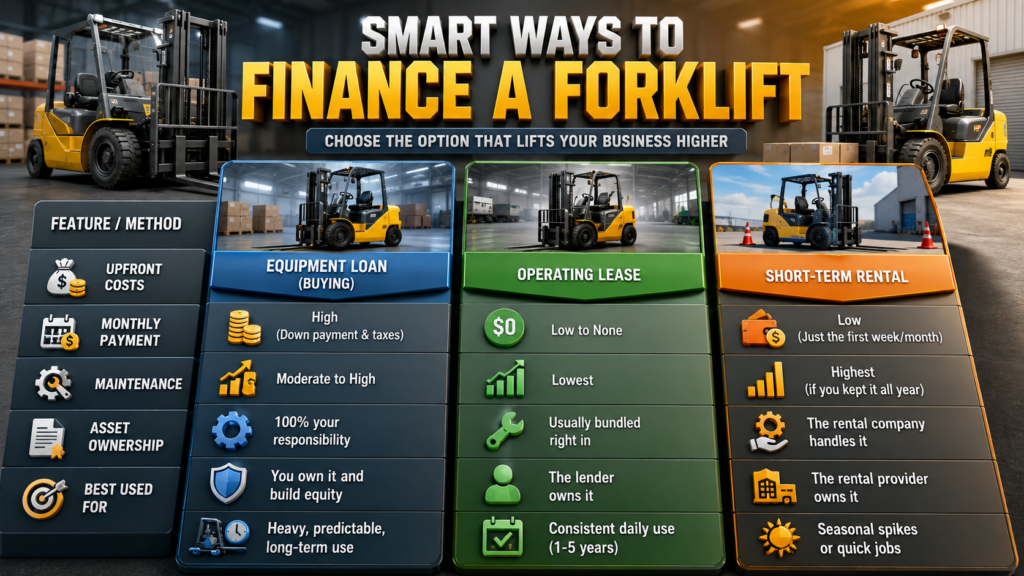
When you plan to finance a forklift, you really have to weigh your daily operational grind against your wallet. Check out the breakdown below to see exactly how these different methods stack up against one another.
- How much flexibility do you really need? If your business pivots a lot, don’t tie yourself down with a five-year loan; look closely at rentals or shorter lease terms.
- Protecting your daily cash flow: If keeping your monthly expenses as low as humanly possible is your number one priority right now, leasing is going to be your best friend.
- What happens at the end? Be completely honest with yourself—do you really want the hassle of selling a used forklift in five years, or would you rather make it the dealer’s problem?
Table: Finance a Forklift Methods
| Feature / Method | Equipment Loan (Buying) | Operating Lease | Short-Term Rental |
| Upfront Costs | High (Down payment & taxes) | Low to None | Low (Just the first week/month) |
| Monthly Payment | Moderate to High | Lowest | Highest (if you kept it all year) |
| Maintenance | 100% your responsibility | Usually bundled right in | The rental company handles it |
| Asset Ownership | You own it and build equity | The lender owns it | The rental provider owns it |
| Best Used For | Heavy, predictable, long-term use | Consistent daily use (1-5 years) | Seasonal spikes or quick jobs |
What to Check Before You Sign Anything
Please, do not just blindly sign a contract to finance a forklift without doing a little homework on your own facility first. We’ve seen too many well-meaning folks get stuck with the wrong machine or terrible terms simply because they didn’t audit their own warehouse needs.
You need to know exactly how much weight you’re lifting, how high it’s going, and whether your team is driving on smooth indoor concrete or rough outdoor gravel.
And don’t forget about the maintenance side of things. If you don’t have a dedicated forklift mechanic on your payroll, taking out a loan and assuming all the repair risks yourself could be a nightmare. In those cases, a lease with a full maintenance plan is a lifesaver.
- Do not guess your annual hours: Leases usually cap you at around 2,000 hours a year (one standard shift). If you guess wrong and run way over, you will get hit with hefty overage fees.
- Match the machine to the environment: Make absolutely sure you’re financing the right power source—electric for tight indoors, and internal combustion for out in the yard.
- Plan for your own growth trajectory: If you plan on doubling your warehouse space and volume next year, keep your lease terms flexible so you can quickly pivot to larger lifts.
FAQs Finance a Forklift
Is it actually better to lease or buy a forklift?
It totally depends on your cash flow and how hard you run the machine. If you want super low monthly payments, access to brand-new technology, and don’t want to deal with selling it later, leasing is the way to go. If you are going to beat the machine up over three shifts a day and want to build business equity, buying is your best bet.
Can I really claim the Section 179 tax deduction if I just finance it?
Yep, you sure can! As long as the paperwork is structured as “Section 179 Qualified Financing” (where the IRS sees your business as the owner) and you use the lift more than 50% for business, you can claim the massive deduction while only making your regular monthly payments.
What happens when a forklift lease finally ends?
You usually get three easy choices: hand the keys back and walk away, buy the forklift outright for its current fair market value, or just keep renting it on a month-to-month basis if you aren’t quite ready to let it go.
Are repair and maintenance costs included in my monthly payment?
If you get a standard bank loan, nope, you are on your own for repairs. But if you lease, you can almost always roll a Planned Maintenance (PM) package right into the monthly bill. It makes budgeting so much easier.
Can I get a tax deduction for buying a used forklift?
Absolutely. Both new and used equipment qualify for the Section 179 tax deduction. The only rule is that the forklift has to be “new to you” and put into service during the year you claim the deduction.
Do forklift leases cap how many hours I can use them?
Yes, they do. Most standard leases give you an allowance of about 2,000 hours per year, which covers a normal 40-hour work week. If you run the machine way more than that, you might have to pay overage penalties when you turn it in.
What on earth is a “Sale-Leaseback”?
If you already own your fleet free and clear but your business desperately needs a fast cash injection, a sale-leaseback is a neat trick. You sell your existing forklifts to a lender for a lump sum of cash, and then immediately lease those exact same lifts back from them. You keep your equipment, but get the cash flow you need.
Wrapping It Up – Finance a forklift
Deciding to finance a forklift shouldn’t feel like you are gambling with your company’s bank account. By just taking a little bit of time to understand the differences between buying, renting, and leasing, you can set up a deal that perfectly matches how money flows through your business.
Whether you go with a lease to keep your monthly overhead microscopic, or you leverage a traditional loan alongside Section 179 tax deductions to wipe out your tax bill, the end goal is exactly the same: keeping your crew moving and your cash flow positive.
At American Forklifts, we exist to help you sort through this exact kind of stuff. Getting the right equipment in your warehouse should drive your profits up, not drain your accounts dry. Take a hard look at your usage, chat with your tax guy, and pick the financing route that sets you up for years of smooth lifting.