The Rise of Modular Forklift Attachments: Customizable Attachments for Every Job Site
Walk onto any active construction site or into a bustling 3PL warehouse today, and you’ll notice something different about the equipment. We are moving well past the era where a forklift was just a heavy counterweight with two rigid steel prongs on the front. Modern logistics simply move too fast for single-purpose machinery with the best modular forklift attachments.
Understanding the Shift to Modular Forklifts Attachments
Facility managers are realizing that buying a highly specialized truck for every unique load profile drains capital and eats up valuable floor space. That realization has fueled a massive shift toward modular forklifts.
By relying on a base machine equipped with easily swappable front-end tools, a single operator can unload standard pallets at 8:00 AM, switch to moving massive paper rolls by 10:00 AM, and finish the afternoon transporting fragile, unpalletized appliances.
This plug-and-play approach turns a standard lift truck into a multi-functional workhorse, allowing businesses to pivot instantly when a new contract or unfamiliar load type hits the receiving dock.
- Warehouses are ditching bloated, specialized fleets in favor of fewer, highly adaptable machines that can handle multiple load profiles in a single shift.
- The ability to swap out modular forklift attachments in a matter of minutes keeps dock throughput moving and prevents bottlenecks during peak hours.
- Operators aren’t forced into dangerous workarounds when a load doesn’t fit standard forks, keeping the job site safer and much more efficient.
Why Operations Are Switching to Customizable Tools
If you look closely at a company’s profit and loss statement, you’ll see exactly why customizable forklift attachments are taking over. Standard forks are great for standard pallets, but the minute you try to move 55-gallon chemical drums or stacked washing machines with them, you invite disaster.
Slippage, crushed boxes, and dropped loads result in damaged goods, insurance claims, and unhappy clients. When you invest in the right front-end tools—like the heavy-duty Clamp Masters hydraulic attachments carried by American Forklifts—you eliminate the guesswork.
The operator gets a secure, controlled grip on the product. Beyond just saving the inventory, this modular approach drastically cuts down on the physical footprint of your fleet. You don’t need to park three different trucks in the charging bay if one machine can safely do the job of all three just by swapping out the carriage tool.
- Facility directors see immediate reductions in product write-offs because specialized clamps apply the exact right amount of pressure to fragile goods.
- Daily throughput jumps significantly when drivers can hydraulically align or rotate loads from the cab instead of getting out to manually wrestle with the freight.
- Maintenance teams save hours of labor each week by servicing a smaller, consolidated fleet of versatile machines rather than maintaining a dozen single-use trucks.
The Most Practical Attachments Hitting the Market
You can’t talk about fleet upgrades without looking at the specific tools that are actually moving the needle on the warehouse floor. The options available today are engineered to solve very specific, frustrating material handling problems.
For example, if your team spends half their day backing up and repositioning because they missed the pallet slots by an inch, a side shifter fixes that instantly. If you are dealing with agricultural waste or scrap metal, a rotator lets the driver dump bins directly into a hopper without ever leaving the seat.
When paired with modern equipment—especially those running clean electric forklifts material handling setups—these attachments operate smoothly and quietly. Let’s break down the most common tools you’ll see in the field.
- Side shifters and fork positioners are the most requested upgrades because they let the driver move the forks left, right, in, or out using hydraulic levers.
- Rotators are heavily used in food processing and recycling, offering 360 degrees of continuous rotation to dump large containers quickly.
- Specialized clamps (like carton, bale, or roll clamps) completely remove the need for wooden pallets, securely gripping the sides of odd-shaped or heavy loads.
Table: The Rise of Modular Forklift Attachments
| Attachment Type | Typical Job Site Use | Primary Advantage on the Floor |
| Carton Clamps | Unpackaged appliances, electronics, beverages | Grips boxes securely from the sides; completely eliminates pallet costs. |
| Paper Roll Clamps | Paper manufacturing, newspaper printing | Curves to fit cylindrical shapes; stops tearing and edge bruising. |
| Bale Clamps | Scrap recycling, cotton, synthetic fibers | Uses high hydraulic pressure to bite into dense, tightly packed materials. |
| Drum Clamps | Chemical processing, oil refineries, brewing | Locks onto cylindrical drum rims to prevent toxic or expensive spills. |
| Fork Extensions | Lumber yards, pipe transport, furniture | Slides over standard forks to safely stabilize exceptionally long materials. |
What’s Driving the Demand Right Now?
So, why is everyone suddenly talking about customizable forklift attachments? A lot of it comes down to the explosion of e-commerce. Fulfillment centers are processing a wider variety of product shapes and sizes than ever before. You might get a truckload of standard boxes one day and a container full of oversized, awkward furniture the next.
The equipment has to keep up. On top of that, warehouse real estate is incredibly expensive. Companies are building their storage racks higher and their aisles narrower to cram more inventory into the same square footage. You can’t maneuver a bulky, oversized lift truck in those spaces.
You need a compact, agile machine outfitted with tools that can reach, shift, and grab without requiring a wide turning radius. Finally, the industry-wide push for sustainability is driving a huge movement toward palletless handling. Ditching wooden pallets means less weight on the shipping trucks and fewer broken boards ending up in local landfills.
- E-commerce facilities require machines that can instantly pivot between different packaging types as consumer buying habits shift.
- Narrow-aisle warehouse layouts force operators to rely on side-shifting and pivoting attachments rather than steering the whole truck to align with a rack.
- Corporate sustainability goals heavily favor pallet-free operations, which cuts down on deforestation and reduces the facility’s overall carbon footprint.
How to Actually Pick the Right Setup for Your Fleet
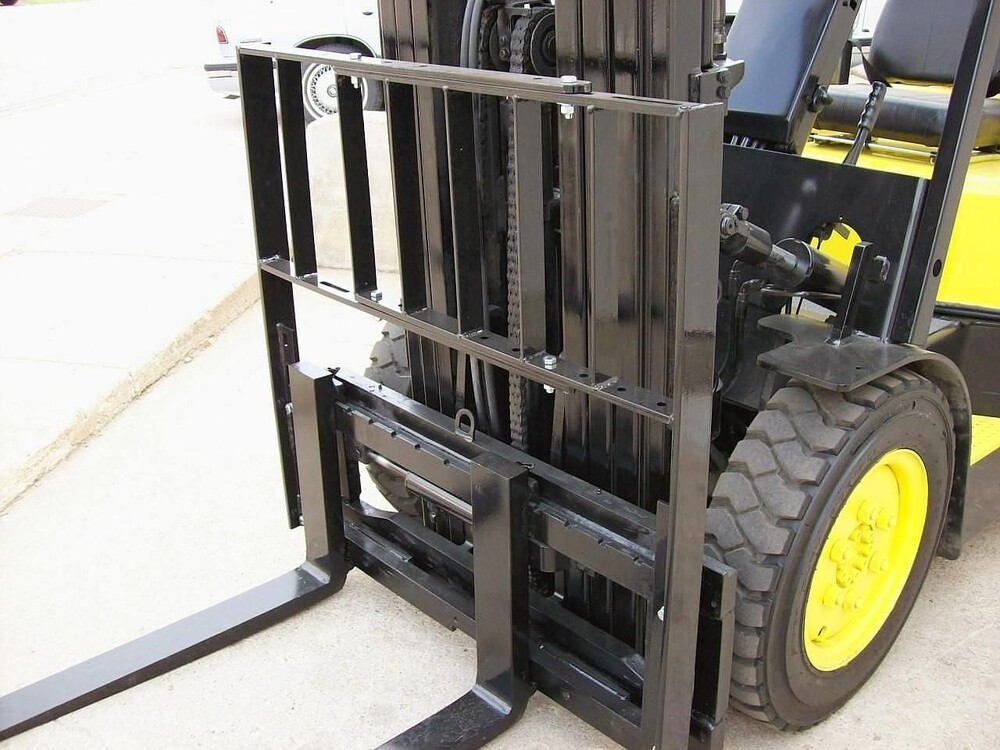
You can’t just jump online, find forklift attachments for sale, buy the cheapest one, and bolt it onto your machine. It doesn’t work that way, and doing so is a massive safety hazard. First, the carriage class of the attachment has to perfectly match your forklift.
If you try to mount a Class III clamp onto a Class II carriage, you’re going to have a bad time. More importantly, you have to understand the math behind “derating.” Whenever you add a heavy piece of steel to the front of a lift truck, it pushes the machine’s center of gravity further forward.
A forklift rated to lift 5,000 pounds with standard forks might only be safe to lift 3,800 pounds once a heavy hydraulic paper roll clamp is installed. Getting this wrong leads to tipped machines and serious OSHA violations.
This is why smart fleet managers always work closely with experienced dealers, like the crew at American Forklifts equipment, to calculate exactly what the base machine can safely handle.
- Purchasing managers must physically verify whether their lift trucks have Class II, III, or IV carriages before finalizing an attachment order.
- Safety directors have to update the data plates on the forklift to reflect the newly derated lifting capacity after a heavy attachment is installed.
- You have to match the attachment to the environment—using rugged, sealed hydraulics for dusty outdoor yards and precision clamps for clean indoor facilities.
Questions About Modular Forklift Attachments
Does adding an attachment change how much my forklift can pick up?
Yes, it changes it significantly. Because attachments are heavy and push the load further away from the forklift’s back counterweight, the machine’s safe lifting capacity decreases. This is known as the “derated capacity,” and your dealer has to provide an updated data tag for the truck.
Are special hydraulic lines required for these tools?
Most clamps, rotators, and side shifters require auxiliary hydraulic functions. If your forklift was only built with basic up/down and tilt functions, you will likely need to install a third or fourth hydraulic valve and route new hoses down the mast to power the attachment.
Do my operators need a different certification to use these tools?
Absolutely. OSHA rules state that forklift certifications are equipment-specific. If an operator has only ever driven a standard fork setup, they must be formally trained and evaluated on the new driving dynamics and controls of the specific attachment they will be using.
What is the difference between a carton clamp and a bale clamp?
They look somewhat similar but do totally different jobs. Carton clamps have large, flat, smooth aluminum pads meant to squeeze boxed appliances gently without crushing the cardboard. Bale clamps have smaller, heavily ribbed, aggressive arms designed to physically dig into rugged materials like recycled scrap or baled cotton.
How often do these attachments need to be serviced?
They require a quick visual inspection before every single shift to check for hydraulic fluid leaks or frayed hoses. Beyond that, the mechanical pivot points need regular greasing, and the contact pads must be cleaned of debris to ensure they maintain a solid grip on the cargo.
Can attachments really save money on pallets?
Yes. By using push/pull attachments (slip sheets) or carton clamps, facilities can handle outbound freight entirely without wooden pallets. When you calculate the daily cost of buying, repairing, and disposing of pallets, going palletless often pays for the attachment within the first few months.
Which attachment is best if my warehouse aisles are extremely tight?
A side shifter is your best friend in a narrow aisle. Instead of the driver having to back up, turn the wheel, and inch forward multiple times to line up with a pallet slot, they can just use a lever to shift the forks horizontally a few inches to the left or right.
Final Thoughts on Future-Proofing Your Equipment: Modular Forklift Attachments
At the end of the day, outfitting your lift trucks with modular forklift attachments just makes financial sense. The days of throwing manual labor at a material handling problem are over. By transforming a standard truck into a highly customized piece of machinery, you give your floor operators the exact tools they need to move product faster, safer, and with zero damage.
Whether you are leaning into smart warehouse attachments that send data back to your management software or you just need a rugged set of clamps to handle outdoor pipe loads, modularity is the future of the industry.
The best approach is to partner with a trusted supplier who knows the math and the safety regulations inside and out. With the right guidance and the right gear, your fleet will be ready for whatever comes through the dock doors next.
- Transitioning to a modular fleet keeps capital expenditures low by avoiding the purchase of unnecessary, single-purpose lift trucks.
- Integrating attachments with built-in scales and sensors helps modern facilities track inventory weights and impacts in real time.
- Working with reputable dealers guarantees that your base trucks and new attachments are perfectly matched, keeping your team safe and OSHA-compliant.