Discover the future of logistics with Forklift Telematics. Gain real-time insights!
Tracking your forklifts with telematics systems can give you real-time data that will allow you to run your entire fleet much more efficiently. As a warehouse manager, handling all aspects of such a busy environment simply cannot be done without the help of technology nowadays. A lot of your time goes to ensuring operator safety, reducing unexpected machine breakdowns, and still meeting shipment deadlines on time that running a warehouse on manual logging really seems next to impossible.
Manual monitoring of your industrial equipment keeps you out of the loop on most imperceptible inefficiencies. Luckily, a new era in logistics has left the good old pen and paper behind. By connecting your material handling equipment to smart data systems, you get a very thorough view of the industrial machinery you have at your disposal in the yard.
Forklift telematics is a system that allows operation managers to keep track of the level of machinery utilization, study changes in operator behaviors, and make maintenance schedule optimizations without any delay to mention a few of the benefits from using this technology.
Apart from the numerous benefits, this new technology also changes the way we think about warehouse management since going from a reactive mode dealing with breakdowns can be a very stressful and inefficient way of problem solving to a strategic and proactive way of fleet management is by no means a small feat.
Forklift Telematics and Its Working Principle
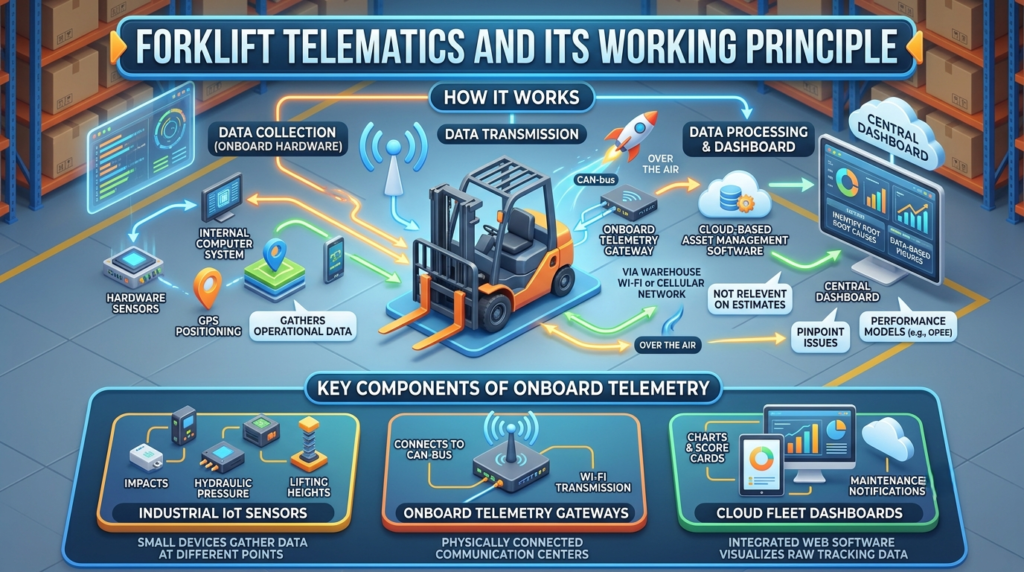
In essence, telematics is the digital nervous system for your forklifts. It gathers operational data straight from the machine’s internal computer system by the onboard hardware sensors, GPS positioning and cloud-based asset management software combination. This data is then sent over the air to a central dashboard, giving you an instant picture of what’s happening on the warehouse floor.
Instead of relying on rough estimates as to how long the engine has been running or whether a machine is left on idle, operations managers are provided with data-based definite figures. These figures can subsequently be employed in conjunction with comprehensive performance models, such as Operating Equipment Effectiveness (OPEE), to pinpoint the root causes of operational problems.
Components of Telematics Onboard
- Industrial IoT Sensors: These are small electronic devices that get arranged at various points on the body of the forklift to capture impacts, changes in hydraulic pressure, and lifting heights.
- Onboard Telemetry Gateways: These are physically connected communication centers that gather data from the vehicle’s Controller Area Network (CAN-bus) and transmit it via the warehouse Wi-Fi network.
- Cloud Fleet Dashboards: These are integrated software accessible via the web that process and visualize raw tracking data in the form of charts, operator score cards, and maintenance notifications.
Cut Down on Forklift Idling by Various Methods
While a forklift is idling, it is burning fuel and a battery drain occurs silently at the same time. This is one of the reasons why the monthly warehouse utility bills can suddenly become higher than normal without you even knowing it.
Imagine when the operator leaves an engine idling for a considerable amount of time or an electric forklift is not able to even perform one single pallet of work while the operator is busy with the paperwork, though apparently it is doing nothing it is consuming resources.
The telematics system premises on sensor tracking etc., to keep a record of when the engine is running but not engaged in work. By monitoring the precise forklift loaded travel time to the idle times ratio, warehouse managers are able to quite conveniently uncover bottlenecks where drivers get delayed in the warehouse.
Ways to Control the Situation and Stop Making Money Escape through Roadside
First of all, consider installing the system of telematics hardware which is capable of shutting down the vehicle’s engine automatically if it detects zero sensor activity for more than five minutes.
Secondly, after tracking the usage, make it a point to review the layout in terms of congestion by finding out the specific points where forklifts spend excessive time idling while waiting for cross-traffic to pass.
The ultimate course of action is to work on operator idle-time by checking individual extended paperwork duration and coaching the actual drivers to turn off the machines when idle for long periods.
Improve Warehouse Safety through Forklift Collision Avoidance
Operating forklifts are not safe per se just by setting speed limits you need to be actively enforcing these limits through real-time monitoring of how safely the equipment is operated. Material handling yards tend to be a bit chaotic, which is one of the reasons why equipment impacts with racking or inventory are usually minor and go unreported.
Telematics kits installed on forklifts come equipped with multi-axis accelerometers that register impacts to the physical structure as they happen. When a forklift racks a pallet or encounters a deep pothole that causes severe impact, the system records the G-force of the impact and can immediately send a SMS to the shift supervisor notifying the event.
Benefits of Impact Sensors Besides Deterring Accidents in the Warehouse
Real-time safety checks can be carried out after dual lighting of the dock and equipment accidents, and other such instances can be notified to the control room/safety officer at the warehouse by automatically sending a message.
One of the ways to prevent work injuries related to heavy machinery is to lock out the equipment after a high impact event, and with modern software systems, accidents that meet a certain predefined impact force limit can be set to trigger vehicle shutdown.
Technical investigators and incident command teams can make use of the digital record that includes speed, direction, and braking leading up to impact in order to understand the accident causes and derive lessons for future prevention.
Here is the Forklift Impact Severity Scale formatted into a clean, easy-to-read Markdown table:
Changing to Smart Maintenance Schemes
Leveraging only the power of pen and paper to monitor machine hours will inevitably result in either missing service intervals or excessively changing oil. If you rely on manual tracking for your fleet maintenance, you are unknowingly setting yourself up for the risk of running parts to complete failure.
Telematics systems feed management live odometer and meter-hour data from the equipment’s internal CAN-bus network. This constant surge of automated data stream maintenance teams to a new level of scheduling where they can organize service according to actual utilization patterns instead of random calendar days.
What Usage-Based Service Provides You?
Dashboard alerts notify the maintenance crew at a particular running hour of the electric forklift, emphasizing the need for hydraulic fluid change.
Besides the major system failures, early diagnostics of mechanical systems including fault warning codes and electrical components can be carried out remotely. By long-term logs analyses, it can replace high-wear components such as tires and brake pads just before they hit the critical level.
Digitally Control Driver Access
The influx of unauthorized or uncertified personnel operating one or another time heavy industrial equipment has confirmed that paper sign-in sheets can be easily bypassed, which in turn makes the verification of an operator’s credentials a difficult task.
The solution comes from digital telematics that put electronic access control directly at the ignition switch. Drivers will have to either scan an authorized RFID badge or enter a personal PIN code on an onboard keypad before the machine’s electrical system will start.
Main Features of Access Control
Enforcement of OSHA Certification: Your fleet management system can be programmed to disable a driver’s badge access automatically if their safety certification has expired.
Accountability of Individual Operators: Assign ignition cycles, travel routes, and recorded impacts each to a specific user for easily building an unambiguous accountability trail.
Performance Profile Customization: Limit new trainees’ top travel speed but allow well-trained, certified operators the standard speeds.
Map Your Way to Better Fleet Utilization
It is common for some logistics warehouses to procure more material handling equipment than they can practically use on a daily basis. In the absence of precise metrics, it is challenging to discern whether the entire fleet is working at maximum efficiency or if it predominantly comprises machines performing the heavy lifter roles.
Telematics platforms enable the manufacturing site to view a macro image of how their machinery moves through the warehouse. They are able to identify simple switching areas by juxtaposing travel paths vis-à-vis traffic deliveries or physical impediments and thereby solve the inefficiencies caused by the design layout.
Follow Steps to Balance Workloads Effectively in a Fleet
- Identification of Superfluous Assets (Forklifts): Using parking time metric to single out vehicles which spend the bulk of the times at charging points will help you to reallocate or consider downsizing of the fleet.
- Traffic Flow Visualisation with the Use of Travel Logs: At points where forklifts have delays, measure, and identify the problem areas to change the layout to reduce travel distances.
- Intelligent Attachment Standardization: Following the success of use frequency of specialized equipment (such as paper roll clamps or carpet poles), purchase the right material handling equipment for your needs.
Frequently Asked Questions – Forklift Telematics and Fleet Management
What parameters does a forklift telematics system track?
A complete telematics system keeps track of various operational parameters by tapping into the vehicle’s on-board computer network. It constantly monitors engine run hours, in-use versus idle times, number of raise and lower cycles, battery state of charge, and impact forces on multiple axes. More sophisticated systems can also monitor operator seatbelt usage, speeds, and the occurrence of fault codes in real time.
Is telematics hardware compatible with older, mixed-brand forklift fleets?
Indeed, top telematics gear is built to be brand-independent, and hence, you can use it on mixed-brand fleets. Most of the new units will be able to hook up with the factory CAN-bus network, but for older mechanical versions, standalone sensors can be deployed for monitoring the ignition state, battery voltage, and structural impacts. The advantage of this is that you can have your whole fleet tracked on a single web dashboard irrespective of the make and model year of each machine.
How do forklift impact sensors differentiate between normal floor bumps and actual collisions?
Impact detection is done using three-axes accelerometers that are also capable of being configured to be less sensitive to normal movements. The fleet software is designed to filter out normal floor vibrations, dock plate transitions, and minor expansion joints to ensure that only real, high-G impacts capable of damaging racks or inventory are flagged by the system.
In what ways can telematics hardware improve the safety of warehouse operators?
Telematics are safety systems and as such are one piece of a larger puzzle that includes training, management, and work culture. They do, however, support safety culture through their ability to ensure that only authorized, trained drivers operate the equipment. Operators are often required to complete an electronic pre-shift safety checklist prior to vehicle operation and instances of speeding or reckless driving are logged automatically. Continuous monitoring and promotion of safe driving become an integral part of warehousing culture when these systems are in place.
What is the difference between forklift utilization and engine hours?
Engine hours only quantify the cumulative duration the motor of a forklift is kept running without distinguishing work-time from idle, while forklift utilization, on the other hand, measures real productivity by taking into account the operation time vis-à-vis the scheduled working hours. Thanks to this difference the warehouse managers will be able to pinpoint assets that are either underutilized or generating loss through unnecessary idling.
Does a telematics dashboard help in extending the life of an electric forklift battery?
Yes, telematics platforms provide very detailed information on the conditions and charging practices of batteries used in electric forklifts. Sensors help monitor battery temperature, water levels, and historical charging to help avoid issues such as short charging or deep discharging. Detecting these faults and habits early ensures warehouses get the maximum lifespan out of their battery investments.
Are warehouse insurance premiums lowered by the use of telematics?
The vast majority of insurance companies willing to work with warehouses are also willing to offer discounts for safety and therefore reduced insurance premiums to those warehouses that install telematics systems. By showing that you follow electronic access control, impact logging, and digital safety checklists you demonstrate that you are taking risk management very seriously. The fewer warehouse accidents and property damages that can lead to insurance claims will, in time, result in a gradual lowering of your overall insurance costs.