Silent Working – Why Quiet Electric Forklifts are Introducing a Change in Warehousing
Running operations from a large fulfillment center and meeting all the demands at the same time may sound daunting to you. Besides maintaining high productivity, there is also a need to control maintenance costs and assure health and safety of staff. Exhaust emissions get more attention in a vice of selecting material handling equipment.
In reality, acoustic safety is just as important. High noise levels get operator tiredness, and even cause employee communication problem and hearing damages over the long run. In case you are interested in adjusting the sound level of your workplace, the best way will be your purchase of quiet electric forklifts.
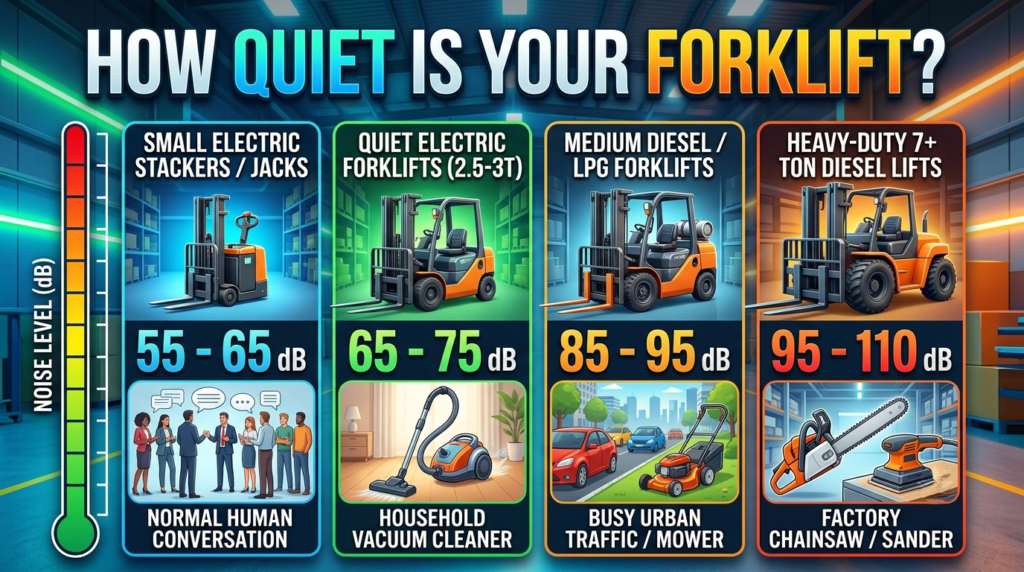
You probably now wonder how noisy can be the loudest electric forklifts. That is really an unnecessary worry because the truth is that they are really very silent if compared to other types. Their working noise level will generally lay between 55 and 75 decibels (dB). To help you understand better, this level is from a human conversation volume to vacuum cleaner. In contrast, internal combustion (IC) forklifts that generate 85 to 110 decibels are distressed and noisy. quiet electric forklifts promise really significantly less sound energy.
Forklift Noise Levels – Electric vs. Internal Combustion
In order to get the essence of why quiet electric forklifts have been adopted as the main equipment in industry job sites today, it will be very helpful if you learn first about the measuring of sound. The decibel level scale is logarithmic, so every 10 dB increase in level corresponds to a 10 times increase in sound intensity and doubled perceived loudness by human.
A forklift running at 85 dB is not only slightly louder than quiet electric forklifts at 65 dB – this is a really much louder sound that can even cause physical and cognitive capacity overload of the workers.
Engine burning is what mainly distinguishes between the acoustic profile of premium electric forklift and the rest of the market. The only noises these machines make are mechanical actions which happen occasionally and are not the main source of the sound whereas internal combustion drive engines work as continuous explosions. Understanding this major difference will only add to the advantages of quiet electric forklifts that make them highly recommended and suitable for clean, enclosed, and high-density storage facilities.
Sound Dynamics of Forklifts – Key Factors:
- Decibel scale is logarithmic: As it means a doubling of sound pressure every few decibels, replacing your whole fleet with quiet electric forklifts will lower the acoustic energy in your warehouse by up to 90%.
- Workplace Loudness Perception: It is at around 60 dB level for machines in use at factories that workers may speak without raising their voices.
- Acoustic Fatigue Mitigation: Operators working removing the low-frequency drone from internal combustion will not get tired so soon and the handling errors will go down.
The Breakdown of Electric Forklift Operational Sound Levels
The sound of an electric forklift during operation varies depending on the type of work and the level of exertion of the machine. For instance, small electric pallet jacks and order pickers have the lowest operational noise from 55 to 65 dB.
However, large counterbalanced machines, such as the 2.5-ton and 3.0-ton models, range from 65 to 75 dB during heavy hydraulic pumping.
Even when fully laden, quiet electric forklifts do not emit the highfrequency harsh noise or exhaust roar of the diesel or LPG models. What you hear is the humming of the electric motor and hydraulic valve flow hiss. This low, controlled volume signature gives the flexibility to deploy fleets confidently in multi-stage logistical delivery setups.
Table: Quiet Electric Forklifts
| Equipment Type | Average Noise Level | Common Audio Analogy |
| Small Electric Stackers / Jacks | 55 – 65 dB | Normal Human Conversation |
| Quiet Electric Forklifts (2.5-3T) | 65 – 75 dB | Household Vacuum Cleaner |
| Medium Diesel / LPG Forklifts | 85 – 95 dB | Busy Urban Traffic / Mower |
| Heavy-Duty 7+ Ton Diesel Lifts | 95 – 110 dB | Factory Chainsaw / Sander |
Safety Note: Noise levels above 85 dB require hearing protection in most workplace safety jurisdictions to prevent long-term hearing damage.
Forklift Noise Sources – Electric:
- Electric Motor Buzz: AC motors of modern electric forklifts make a very faint low-frequency noise that can be hidden well in the background noise of the warehouse.
- Hydraulic Pump Activation: The operation of hydraulic systems generates a hum of 65-72 dB in the localized area.
- Floor and Tire Friction: Movement of polyurethane or solid cushion tires on flat, hard indoor surfaces produces a slight rolling sound that is rarely above 60 dB.
What Makes Internal Combustion Forklifts So Noisy?
One would not have to surprise themselves in finding out that quiet electric forklifts are so noiseless when one compares their operation to traditional IC forklifts. Also, a continuous fuel burning inside the engine block, mechanical transmissions with heavy gearboxes, and open exhaust pipes, make the design of internal combustion forklifts be the source of structural vibrations mixed with airborne noise emanating from the engine compartment.
Even though small 3.5-ton diesel forks operate constantly at 85 dB while very large 7-ton to 8-ton heavy industrial outdoor lifts often reach 95 to 110 dB levels, all sound emissions correspond to those of a bulky construction machine or commercial chainsaws. Such noise levels make the indoor operation challenging, hence IC equipments are not the best option for use in tight warehouse spaces or narrow aisles.
Where Internal Combustion Noise Comes From:
- Engine Cylinder Combustion: The continuous sequence of fuel ignitions creates high-intensity, low-frequency sound waves that pass right through standard engine shrouds.
- Mechanical Transmission Systems: Heavy-duty gearboxes and drive axles produce constant mechanical whine and clatter when shifting and accelerating under load.
- Exhaust and Muffler Discharge: Expelling spent combustion gases produces sharp acoustic pressure spikes that require large, specialized mufflers to reduce.
How the Reduced Noise of Material Handling Equipment Work to Your Favor
Lowering noise is a significant factor in workers’ health, but it also leads to better safety, allows for more flexible layouts of working areas, and increases productivity in general. Once you eliminate noise to the extent of quiet electric forklifts, instead of a loud environment, chaos on your warehouse floor changes into a well-focused logistics area.
Instructions given by supervisors can be heard without difficulty, operators are more aware of their environment, and the need for very loud hearing protection is reduced. The range of noises coming from the various machines goes from low whisper to shouting, but once the volume lies somewhere in the middle, then communication is possible without too much effort.
On top of that, the low noise levels mean your business locations can come up with new choices. Late-night and early-morning shifts positions in mixed-use commercial zones and close neighborhoods will not cause noise complaints any longer. Company layout decisions include such manufacturings as, working offices, packing stations, and customer pick-up areas. Such changes become feasible.
Benefits of a Quieter Floor where the Logistical Work is Going On:
- Workplace Communication Enhancement: It will be within a minute for the staff to communicate with one another without shouting over engine noise, resulting in fewer mistakes when picking and tracking.
- Environmental Flexibility will be Enhanced: Quiet electric forklifts will be your weapon to carry out indoor logistics around the customer-facing / grocery / distribution area zones without showstoppers.
- Suffer Operational Restrictions: Facilities can expand into late-night or 24/7 schedules without exposing local residents to noise disturbances or ignoring municipal noise limits, thus distracting neighbors will be avoided.
Safety Aspects: Electric Forklifts The Silent Threat
While a silent work environment is good generally for efficiency, the very nature of quiet electric forklifts being silent can turn out to be a rock in the way of safety. At a warehouse busy with conveyor belts, packaging machinery, and cooling fans, it will be next to impossible to hear an operator driving an electric lift along a narrow aisle. Because ears fail to help detecting sound of new machines, measures must therefore be taken actively to ensure site safety.
Makes use of visual signals, sound alarm systems, and work practices to prevent accidents is how you counteract the stealth factor. Highvisibility safety setups could be the solution, so that while your team enjoys the quieter work environment they will be safe on the floor too.
Safety Gears That are Essential for Electric Fleet Operations:
- Pedestrian Safety Spotlights: High-intensity blue or red LED lights cast a bright beam onto the floor several feet ahead of or behind the moving vehicle to warn pedestrians at blind corners.
- Electronic Backup Alarms: Smart, self-adjusting backup alarms emit distinct white-noise whooshing sounds or clear beeps that stay exactly 10 dB louder than the ambient room noise.
- Proximity Alert Sensors: Magnetic field systems or radar sensors mounted on the vehicle communicate directly with wearable badges worn by workers, giving vibrating alerts to prevent collisions.
OSHA Noise Standards and Worker Health Compliance
Maintaining a quiet fleet is also a matter of regulatory compliance. The Occupational Safety and Health Administration (OSHA) sets strict guidelines for workplace noise exposure to protect industrial workers from permanent hearing loss. Under OSHA regulations, employers must set up a formal hearing conservation program whenever worker noise exposure equals or exceeds 85 decibels over an 8-hour time-weighted average (TWA).
If a loud diesel or LPG forklift that pushes past the 85 dB point is a part of your facility’s means of production, then you are under obligation to periodically test your staff’s hearing, provide mandatory hearing protection, and do a detailed noise record keeping. Transition to quiet electric forklifts will assist you in naturally steering clear of such regulatory situations, shorten the time spent on paperwork again, and contribute to a long and healthy life condition for your workers.
OSHA Compliance Highlights:
- The 85 dB Action Level: Upon hitting an 8-hour average of 85 dBA, the company is obligated to supply employees with hearing protection and arrange annual hearing test uptakes.
- The Permissible Exposure Limit (PEL): For an 8-hour shift, OSHA has set a stringent cap of 90 dBA going beyond which mechanical or structural modifications become necessary.
- The 3 dB Halving Rule: Each time your noise goes up by 3 dB, the safe exposure time gets automatically halved so an 88 dB environment would only be safe for four hours without protection.
Choosing the Best Electric Forklift for Your Work Area
One of the main points which you need to be really up to date about is proper outfitting of your material handling machine because that would heavily depend on the physical layout of your facility. Top performing, environmentally friendly electric fleets are capable of maneuvering from tight indoor spaces to heavy industrial loads. For closed, clean warehouses, compact ones like 2.5-ton capacity electric lifts give excellent agility and narrow aisle accessibility.
In situations where your logistics require power only to move and stack pallets, you get 3.0-ton capacity electric models that of course are extremely quiet with side-shift technology combined for convenience. Modern quiet electric forklifts depend on sophisticated and easy-to-charge battery systems for their multi-shift operation.
Fleet Selection Essentials:
- Capacity and Application: You may consider 2.5-ton electric forklifts for your store rooms with limited space. 3.0-ton models are more suitable for the heavy load industries.
- Low Noise Level: Check manufacturers’ decibel levels to be sure their equipment will meet your desired indoor noise target.
- Battery System: It is recommended to have battery configurations that allow fast charging even during breaks and maintain continuous fleet availability across shifts.
FAQs: Quiet Electric Forklifts Noise Are Transforming Modern Warehouses
What is the noise level of quiet electric forklifts?
Their operations normally run within a range of 55 and 75 decibels. For those smaller equipment with the likes of walkie stackers and electric pallet jacks, their noise level is at the lower end i.e. 55 to 65 dB which also equate to normal conversation. On the other hand, large counterbalanced electric lifts have the potential to noisily performing at a level of 65 or 75 dB when heavy hydraulic pump comes into operation which is a typical household vacuum cleaner in terms of sound.
Are quiet electric forklifts much quieter than propane or diesel ones?
Yes, they are much more silent than both propane forklifts and diesel ones. Whereas electric forklift noise remains under the 75 dB range, propane models usually vary from 80 to 95 dB, and diesel ones can easily reach 95 to 110 dB. Even more because the decibel level is logarithmic, an internal combustion forklift can be perceived as twice louder—or even more—to human ear than an electric one.
Should forklift drivers use ear protection when using quiet electric forklifts?
It is widely accepted that drivers of quiet electric forklifts do not need ear protection as the noise is far below the OSHA’s 85 dB standard. However, if the forklift is working in noisy environments with industrial machines like stamping presses or conveyors, the operators may still require hearing protection because of the surrounding noise volume.
Why quiet electric forklifts are considered dangerous due to their low noise level?
Due to their silence, quiet electric forklifts can be pose a safety risk as well. Since they move quietly, they are a “stealth factor” where pedestrians won’t be able to hear them. So, it is important to install safety gear such as blue LED pedestrian lights, horns, and backup alarms on electric forklifts.
From where does an electric forklift create its noise?
Drive motor, hydraulic lift pump and the tires against the floor cause noise to be produced by the machine. Soft humming sound of acceleration is made by motor, whirring sound of hydraulic pump is made when lifting heavy pallets, while rolling sound of tires against concrete floors is lowest.
Must OSHA require backup alarms for quiet electric forklifts?
When workplaces do have obstructed views, and high ambient noise are such that clear sight lines may get blocked, OSHA will require that all forklifts, including quiet electric models, be equipped with an audible warning such as horn or backup alarm. Electric forklifts commonly use self-adjusting white-noise backup alarms to raise awareness without noise pollution in the facility.
How could forklift noise reduction increase warehouse productivity?
Forklift noise reduction has an effect on productivity by lowering operator fatigue, reducing stress and making communication clearer and easier. When noise is low, members can hear one another and beautifully. As a result, less handling errors, safer floor and smooth workflow across warehouse shifts will occur.